

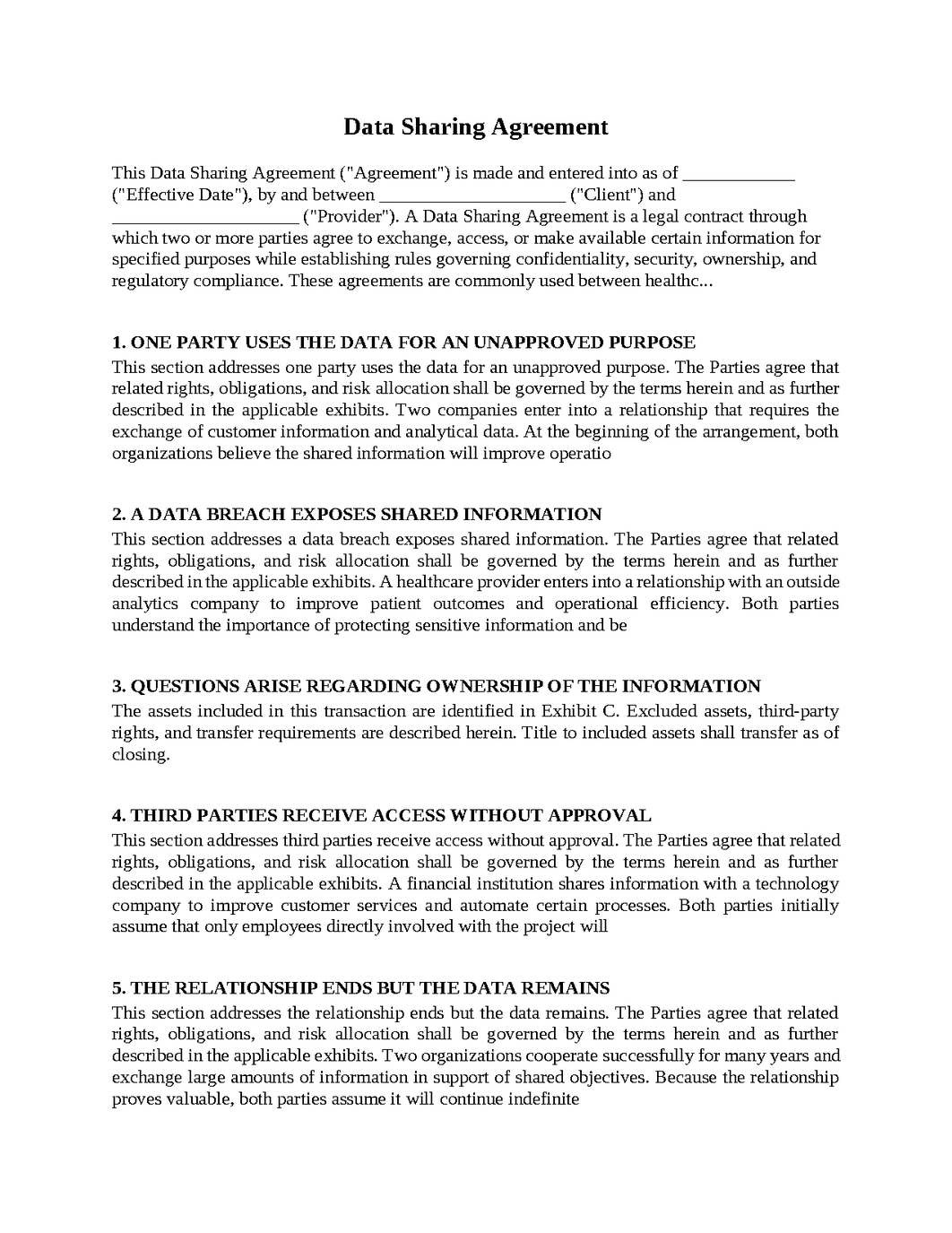
Data Sharing Agreement
A Data Sharing Agreement is a legal contract through which two or more parties agree to exchange, access, or make available certain information for specified purposes while establishing rules governing confidentiality, security, ownership, and regulatory compliance. These agreements are commonly used between healthcare organizations, financial institutions, government agencies, software companies, research organizations, educational institutions, and business partners that rely on shared information to accomplish common objectives. A Data Sharing Agreement typically addresses the types of data involved, authorized uses, security requirements, access controls, retention obligations, and procedures for responding to privacy incidents. Because valuable and sensitive information often passes between multiple organizations, disputes can arise when expectations regarding access and responsibility are not documented clearly. A carefully drafted Data Sharing Agreement helps establish certainty and promote responsible handling of information throughout the relationship.
One Party Uses the Data for an Unapproved Purpose
Two companies enter into a relationship that requires the exchange of customer information and analytical data. At the beginning of the arrangement, both organizations believe the shared information will improve operational efficiency and help deliver better services to their customers.
Over time, one company begins using the information to support additional projects that were never discussed during the original negotiations. Internal teams discover new ways to extract value from the data and expand its use into areas unrelated to the initial purpose of the relationship.
The organization providing the data becomes concerned that its information is being used in ways it never authorized. The receiving party believes the additional uses are beneficial and argues that broader access creates efficiencies that ultimately help both businesses. As trust begins deteriorating, the parties find themselves disagreeing over the proper scope of the relationship and the limits that should apply to the shared information.
To help avoid this problem, a Data Sharing Agreement should clearly define authorized uses of the data and establish restrictions governing activities that fall outside the original purpose of the relationship.
A Data Breach Exposes Shared Information
A healthcare provider enters into a relationship with an outside analytics company to improve patient outcomes and operational efficiency. Both parties understand the importance of protecting sensitive information and believe existing safeguards are sufficient to maintain confidentiality.
For several years, the relationship functions smoothly and no significant security issues arise. Eventually, however, unauthorized individuals gain access to systems containing shared information, resulting in a breach that affects thousands of records and creates substantial regulatory concerns.
The healthcare provider believes the analytics company failed to maintain adequate security procedures and should bear responsibility for the resulting damages. The analytics company argues that sophisticated attacks can occur despite reasonable safeguards and maintains that industry-standard practices were followed. As regulators, customers, and legal advisors become involved, disagreements emerge regarding liability and the obligations of each party following the incident.
To help prevent these issues, a Data Sharing Agreement should clearly establish security requirements and define the procedures that apply when unauthorized access or disclosure occurs.
Questions Arise Regarding Ownership of the Information
Several organizations collaborate on a project that requires extensive exchanges of customer information, research findings, and operational data. Initially, everyone focuses on the benefits of cooperation and assumes ownership issues will never become a problem.
As the project evolves, valuable insights, reports, and derivative datasets are created from the information being shared. The resulting materials become increasingly valuable and attract interest from additional business partners and investors.
One organization believes ownership should remain with the party that originally supplied the information. Another believes the newly created data and analytical results should belong to everyone involved in the project. As the commercial value of the information increases, disagreements begin affecting the relationship and limiting future collaboration.
To help avoid these problems, a Data Sharing Agreement should clearly distinguish original information from derivative data and establish ownership rights for materials created through the relationship.
Third Parties Receive Access Without Approval
A financial institution shares information with a technology company to improve customer services and automate certain processes. Both parties initially assume that only employees directly involved with the project will access the information.
As operations expand, the technology company begins relying on outside vendors and subcontractors to support portions of the work. The financial institution later discovers that several third parties have access to information that it never intended to share beyond the original relationship.
The financial institution believes prior approval should have been required before additional parties received access to the data. The technology company believes the use of subcontractors is necessary to provide efficient services and argues that adequate safeguards remain in place. As concerns regarding oversight and accountability increase, both sides begin questioning whether the information is receiving sufficient protection.
To help prevent these issues, a Data Sharing Agreement should clearly address third-party access and establish procedures governing the use of subcontractors and affiliated entities.
The Relationship Ends but the Data Remains
Two organizations cooperate successfully for many years and exchange large amounts of information in support of shared objectives. Because the relationship proves valuable, both parties assume it will continue indefinitely and devote substantial resources to integrating systems and processes.
Eventually, strategic priorities change and the parties decide to end the arrangement. Although both organizations initially expect the transition to be straightforward, disagreements emerge regarding what information should be returned, deleted, retained, or archived following termination.
One organization believes all shared information should be destroyed immediately to minimize risk and satisfy privacy obligations. The other believes certain records must be preserved for regulatory, operational, and legal purposes. As discussions become increasingly complicated, both parties realize that managing years of accumulated information is far more difficult than anyone anticipated when the relationship began.
To help avoid this problem, a Data Sharing Agreement should clearly establish procedures governing the return, retention, and destruction of information following the conclusion of the relationship.
Data Sharing Agreements are essential tools for organizations that rely on the exchange of valuable information to achieve common goals. However, issues involving unauthorized uses, data breaches, ownership rights, third-party access, and post-termination obligations can become significant sources of conflict when expectations are not documented clearly. A carefully drafted Data Sharing Agreement provides a structured framework for allocating responsibilities and protecting sensitive information throughout the relationship. When prepared thoughtfully, it can reduce uncertainty, strengthen trust, improve regulatory compliance, and provide the foundation necessary for secure and productive information-sharing arrangements.

Get started with Upsign today!
Easily send, sign and track your documents