

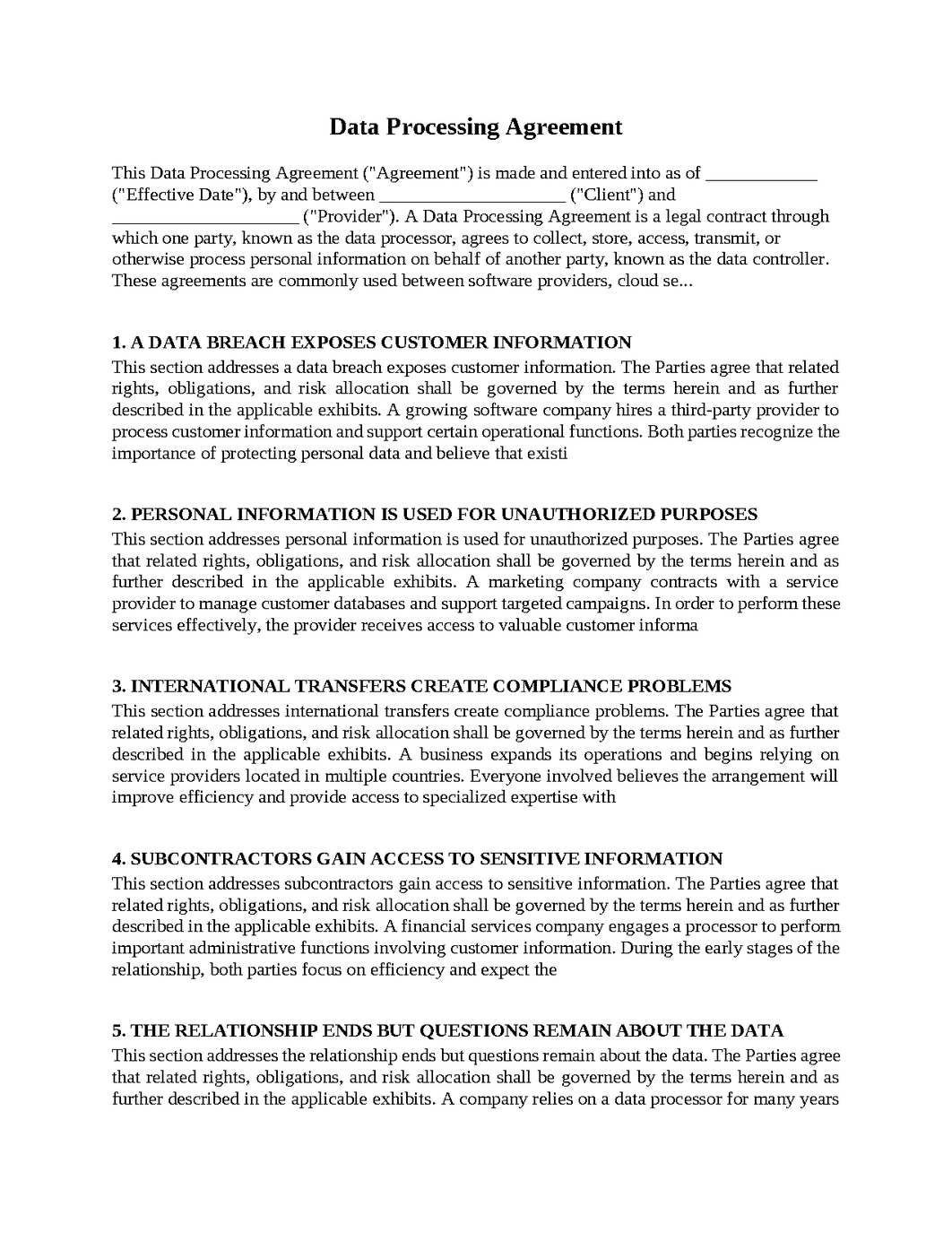
Data Processing Agreement
A Data Processing Agreement is a legal contract through which one party, known as the data processor, agrees to collect, store, access, transmit, or otherwise process personal information on behalf of another party, known as the data controller. These agreements are commonly used between software providers, cloud service companies, payroll processors, marketing agencies, healthcare organizations, financial institutions, and businesses that outsource functions involving customer or employee information. A Data Processing Agreement typically addresses data security requirements, privacy obligations, permitted uses of information, international transfers, breach notification procedures, and compliance with applicable privacy laws. Because personal information is increasingly valuable and subject to extensive regulation, disputes can arise when expectations regarding privacy and security are not documented clearly. A carefully drafted Data Processing Agreement helps establish certainty and protect the interests of both parties while promoting responsible handling of sensitive information.
A Data Breach Exposes Customer Information
A growing software company hires a third-party provider to process customer information and support certain operational functions. Both parties recognize the importance of protecting personal data and believe that existing security measures are sufficient to safeguard the information being handled.
For several years, the relationship functions smoothly and neither side experiences any significant security incidents. Eventually, however, unauthorized individuals gain access to sensitive customer information, resulting in a data breach that affects thousands of users and triggers regulatory reporting obligations.
The software company believes the processor failed to maintain adequate security safeguards and should bear responsibility for the resulting damages. The processor argues that sophisticated cybercriminals can sometimes bypass even reasonable protections and maintains that industry-standard security procedures were followed. As customers, regulators, and business partners begin demanding answers, the parties find themselves disagreeing over liability and the proper response to the incident.
To help avoid this problem, a Data Processing Agreement should clearly establish security requirements, breach notification procedures, and the allocation of responsibilities following a cybersecurity incident.
Personal Information Is Used for Unauthorized Purposes
A marketing company contracts with a service provider to manage customer databases and support targeted campaigns. In order to perform these services effectively, the provider receives access to valuable customer information and demographic data.
At the outset, both parties focus on improving customer engagement and increasing revenue. Over time, however, concerns arise when information originally provided for one purpose appears to be used for unrelated projects and analytical activities that were never discussed during the negotiations.
The marketing company believes customer information should only be processed for the purposes specifically authorized under the relationship. The processor argues that the additional uses were intended to improve efficiency and provide broader insights. As trust begins deteriorating, both sides become increasingly concerned about privacy obligations, reputational risks, and potential regulatory consequences.
To help prevent these issues, a Data Processing Agreement should clearly define permitted processing activities and establish restrictions on the use of personal information.
International Transfers Create Compliance Problems
A business expands its operations and begins relying on service providers located in multiple countries. Everyone involved believes the arrangement will improve efficiency and provide access to specialized expertise without creating significant complications.
As operations become more global, customer information starts flowing across international borders and being stored in different jurisdictions. Questions begin emerging regarding which privacy laws apply and whether appropriate safeguards exist to support cross-border transfers.
The business believes the processor should ensure compliance with all applicable requirements. The processor believes responsibility for understanding regulatory obligations belongs primarily to the customer. As legal advisors and regulators become involved, uncertainty grows regarding the proper handling of international data transfers and the obligations imposed on each party.
To help avoid these problems, a Data Processing Agreement should clearly address international transfers and establish procedures designed to comply with applicable privacy regulations.
Subcontractors Gain Access to Sensitive Information
A financial services company engages a processor to perform important administrative functions involving customer information. During the early stages of the relationship, both parties focus on efficiency and expect the processor to handle the work internally.
As the processor grows, certain tasks are outsourced to subcontractors and affiliated companies located in different regions. The financial institution later discovers that multiple outside parties have access to sensitive information and becomes concerned about the additional risks created by these arrangements.
The financial institution believes approval should have been obtained before sharing information with subcontractors. The processor believes the use of specialized vendors is necessary to provide efficient services and that appropriate safeguards remain in place. As concerns regarding oversight and accountability increase, both sides begin questioning whether adequate protections exist throughout the processing chain.
To help prevent these issues, a Data Processing Agreement should clearly address the use of subcontractors and establish procedures governing third-party access to personal information.
The Relationship Ends but Questions Remain About the Data
A company relies on a data processor for many years and gradually transfers large amounts of customer information to support business operations. Both parties assume the relationship will continue indefinitely and devote substantial resources to maintaining efficient systems and processes.
Eventually, changing business priorities lead the company to terminate the relationship and transition to a different provider. Although both sides initially expect the separation to proceed smoothly, disagreements emerge regarding the return, deletion, and retention of customer information accumulated over the years.
The company believes all information should be returned or destroyed immediately to minimize risk and satisfy regulatory requirements. The processor believes certain records must be retained for legal, operational, or compliance purposes. As discussions become more complicated, both parties realize that determining what information should be retained and what should be deleted is far more difficult than originally anticipated.
To help avoid this problem, a Data Processing Agreement should clearly establish procedures governing the return, deletion, and retention of personal information following the termination of the relationship.
Data Processing Agreements are essential tools for protecting personal information and allocating responsibilities between businesses that handle sensitive data. However, issues involving data breaches, unauthorized processing, international transfers, subcontractor access, and post-termination obligations can become significant sources of conflict when expectations are not documented clearly. A carefully drafted Data Processing Agreement provides a structured framework for defining responsibilities and promoting compliance with evolving privacy requirements. When prepared thoughtfully, it can reduce uncertainty, strengthen customer trust, improve regulatory compliance, and provide the foundation necessary for secure and responsible data management.

Get started with Upsign today!
Easily send, sign and track your documents