

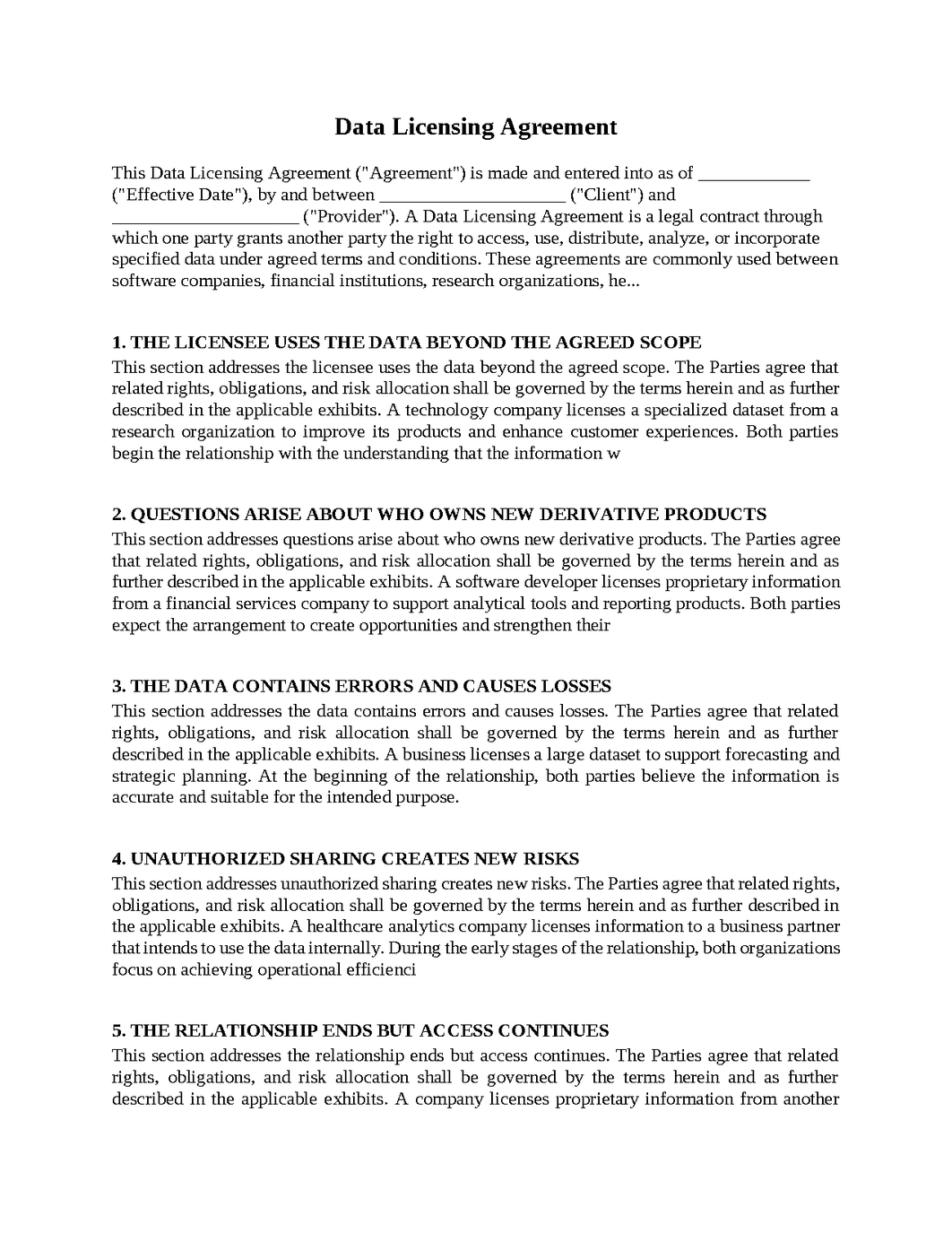
Data Licensing Agreement
A Data Licensing Agreement is a legal contract through which one party grants another party the right to access, use, distribute, analyze, or incorporate specified data under agreed terms and conditions. These agreements are commonly used between software companies, financial institutions, research organizations, healthcare providers, marketing firms, analytics companies, and businesses that monetize proprietary datasets. A Data Licensing Agreement typically addresses permitted uses, ownership rights, licensing fees, confidentiality obligations, restrictions on redistribution, data quality disclaimers, and procedures for terminating the arrangement. Because data often represents a valuable commercial asset, disputes can arise when expectations regarding ownership, usage rights, and quality are not documented clearly. A carefully drafted Data Licensing Agreement helps establish certainty and protect the interests of both licensors and licensees.
The Licensee Uses the Data Beyond the Agreed Scope
A technology company licenses a specialized dataset from a research organization to improve its products and enhance customer experiences. Both parties begin the relationship with the understanding that the information will only be used for a limited purpose defined during negotiations.
Initially, the arrangement functions smoothly and the technology company incorporates the data into its products successfully. As new opportunities emerge, however, internal teams begin using the information in additional applications and sharing it among divisions that were never contemplated when the agreement was signed.
The research organization becomes concerned that its valuable information is being used beyond the original scope of the license. The technology company believes the expanded uses create efficiencies and additional value without harming the owner of the data. As the commercial significance of the information grows, disagreements emerge regarding the extent of the rights granted under the agreement.
To help avoid this problem, a Data Licensing Agreement should clearly define authorized uses and establish restrictions governing activities that fall outside the intended scope of the license.
Questions Arise About Who Owns New Derivative Products
A software developer licenses proprietary information from a financial services company to support analytical tools and reporting products. Both parties expect the arrangement to create opportunities and strengthen their competitive positions.
Over time, the software developer creates reports, algorithms, and derivative products based on the licensed information. These new products become increasingly valuable and generate substantial revenue.
The financial services company believes the derivative products depend heavily upon its proprietary data and should remain subject to its ownership rights. The software developer believes the newly created tools and methodologies represent independent intellectual property developed through its own efforts. As the value of the products increases, disagreements emerge regarding ownership and the future use of the technology.
To help prevent these issues, a Data Licensing Agreement should clearly distinguish licensed information from derivative works and establish ownership rights for materials created during the relationship.
The Data Contains Errors and Causes Losses
A business licenses a large dataset to support forecasting and strategic planning. At the beginning of the relationship, both parties believe the information is accurate and suitable for the intended purpose.
As the business relies more heavily on the information, certain inaccuracies and omissions begin affecting important decisions. Unexpected errors lead to financial losses and management becomes concerned that the data failed to meet expectations.
The customer believes the provider should be responsible because the information was marketed as reliable and comprehensive. The provider argues that no dataset is perfect and maintains that the agreement was never intended to guarantee complete accuracy. As losses increase, both sides begin disputing the extent of responsibility for the consequences of inaccurate information.
To help avoid these problems, a Data Licensing Agreement should clearly address data quality, disclaimers, and limitations regarding the accuracy and completeness of the information being licensed.
Unauthorized Sharing Creates New Risks
A healthcare analytics company licenses information to a business partner that intends to use the data internally. During the early stages of the relationship, both organizations focus on achieving operational efficiencies and improving customer services.
As the business grows, the licensee begins working with outside vendors and affiliated entities. Eventually, the data is shared with additional parties that were never contemplated during the original negotiations, creating concerns about confidentiality and competitive risks.
The data owner believes prior approval should have been required before any additional access was granted. The licensee believes outside support is necessary to maximize the value of the information and argues that adequate safeguards remain in place. As concerns regarding accountability and control increase, trust between the parties begins deteriorating.
To help prevent these issues, a Data Licensing Agreement should clearly establish restrictions on redistribution and define the circumstances under which third parties may receive access to licensed information.
The Relationship Ends but Access Continues
A company licenses proprietary information from another business for many years and gradually integrates the data into products, reports, and internal systems. Because the arrangement proves valuable, both parties assume the relationship will continue indefinitely and devote significant resources to maintaining compatibility.
Eventually, changing priorities lead the parties to terminate the agreement. Although both sides expect the transition to proceed smoothly, disagreements emerge regarding archived information, historical reports, and continued access to derivative materials.
The data owner believes all access should cease immediately and that copies of the information should be deleted or returned. The licensee believes certain records must be retained for operational and regulatory purposes and argues that previously developed products should remain available. As discussions become increasingly complicated, both parties realize that separating years of integrated data is far more difficult than anyone anticipated.
To help avoid this problem, a Data Licensing Agreement should clearly establish post-termination obligations and define what information may be retained, returned, or destroyed after the relationship ends.
Data Licensing Agreements are valuable tools that allow organizations to monetize information while providing others with access to important resources. However, issues involving unauthorized uses, ownership of derivative products, inaccurate information, third-party access, and post-termination obligations can become significant sources of conflict when expectations are not documented clearly. A carefully drafted Data Licensing Agreement provides a structured framework for allocating rights and responsibilities throughout the relationship. When prepared thoughtfully, it can reduce uncertainty, protect valuable assets, strengthen commercial relationships, and provide the foundation necessary for successful data-driven businesses.

Get started with Upsign today!
Easily send, sign and track your documents