

Buy-Sell Agreement
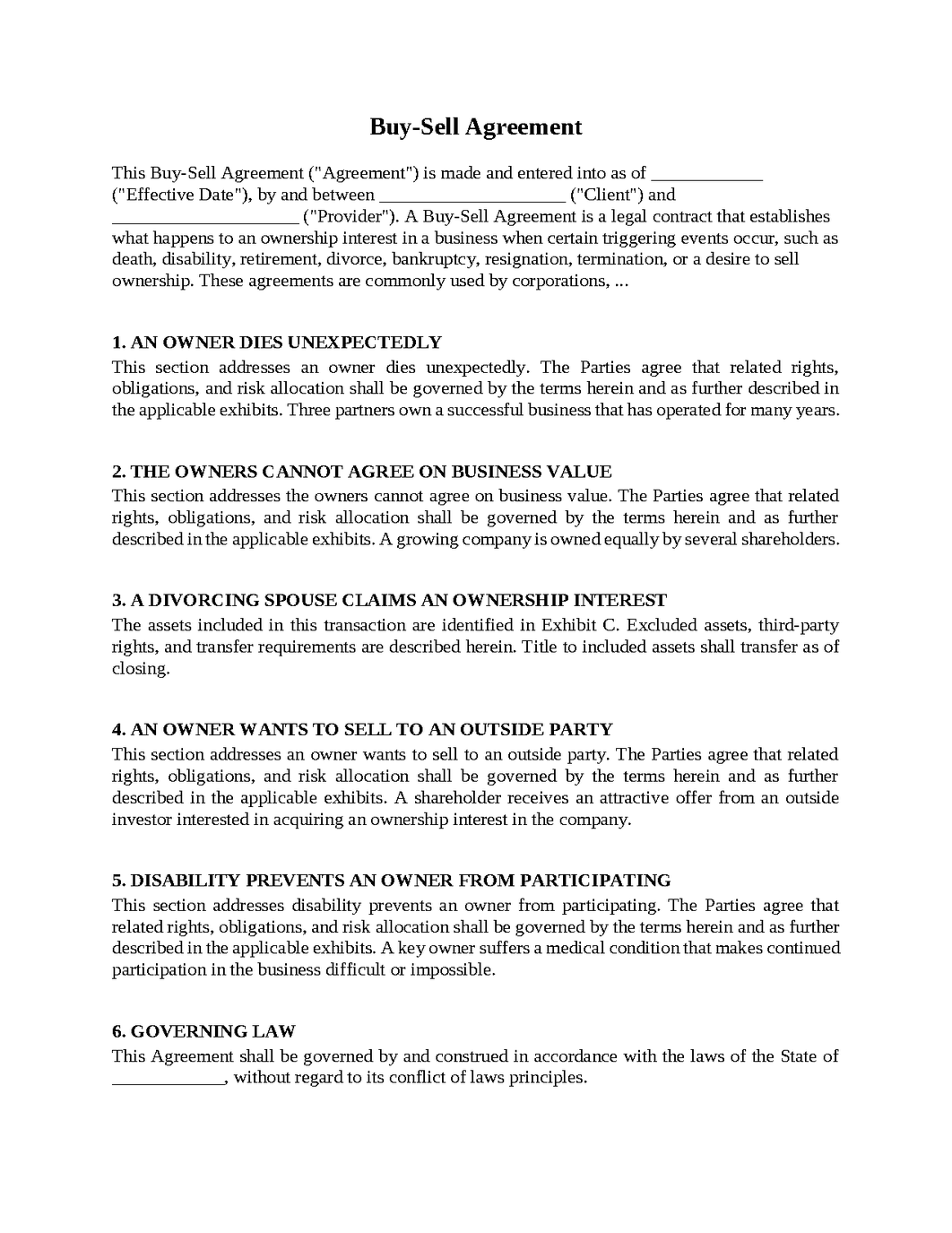
A Buy-Sell Agreement is a legal contract that establishes what happens to an ownership interest in a business when certain triggering events occur, such as death, disability, retirement, divorce, bankruptcy, resignation, termination, or a desire to sell ownership. These agreements are commonly used by corporations, partnerships, limited liability companies, professional practices, family-owned businesses, and closely held companies with multiple owners. The purpose of a Buy-Sell Agreement is to provide a clear roadmap for ownership transitions while protecting the stability of the business and the interests of the remaining owners. Because ownership interests are often among the most valuable assets an individual possesses, disputes can arise when expectations regarding valuation, transfer rights, and succession planning are not documented clearly. A carefully drafted Buy-Sell Agreement helps provide certainty and reduce the risk of disruptive conflicts.
An Owner Dies Unexpectedly
Three partners own a successful business that has operated for many years.
Although the owners work closely together, they rarely discuss what would happen if one of them passed away unexpectedly. The business continues growing, and everyone assumes there will be plenty of time to address succession planning later.
One owner suddenly dies, leaving a substantial ownership interest that becomes part of the owner's estate. Family members inherit the interest and expect to receive the full value of what was owned.
The surviving owners wish to maintain control of the business and are concerned about becoming partners with individuals who have never participated in operations. The family wants fair compensation but has different expectations regarding the value of the ownership interest.
What began as a tragic personal event becomes a dispute regarding ownership, control, and valuation.
To help avoid this problem, a Buy-Sell Agreement should clearly establish procedures for ownership transfers following an owner's death and identify how the interest will be valued and purchased.
The Owners Cannot Agree on Business Value
A growing company is owned equally by several shareholders.
Years earlier, the owners signed a Buy-Sell Agreement but paid little attention to how ownership interests would be valued if a transfer became necessary. At the time, the company was relatively small and valuation seemed straightforward.
As the business grows, one owner decides to retire and invokes the Buy-Sell Agreement. The parties immediately discover that their views regarding the company's value differ dramatically.
The departing owner believes the business is worth substantially more than the remaining owners are willing to pay. The remaining owners believe the valuation should reflect market realities and future business risks.
The disagreement delays the ownership transition and strains relationships among the owners.
To help prevent these issues, a Buy-Sell Agreement should clearly establish valuation methods, appraisal procedures, and mechanisms for resolving valuation disputes.
A Divorcing Spouse Claims an Ownership Interest
A business owner goes through a contentious divorce after years of marriage.
The ownership interest in the business represents a significant portion of the family's wealth. During divorce proceedings, questions arise regarding the spouse's rights to the ownership interest or its value.
The remaining business owners become concerned that a non-owner spouse could gain influence over company affairs or acquire rights associated with ownership. The divorcing owner is caught between obligations to the business and obligations arising from the divorce.
The spouse believes a fair share of marital assets should be received. The other owners want to preserve the existing ownership structure.
The disagreement creates uncertainty regarding who may ultimately hold an interest in the company.
To help avoid these problems, a Buy-Sell Agreement should address divorce-related transfers and establish procedures for maintaining ownership within the intended group of owners.
An Owner Wants to Sell to an Outside Party
A shareholder receives an attractive offer from an outside investor interested in acquiring an ownership interest in the company.
The shareholder views the offer as an opportunity to realize the value of years of hard work and investment. The remaining owners are concerned about introducing a new participant whose goals and management style may differ significantly.
The selling owner believes the interest should be freely transferable. The remaining owners believe they should have an opportunity to purchase the interest before an outsider becomes involved.
The disagreement focuses on balancing individual ownership rights against the stability and continuity of the business.
Relationships among the owners become strained as negotiations continue.
To help prevent these issues, a Buy-Sell Agreement should clearly establish transfer restrictions, rights of first refusal, and procedures governing proposed sales to third parties.
Disability Prevents an Owner From Participating
A key owner suffers a medical condition that makes continued participation in the business difficult or impossible.
The owner remains entitled to the economic value of the ownership interest but can no longer contribute meaningfully to management or operations. The remaining owners must assume additional responsibilities to keep the business functioning effectively.
Questions arise regarding compensation, voting rights, management authority, and whether the disabled owner's interest should be purchased. The affected owner wants financial security and fair treatment.
The remaining owners want operational stability and a practical solution that allows the business to move forward.
The disagreement develops because no one anticipated how difficult the situation would become.
To help avoid these problems, a Buy-Sell Agreement should clearly address disability-related events and establish procedures for determining when a buyout may occur.
Buy-Sell Agreements are among the most important planning documents for closely held businesses because they provide a framework for handling ownership transitions during life's most significant events. However, issues involving death, valuation disputes, divorce, third-party sales, and disability can become major sources of conflict when expectations are not documented clearly. A carefully drafted Buy-Sell Agreement provides a structured framework for preserving business continuity while protecting the interests of owners and their families. When prepared thoughtfully, it can reduce uncertainty, support succession planning, prevent ownership disputes, and provide the stability necessary for long-term business success.

Get started with Upsign today!
Easily send, sign and track your documents