

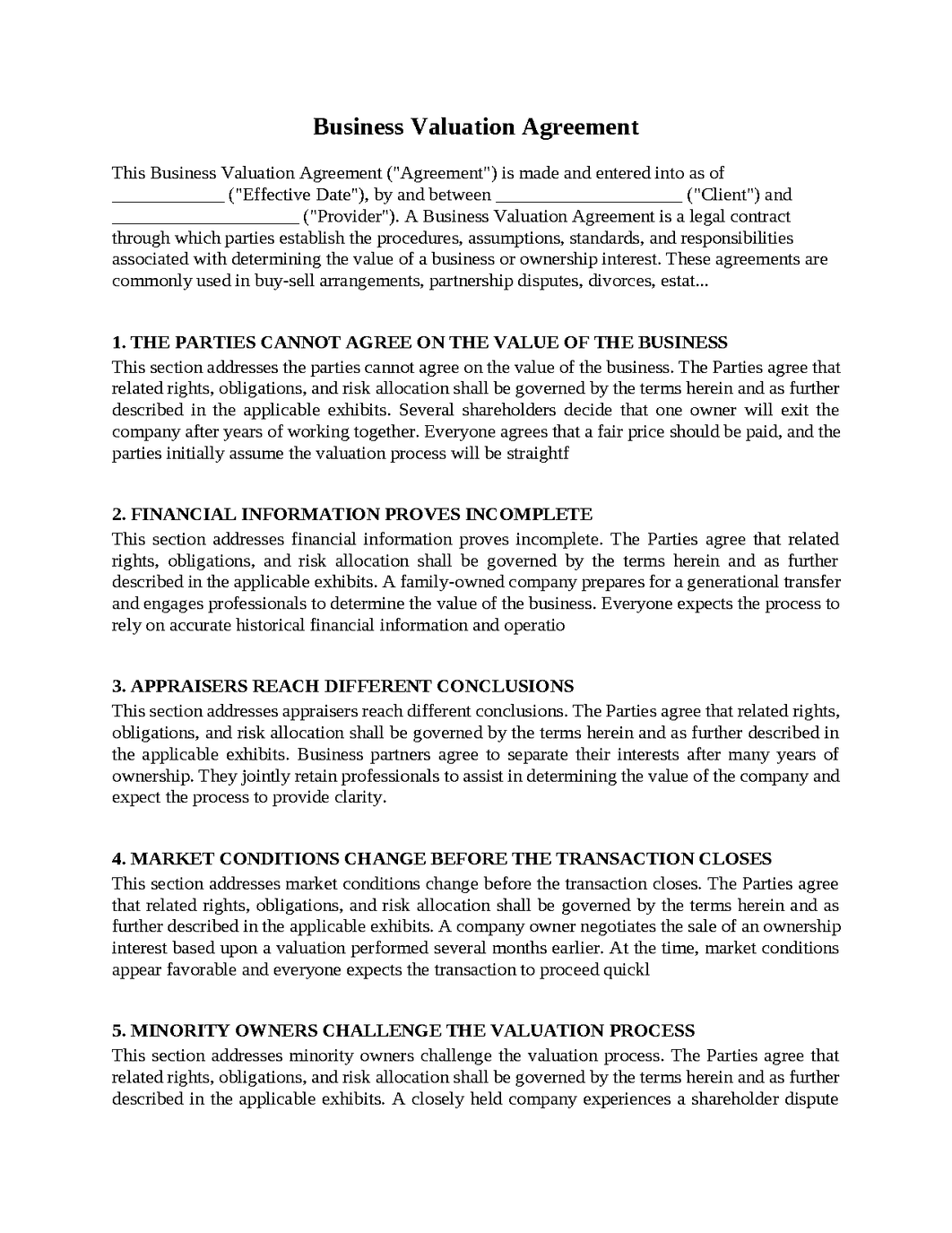
Business Valuation Agreement
A Business Valuation Agreement is a legal contract through which parties establish the procedures, assumptions, standards, and responsibilities associated with determining the value of a business or ownership interest. These agreements are commonly used in buy-sell arrangements, partnership disputes, divorces, estate planning, shareholder transactions, mergers and acquisitions, succession planning, and litigation matters. A Business Valuation Agreement typically addresses the valuation date, methodology, appraisers involved, financial information to be considered, dispute resolution procedures, and the circumstances under which the valuation will be binding. Because the value of a business can significantly affect financial outcomes and ownership rights, disputes frequently arise when expectations regarding the valuation process are not documented clearly. A carefully drafted Business Valuation Agreement helps establish certainty and reduce disagreements before they become costly conflicts.
The Parties Cannot Agree on the Value of the Business
Several shareholders decide that one owner will exit the company after years of working together. Everyone agrees that a fair price should be paid, and the parties initially assume the valuation process will be straightforward.
Financial records are gathered, and different advisors begin reviewing the business. As discussions progress, the departing owner becomes convinced that the company is worth substantially more than the remaining owners believe.
The departing owner focuses on future growth opportunities and customer relationships, while the remaining owners emphasize market risks and operational challenges. Each side obtains separate opinions that support its position, and negotiations begin deteriorating as emotions replace cooperation. What began as an ownership transition gradually turns into a dispute over how value should be measured and whose assumptions should control the process.
To help avoid this problem, a Business Valuation Agreement should clearly establish valuation methodologies and procedures for resolving differences between competing opinions.
Financial Information Proves Incomplete
A family-owned company prepares for a generational transfer and engages professionals to determine the value of the business. Everyone expects the process to rely on accurate historical financial information and operational records.
As the review proceeds, questions emerge regarding undocumented expenses, owner compensation adjustments, and missing records from prior years. Different parties begin interpreting the available information in different ways.
Some family members believe the missing information unfairly understates the value of the company, while others argue that unsupported adjustments would inflate the numbers beyond what a buyer would realistically pay. Tensions increase because no one is certain which assumptions are appropriate, and trust among family members begins suffering as disagreements over the financial records become more personal.
To help prevent these issues, a Business Valuation Agreement should identify the financial information that will be used and establish procedures for handling incomplete or disputed records.
Appraisers Reach Different Conclusions
Business partners agree to separate their interests after many years of ownership. They jointly retain professionals to assist in determining the value of the company and expect the process to provide clarity.
Although both appraisers review similar financial information, they reach dramatically different conclusions regarding the value of the business. One expert emphasizes growth potential and recurring revenue, while the other focuses on industry risks and customer concentration.
Each partner believes the appraisal supporting his position is more reasonable. Discussions become increasingly difficult because both sides view the valuation process as unfair, and the relationship that had supported the company for years begins deteriorating. The disagreement shifts away from the business itself and becomes a conflict regarding the credibility of the experts involved.
To help avoid these problems, a Business Valuation Agreement should clearly address how multiple appraisals will be reconciled and establish mechanisms for resolving valuation disputes.
Market Conditions Change Before the Transaction Closes
A company owner negotiates the sale of an ownership interest based upon a valuation performed several months earlier. At the time, market conditions appear favorable and everyone expects the transaction to proceed quickly.
Unexpected economic developments begin affecting customer demand and profitability. Industry conditions weaken, and both sides begin questioning whether the original valuation still reflects reality.
The buyer believes the business should now be worth less because future earnings have become uncertain. The seller believes the valuation date controls and argues that temporary market fluctuations should not affect the agreed price. As conditions continue changing, frustration increases because each side believes fairness requires a different approach.
To help prevent these issues, a Business Valuation Agreement should clearly establish the valuation date and explain how subsequent events will affect the determination of value.
Minority Owners Challenge the Valuation Process
A closely held company experiences a shareholder dispute involving minority owners who wish to sell their interests. The majority owners agree that a valuation should be obtained and believe the process will resolve the disagreement.
As discussions continue, minority shareholders begin questioning the assumptions used by management and worry that discounts and adjustments unfairly reduce the value of their ownership interests. They become increasingly concerned that they have little influence over the process.
The majority owners believe the valuation reflects ordinary market principles and accurately recognizes the limitations associated with minority ownership. The minority owners believe the process favors those already in control and that important factors have been ignored. The disagreement becomes increasingly emotional because both financial and governance issues are involved.
To help avoid this problem, a Business Valuation Agreement should clearly define valuation assumptions and establish procedures that provide transparency and fairness for all interested parties.
Business Valuation Agreements are essential tools whenever ownership interests or business values must be determined in a fair and predictable manner. However, issues involving competing opinions, incomplete records, changing market conditions, and shareholder conflicts can become significant sources of disagreement when expectations are not documented clearly. A carefully drafted Business Valuation Agreement provides a structured framework for determining value and resolving disputes before they escalate. When prepared thoughtfully, it can reduce uncertainty, preserve relationships, facilitate ownership transitions, and provide the confidence necessary for all parties to move forward with clarity and trust.

Get started with Upsign today!
Easily send, sign and track your documents