

Business Support Agreement
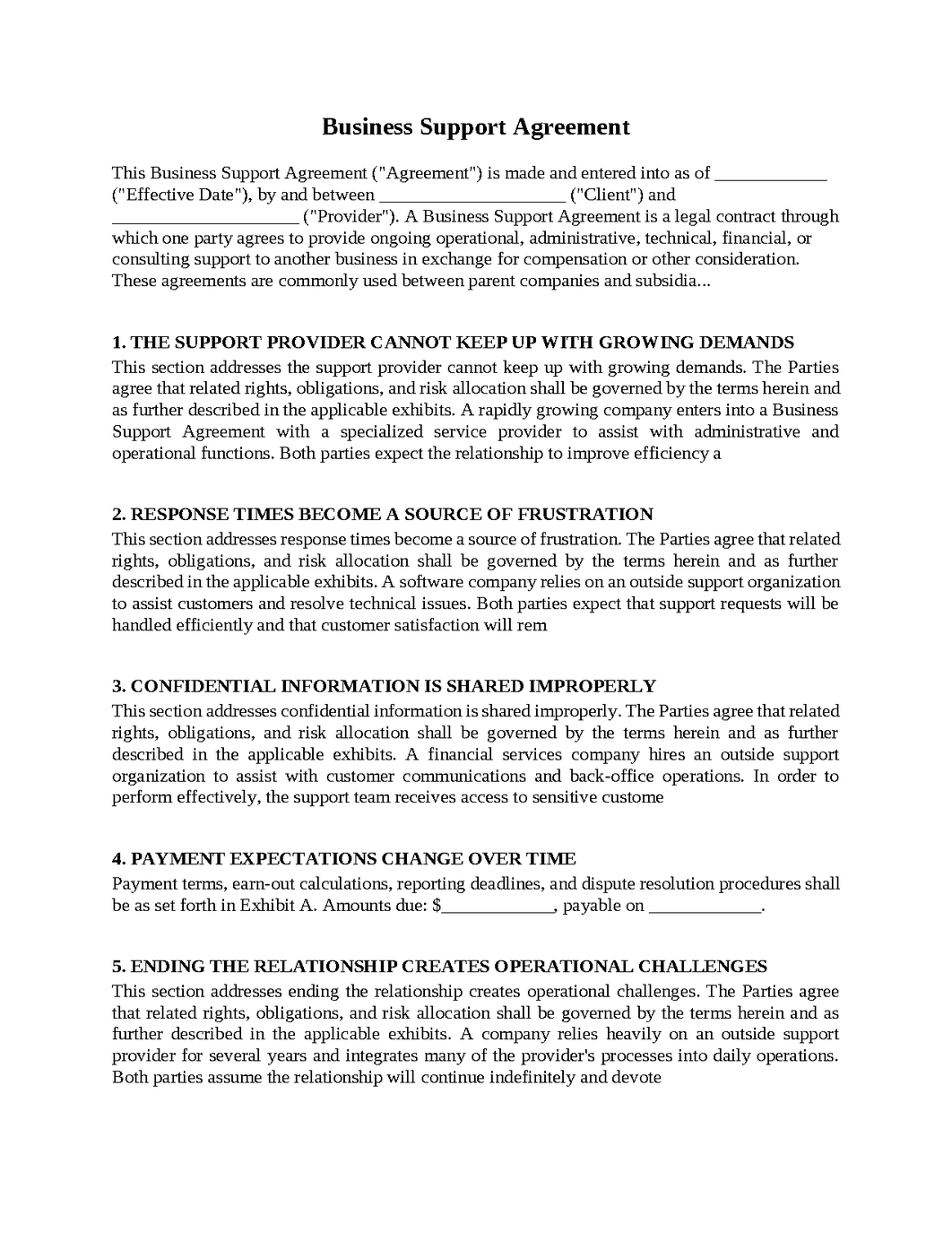
A Business Support Agreement is a legal contract through which one party agrees to provide ongoing operational, administrative, technical, financial, or consulting support to another business in exchange for compensation or other consideration. These agreements are commonly used between parent companies and subsidiaries, affiliated entities, startups and investors, franchisors and franchisees, software providers and customers, and companies that outsource support functions. A Business Support Agreement typically addresses the scope of support services, response times, compensation, reporting obligations, confidentiality, performance standards, and procedures for modifying or terminating the relationship. Because support arrangements often become deeply integrated into day-to-day operations, disputes can arise when expectations regarding responsibilities and service levels are not documented clearly. A carefully drafted Business Support Agreement helps establish certainty and preserve productive business relationships.
The Support Provider Cannot Keep Up With Growing Demands
A rapidly growing company enters into a Business Support Agreement with a specialized service provider to assist with administrative and operational functions. Both parties expect the relationship to improve efficiency and support expansion.
Initially, the arrangement works well, and support requests are handled quickly. As the customer grows, however, transaction volumes increase, new products are introduced, and the complexity of operations rises far beyond what either side originally anticipated.
The customer believes the support provider should continue delivering the same level of service despite the increased workload. The support provider believes the original arrangement was based upon much smaller demands and that additional compensation and staffing are necessary to maintain quality. As delays become more common, frustrations begin affecting the relationship and each side starts questioning whether expectations remain realistic.
To help avoid this problem, a Business Support Agreement should clearly define service levels and establish procedures for adjusting responsibilities when support demands increase substantially.
Response Times Become a Source of Frustration
A software company relies on an outside support organization to assist customers and resolve technical issues. Both parties expect that support requests will be handled efficiently and that customer satisfaction will remain high.
For several months, operations proceed smoothly. Eventually, however, support tickets begin accumulating and customers complain that responses are taking longer than expected.
The software company believes prompt support is critical to maintaining customer relationships and protecting its reputation. The support provider believes that unexpected staffing shortages and increasing complexity have made certain delays unavoidable. As complaints continue increasing, both parties begin disagreeing over what constitutes acceptable performance and whether obligations under the agreement are being satisfied.
To help prevent these issues, a Business Support Agreement should clearly establish response times, performance standards, and procedures for handling periods of unusually high demand.
Confidential Information Is Shared Improperly
A financial services company hires an outside support organization to assist with customer communications and back-office operations. In order to perform effectively, the support team receives access to sensitive customer records and proprietary business processes.
At the outset, both parties focus on efficiency and operational improvements. Over time, concerns emerge when confidential information appears to have been disclosed outside the group originally authorized to access it.
The company believes strict controls should have prevented any unauthorized disclosures and worries about regulatory and reputational consequences. The support provider believes appropriate safeguards were in place and argues that the information was never intentionally misused. As trust begins deteriorating, both sides become increasingly concerned about their legal obligations and long-term relationship.
To help avoid these problems, a Business Support Agreement should clearly define confidential information and establish procedures governing its protection, use, and return.
Payment Expectations Change Over Time
A growing business enters into a support arrangement based upon fixed monthly fees. Both parties believe the pricing structure is fair and expect the relationship to remain stable for many years.
As operations expand, the support provider begins devoting significantly more personnel and resources to the account. Additional projects and responsibilities gradually transform the engagement into something much larger than originally contemplated.
The support provider believes increased demands justify higher compensation and revised pricing. The customer believes many of the new requests are natural extensions of the original arrangement and should not require substantial additional payments. As invoices increase and negotiations become more difficult, disagreements begin affecting cooperation and trust between the parties.
To help prevent these issues, a Business Support Agreement should clearly establish fee structures and provide mechanisms for adjusting compensation when the scope of support changes over time.
Ending the Relationship Creates Operational Challenges
A company relies heavily on an outside support provider for several years and integrates many of the provider's processes into daily operations. Both parties assume the relationship will continue indefinitely and devote substantial resources to supporting one another.
Eventually, changing business priorities lead the company to seek a new provider. Although both sides expect the transition to proceed smoothly, disagreements quickly emerge regarding unfinished work, transfer of records, and the level of assistance required after termination.
The customer believes continued support is necessary to avoid disrupting operations and protect customer relationships. The provider believes it should be free to redirect resources toward other clients and opportunities. As the transition becomes increasingly complicated, both parties realize that separating their operations is far more difficult than establishing the relationship in the first place.
To help avoid this problem, a Business Support Agreement should clearly establish termination procedures and define transition assistance obligations that survive the end of the relationship.
Business Support Agreements are important tools for allowing companies to obtain specialized expertise and operational assistance without developing every capability internally. However, issues involving increasing workloads, service expectations, confidentiality, compensation, and termination responsibilities can become significant sources of conflict when expectations are not documented clearly. A carefully drafted Business Support Agreement provides a structured framework for allocating responsibilities and protecting the interests of both parties. When prepared thoughtfully, it can reduce uncertainty, strengthen working relationships, improve operational efficiency, and provide the stability necessary for successful long-term cooperation.

Get started with Upsign today!
Easily send, sign and track your documents