

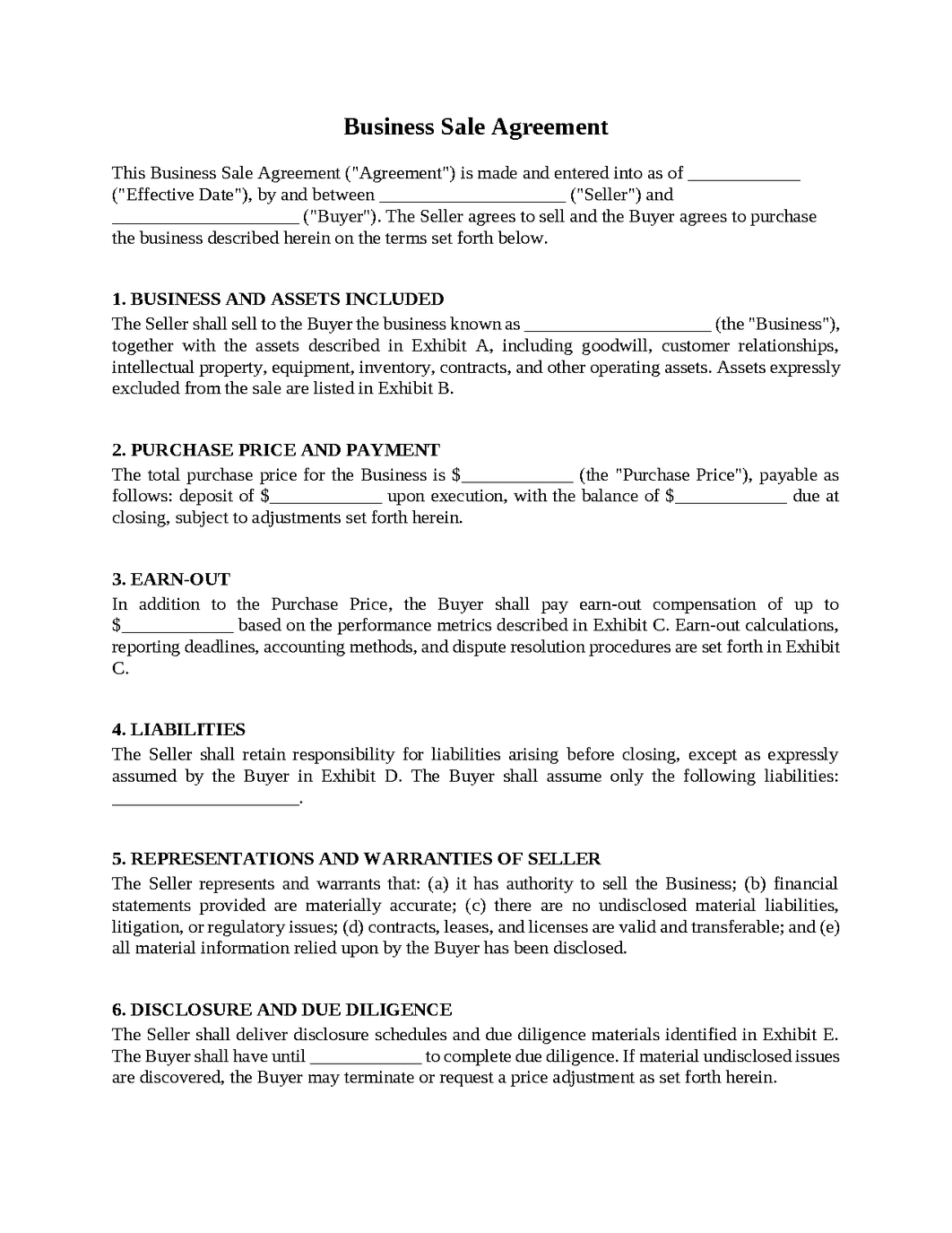
Business Sale Agreement
A Business Sale Agreement is a legal contract through which a business owner agrees to sell all or part of a business to another party under specified terms and conditions. These agreements are commonly used in the sale of privately owned companies, family businesses, franchises, professional practices, online businesses, manufacturing operations, retail stores, service companies, and partnership interests. A Business Sale Agreement governs the transfer of ownership and addresses matters such as the purchase price, assets being sold, liabilities being retained or assumed, employee transitions, intellectual property rights, customer relationships, post-closing obligations, and representations made by the parties. Because the sale of a business often involves years of accumulated value, goodwill, and financial investment, disputes can arise when expectations regarding the transaction are not documented clearly. A carefully drafted Business Sale Agreement helps establish certainty and reduce the risk of future conflicts.
The Buyer Claims Important Information Was Not Disclosed
A business owner decides to sell a successful company after many years of operation.
During negotiations, the seller provides financial records, customer information, and operational details to help the buyer evaluate the opportunity. The buyer reviews the information and agrees to proceed with the acquisition.
Several months after closing, the buyer discovers issues that were not fully disclosed during the transaction. These may include declining customer relationships, pending regulatory concerns, supplier problems, or operational weaknesses that affect profitability.
The buyer believes the undisclosed information materially affected the value of the business and would have influenced the purchase decision. The seller argues that sufficient information was provided and that the buyer had an opportunity to conduct independent due diligence.
The disagreement becomes a dispute regarding what information should have been disclosed before the sale was completed.
To help avoid this problem, a Business Sale Agreement should clearly address disclosure obligations, representations, warranties, and the information relied upon by the buyer.
Earn-Out Payments Become Contested
A seller agrees to accept a portion of the purchase price through future earn-out payments tied to the performance of the business after closing.
Both parties believe the arrangement aligns their interests and helps bridge differing views regarding the value of the company. The transaction closes successfully, and the buyer assumes operational control.
As the earn-out period progresses, disagreements emerge regarding how performance metrics should be calculated. The seller believes the business is performing well enough to trigger additional payments.
The buyer argues that certain expenses, operational changes, or market conditions affect the calculations differently. Both sides review financial reports and arrive at different conclusions.
The dispute focuses on whether the conditions required for additional compensation have actually been satisfied.
To help prevent these issues, a Business Sale Agreement should clearly define earn-out calculations, reporting procedures, and methods for resolving financial disputes.
Employees Leave Shortly After the Sale
A company is acquired largely because of its experienced workforce and management team.
The seller emphasizes the quality of the employees and the stability of the organization during negotiations. The buyer views employee retention as a critical component of the transaction's value.
Shortly after closing, several key employees resign or accept positions elsewhere. Operations become more difficult, customer service suffers, and the buyer struggles to maintain business performance.
The buyer believes the seller overstated the stability of the workforce or failed to disclose employee concerns before closing. The seller argues that employment decisions are personal choices beyond the seller's control.
The disagreement develops because employee departures significantly affect the value of the acquired business.
To help avoid these problems, a Business Sale Agreement should clearly address employee matters and identify any representations regarding key personnel, retention arrangements, or transition obligations.
Ownership of Assets Is Questioned
A buyer purchases a business that includes equipment, inventory, intellectual property, customer contracts, and other operational assets.
The parties execute a Business Sale Agreement and complete the transaction. Initially, everyone believes the transfer has been handled properly.
Later, questions arise regarding whether certain assets were actually owned by the seller or properly included in the sale. Leased equipment, licensed software, shared intellectual property, or third-party contractual rights create uncertainty.
The buyer believes all necessary assets were supposed to transfer as part of the acquisition. The seller believes the agreement accurately described what was included and excluded.
The disagreement centers on whether ownership of specific assets was transferred successfully.
To help prevent these issues, a Business Sale Agreement should clearly identify the assets being sold and distinguish them from assets that are excluded from the transaction.
The Seller Reenters the Market
A business owner sells a successful company and receives compensation based in part on the goodwill and reputation associated with the business.
After the sale closes, the buyer begins operating under the expectation that the acquired business will retain its market position and customer relationships. For a period of time, the transition proceeds smoothly.
Several years later, the seller launches a new business serving a similar market and begins attracting former customers, vendors, and employees. The buyer becomes concerned that the value purchased in the transaction is being eroded.
The seller believes the new venture is permissible under the agreement. The buyer believes the seller is violating the spirit or terms of the sale.
The disagreement becomes increasingly important as competition between the parties intensifies.
To help avoid these problems, a Business Sale Agreement should clearly address non-competition obligations, customer solicitation restrictions, and post-closing business activities.
Business Sale Agreements play a central role in ownership transitions because they govern the transfer of valuable assets, relationships, and operational responsibilities from one party to another. However, issues involving disclosures, earn-out payments, employee retention, asset ownership, and post-sale competition can become significant sources of conflict when expectations are not documented clearly. A carefully drafted Business Sale Agreement provides a structured framework for allocating risk and defining the rights and responsibilities of both parties. When prepared thoughtfully, it can reduce uncertainty, support successful business transitions, protect valuable commercial interests, and provide the confidence necessary for buyers and sellers to complete complex transactions successfully.

Get started with Upsign today!
Easily send, sign and track your documents