

Business Partnership Agreement
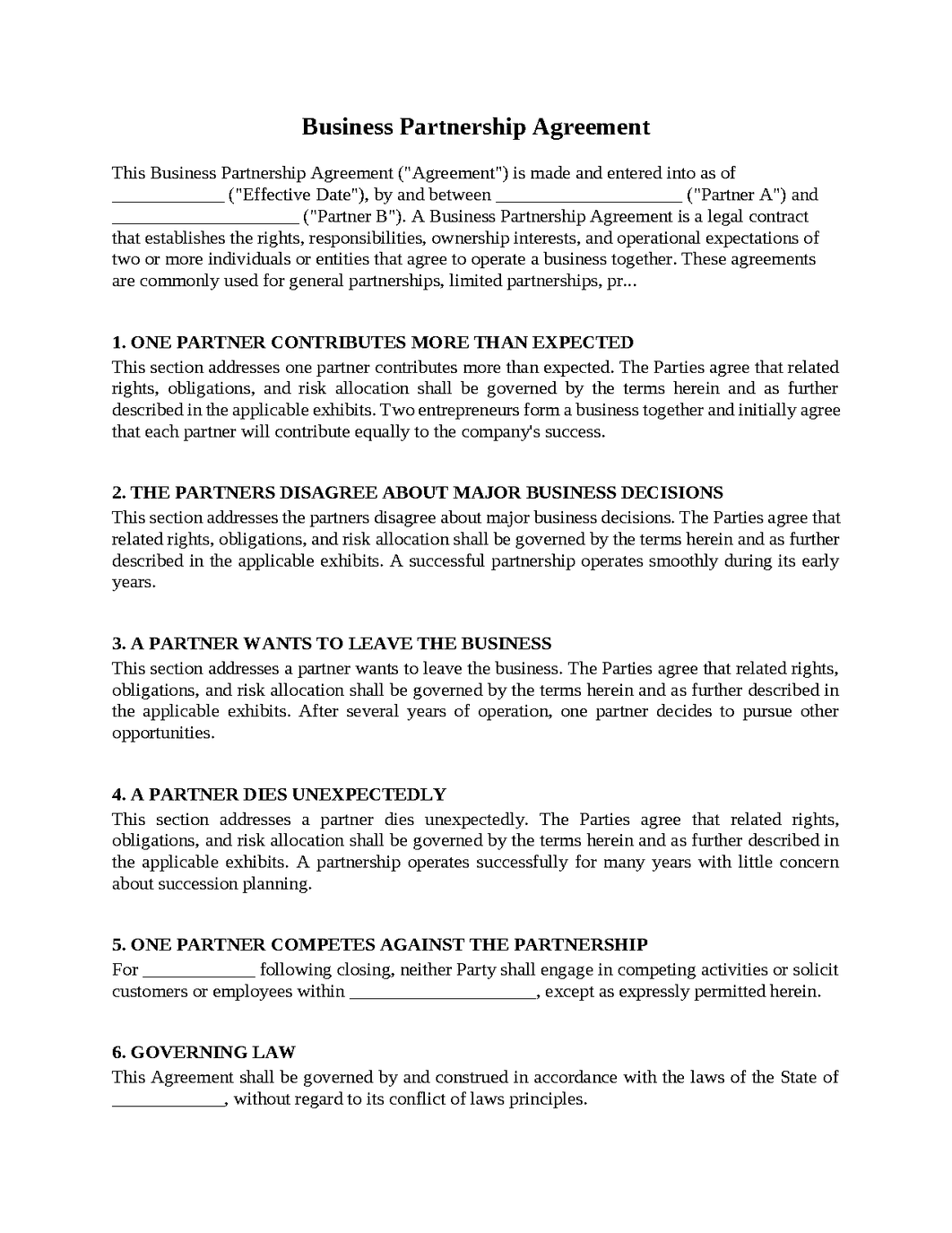
A Business Partnership Agreement is a legal contract that establishes the rights, responsibilities, ownership interests, and operational expectations of two or more individuals or entities that agree to operate a business together. These agreements are commonly used for general partnerships, limited partnerships, professional practices, family businesses, investment ventures, startup companies, real estate partnerships, and closely held businesses. A Business Partnership Agreement typically addresses ownership percentages, capital contributions, profit and loss allocations, management authority, decision-making procedures, dispute resolution, withdrawal rights, and dissolution procedures. Because business partners often invest substantial time, money, and personal effort into a shared enterprise, disputes can arise when expectations regarding control, compensation, and responsibilities are not documented clearly. A carefully drafted Business Partnership Agreement helps establish certainty and protect the interests of all partners.
One Partner Contributes More Than Expected
Two entrepreneurs form a business together and initially agree that each partner will contribute equally to the company's success.
A Business Partnership Agreement is signed, and operations begin. As the business grows, one partner devotes significantly more time, energy, and resources to daily operations than originally anticipated.
The more active partner begins feeling that profit distributions and ownership percentages no longer reflect the actual contributions being made. The other partner believes the original ownership arrangement remains fair because both parties accepted the risks when the partnership was formed.
Resentment gradually develops as each partner views the situation differently.
The disagreement focuses on whether increased effort should result in greater compensation, ownership, or decision-making authority.
To help avoid this problem, a Business Partnership Agreement should clearly address partner responsibilities, compensation arrangements, and procedures for handling unequal contributions over time.
The Partners Disagree About Major Business Decisions
A successful partnership operates smoothly during its early years.
As the business expands, opportunities arise involving new locations, additional employees, financing arrangements, and strategic investments. Some partners favor aggressive growth while others prefer a more conservative approach.
Important decisions become difficult because the partners have different visions for the future of the company. Meetings become increasingly contentious and progress slows as disagreements continue.
One group of partners believes growth opportunities must be pursued quickly. Others believe the risks outweigh the potential rewards.
The business begins suffering because decisions are delayed or never implemented.
To help prevent these issues, a Business Partnership Agreement should clearly establish voting procedures, management authority, and methods for resolving deadlocks involving major decisions.
A Partner Wants to Leave the Business
After several years of operation, one partner decides to pursue other opportunities.
The departing partner wants to receive fair value for the ownership interest and exit the business smoothly. The remaining partners want continuity and financial stability.
Questions immediately arise regarding how the departing partner's interest should be valued and who will purchase it. The remaining partners may not have sufficient funds available to complete a buyout immediately.
The departing partner believes payment should occur promptly. The remaining partners believe a longer payment schedule is necessary to protect the business.
The disagreement centers on valuation and buyout terms.
To help avoid these problems, a Business Partnership Agreement should clearly establish withdrawal procedures, valuation methods, and buyout mechanisms for departing partners.
A Partner Dies Unexpectedly
A partnership operates successfully for many years with little concern about succession planning.
One partner unexpectedly passes away, leaving a significant ownership interest that becomes part of the estate. Family members inherit rights associated with the ownership interest and expect fair treatment.
The surviving partners want to continue operating the business without disruption. The family wants to maximize the value received from the deceased partner's interest.
Questions arise regarding management rights, ownership transfers, and valuation of the partnership interest. The parties discover they have different expectations regarding what should happen next.
The business becomes distracted by uncertainty during an already difficult period.
To help prevent these issues, a Business Partnership Agreement should clearly address death, succession planning, and procedures for purchasing a deceased partner's ownership interest.
One Partner Competes Against the Partnership
A partnership develops valuable customer relationships, confidential information, and industry goodwill over many years.
Without informing the other partners, one partner begins pursuing side opportunities that directly compete with the partnership's business. Customers and business opportunities gradually shift away from the company.
The remaining partners discover the competing activities and believe the partner has violated obligations owed to the partnership. The partner argues that personal business opportunities remain separate from partnership activities.
Trust quickly deteriorates and the working relationship becomes strained.
The disagreement focuses on loyalty, competition, and the proper use of partnership resources and opportunities.
To help avoid these problems, a Business Partnership Agreement should clearly address fiduciary duties, conflicts of interest, non-competition obligations, and ownership of business opportunities.
Business Partnership Agreements are among the most important documents for any jointly owned business because they establish the framework for ownership, management, and decision-making. However, issues involving unequal contributions, management disputes, partner departures, succession planning, and competitive activities can become significant sources of conflict when expectations are not documented clearly. A carefully drafted Business Partnership Agreement provides a structured framework for allocating rights and responsibilities among partners. When prepared thoughtfully, it can reduce uncertainty, preserve business relationships, support long-term growth, and provide the stability necessary for a successful partnership.

Get started with Upsign today!
Easily send, sign and track your documents