

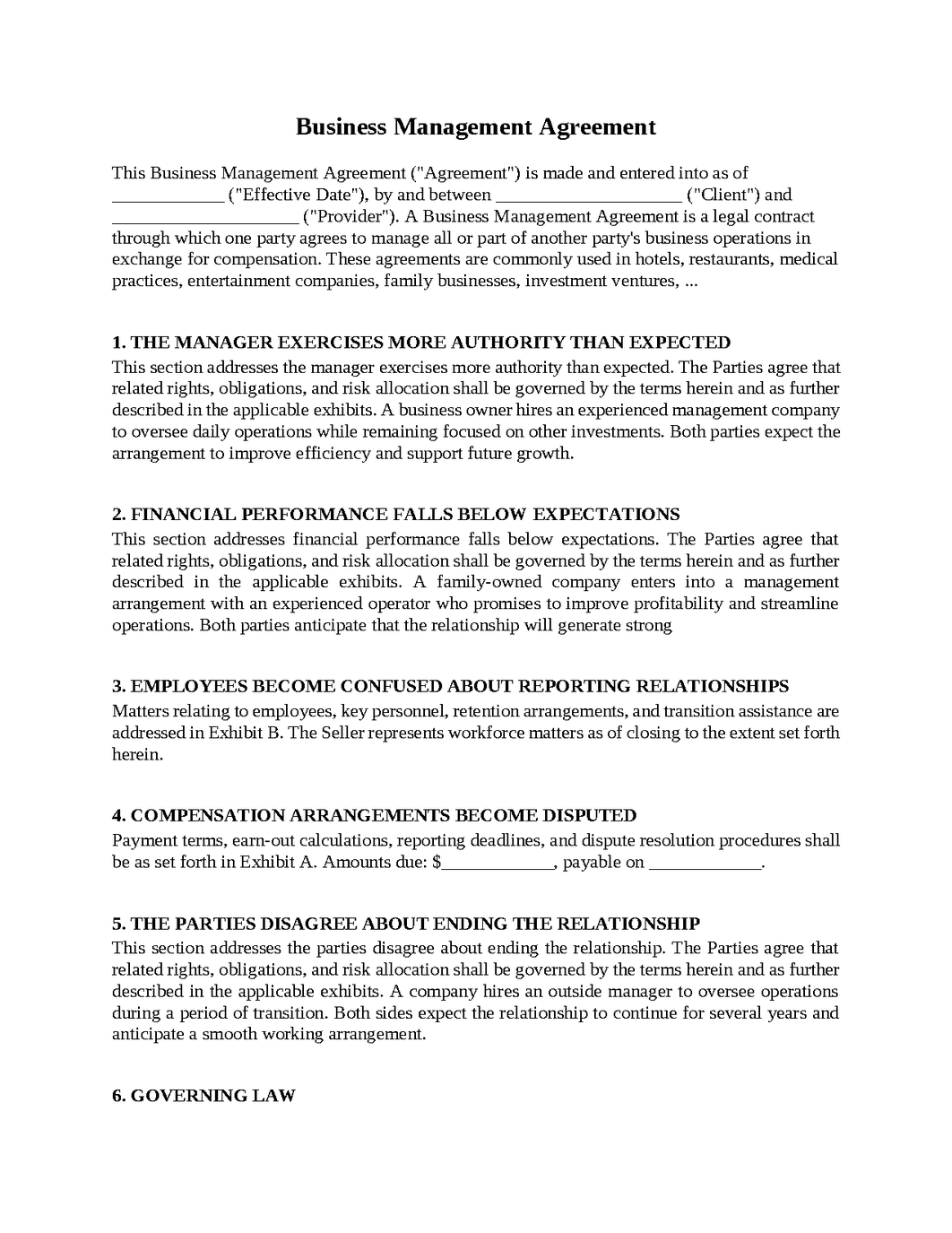
Business Management Agreement
A Business Management Agreement is a legal contract through which one party agrees to manage all or part of another party's business operations in exchange for compensation. These agreements are commonly used in hotels, restaurants, medical practices, entertainment companies, family businesses, investment ventures, professional service firms, and businesses whose owners prefer to delegate day-to-day operations to experienced managers. A Business Management Agreement typically addresses management authority, compensation, performance expectations, financial reporting, decision-making authority, employee supervision, and procedures for terminating the relationship. Because ownership and operational control are separated under these arrangements, disputes can arise when expectations regarding authority, performance, and accountability are not documented clearly. A carefully drafted Business Management Agreement helps establish certainty and preserve productive working relationships.
The Manager Exercises More Authority Than Expected
A business owner hires an experienced management company to oversee daily operations while remaining focused on other investments. Both parties expect the arrangement to improve efficiency and support future growth.
During the first several months, operations improve and the owner is pleased with the results. As time passes, however, the management company begins making decisions involving staffing, contracts, and expenditures that the owner assumed would require approval.
The owner becomes concerned that too much authority has been delegated and believes certain decisions should remain under direct ownership control. The management company believes it cannot operate effectively without broad discretion to manage the business. Frustration grows because each side has developed different expectations regarding the balance between oversight and operational independence.
To help avoid this problem, a Business Management Agreement should clearly define management authority and identify which decisions require owner approval.
Financial Performance Falls Below Expectations
A family-owned company enters into a management arrangement with an experienced operator who promises to improve profitability and streamline operations. Both parties anticipate that the relationship will generate stronger financial results over time.
Unexpected market conditions and rising costs begin affecting the business shortly after the transition. Revenues remain stagnant, and operating expenses increase faster than anyone expected.
The owners believe the manager should be held accountable for the disappointing results because operational control was delegated specifically to improve performance. The manager argues that broader economic conditions and competitive pressures are responsible for the decline and that no one could have prevented the setbacks. As financial pressures increase, disagreements emerge regarding whether the management company is fulfilling its obligations under the agreement.
To help prevent these issues, a Business Management Agreement should clearly establish performance expectations and identify how success will be measured.
Employees Become Confused About Reporting Relationships
A medical practice hires a management company to oversee administrative functions while physicians continue focusing on patient care. Initially, employees appreciate the additional support and expect operations to become more efficient.
As new policies are introduced, staff members begin receiving instructions from both the physicians and the outside management company. Different priorities and inconsistent directives create confusion throughout the organization.
Employees become uncertain regarding who possesses ultimate authority over scheduling, compensation, and operational procedures. The physicians believe they retain control over important matters, while the management company believes effective administration requires centralized authority. Morale begins suffering because employees receive conflicting instructions and uncertainty spreads throughout the practice.
To help avoid these problems, a Business Management Agreement should clearly define reporting structures and establish responsibilities for employee supervision and operational decisions.
Compensation Arrangements Become Disputed
A hotel owner retains a professional management company to operate the property. Both parties agree that compensation will include management fees and incentives tied to financial performance.
During the first few years, occupancy rates improve and revenues increase. As profits grow, disagreements emerge regarding how management fees should be calculated and which expenses should be deducted before incentive compensation is determined.
The owner believes certain costs should reduce the amount used to calculate bonuses. The management company believes the agreement supports a different methodology and that the increased profitability justifies higher compensation. As the financial stakes become larger, the parties find themselves interpreting the agreement differently and questioning assumptions that seemed straightforward at the beginning of the relationship.
To help prevent these issues, a Business Management Agreement should clearly define fee structures and explain how performance-based compensation will be calculated.
The Parties Disagree About Ending the Relationship
A company hires an outside manager to oversee operations during a period of transition. Both sides expect the relationship to continue for several years and anticipate a smooth working arrangement.
After several changes in ownership and strategy, the owners decide they would prefer to resume direct control of the business. The management company believes it should continue managing operations and points to the long-term nature of the agreement.
The owners believe changing circumstances justify terminating the arrangement. The manager argues that ending the relationship prematurely would undermine expectations and deprive it of anticipated compensation. As negotiations become more difficult, disagreements develop regarding notice requirements, transition responsibilities, and the handling of ongoing contracts and employees.
To help avoid this problem, a Business Management Agreement should clearly establish termination rights and identify the responsibilities that apply when the management relationship ends.
Business Management Agreements are valuable tools for allowing owners to benefit from specialized expertise while preserving their investment interests. However, issues involving management authority, financial performance, employee supervision, compensation arrangements, and termination rights can become significant sources of conflict when expectations are not documented clearly. A carefully drafted Business Management Agreement provides a structured framework for allocating responsibilities and preserving accountability. When prepared thoughtfully, it can reduce uncertainty, improve operations, strengthen business relationships, and provide the stability necessary for long-term success.

Get started with Upsign today!
Easily send, sign and track your documents