

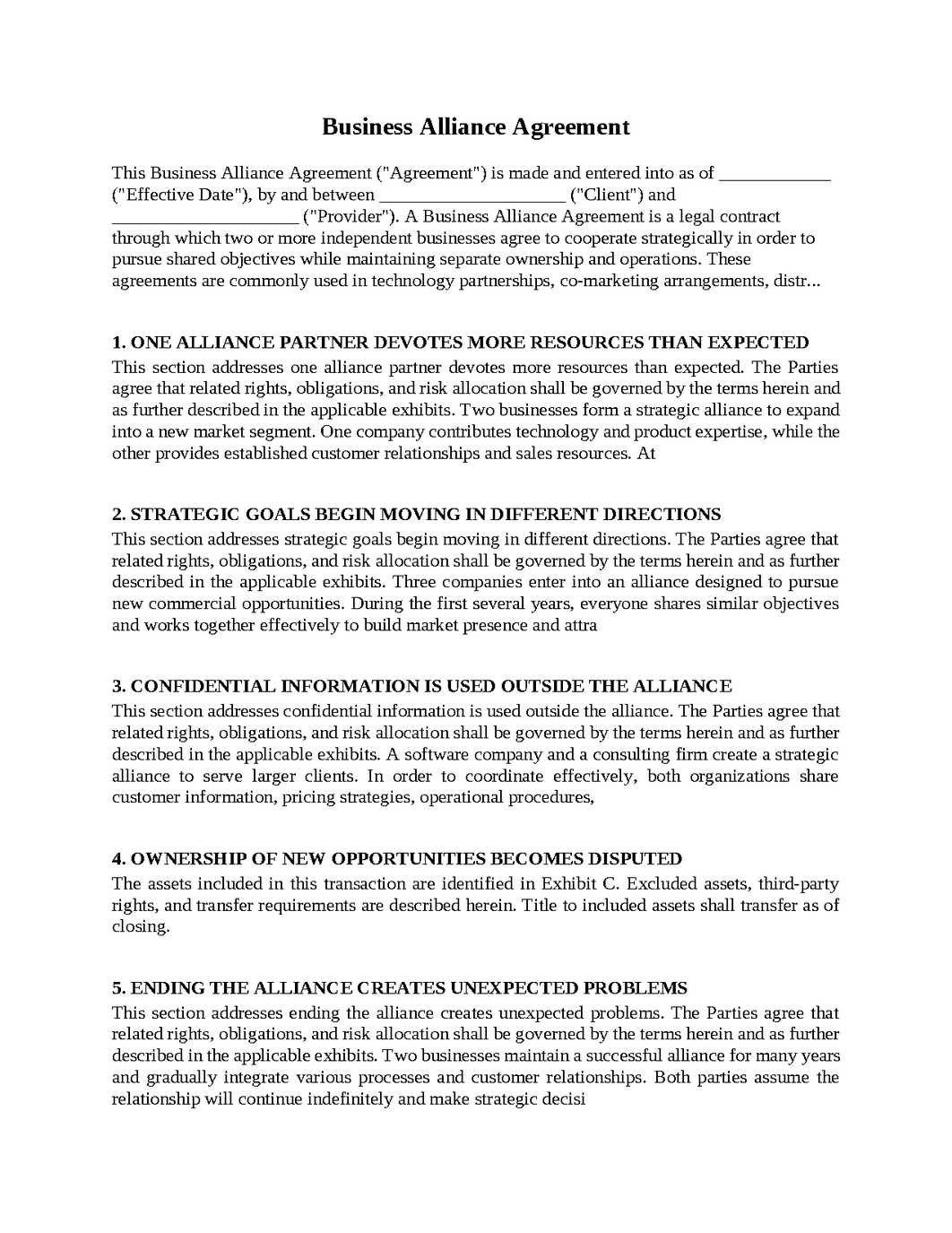
Business Alliance Agreement
A Business Alliance Agreement is a legal contract through which two or more independent businesses agree to cooperate strategically in order to pursue shared objectives while maintaining separate ownership and operations. These agreements are commonly used in technology partnerships, co-marketing arrangements, distribution relationships, manufacturing collaborations, referral networks, international expansion efforts, and strategic alliances between complementary businesses. A Business Alliance Agreement typically addresses the responsibilities of each party, financial commitments, intellectual property rights, confidentiality obligations, revenue sharing, dispute resolution procedures, and the circumstances under which the alliance may be modified or terminated. Because alliance relationships often involve long-term cooperation and evolving business goals, disputes can arise when expectations regarding contributions and benefits are not documented clearly. A carefully drafted Business Alliance Agreement helps establish certainty and preserve productive strategic relationships.
One Alliance Partner Devotes More Resources Than Expected
Two businesses form a strategic alliance to expand into a new market segment. One company contributes technology and product expertise, while the other provides established customer relationships and sales resources. At the beginning of the relationship, both parties believe their contributions are balanced and expect the alliance to create mutual benefits.
As the market opportunity develops, unexpected challenges require additional personnel, investments, and support. One company begins assigning more employees, spending more money, and dedicating substantially more time to the alliance than originally anticipated. Despite the increased workload, both parties continue operating under the original arrangement.
The company providing additional resources begins questioning whether the existing structure remains fair. The other party believes the risks and rewards were agreed upon at the outset and should not be changed simply because circumstances evolved differently than expected. As frustrations increase, disagreements emerge regarding future responsibilities and how the value created by the alliance should be allocated.
To help avoid this problem, a Business Alliance Agreement should clearly define each party's contributions and establish procedures for adjusting responsibilities when circumstances change.
Strategic Goals Begin Moving in Different Directions
Three companies enter into an alliance designed to pursue new commercial opportunities. During the first several years, everyone shares similar objectives and works together effectively to build market presence and attract customers.
Over time, however, industry conditions change and each company develops different priorities. One participant wants to accelerate growth through aggressive investments, while another becomes increasingly focused on profitability and reducing risk. The third party wants to maintain the original strategy and avoid significant changes.
The businesses begin disagreeing over pricing, expansion plans, and resource allocation. Each side believes its approach offers the greatest long-term benefits, and the absence of a clear decision-making process causes important opportunities to be delayed. As frustrations grow, the relationship becomes increasingly strained and confidence in the alliance begins to weaken.
To help prevent these issues, a Business Alliance Agreement should clearly establish governance procedures and provide mechanisms for resolving strategic disagreements.
Confidential Information Is Used Outside the Alliance
A software company and a consulting firm create a strategic alliance to serve larger clients. In order to coordinate effectively, both organizations share customer information, pricing strategies, operational procedures, and proprietary methods developed over many years.
Initially, the relationship produces strong results and both companies benefit from the combined expertise. Over time, however, concerns emerge when one party appears to be using information obtained through the alliance in unrelated projects and business opportunities. Questions begin arising regarding whether sensitive information is receiving adequate protection.
One company believes confidential information should be used solely to support the alliance. The other party believes no improper disclosures occurred and argues that some overlap between business activities is unavoidable. As trust begins deteriorating, both sides become increasingly concerned about protecting their competitive advantages and preserving their reputations.
To help avoid these problems, a Business Alliance Agreement should clearly define confidential information and establish obligations regarding its use, protection, and return following termination.
Ownership of New Opportunities Becomes Disputed
Two businesses form an alliance with the expectation that new products and opportunities will emerge over time. Both parties contribute expertise and relationships that help generate unexpected commercial success.
As the alliance grows, customers begin requesting additional products and services that were never contemplated when the relationship began. Valuable new opportunities emerge, and both companies recognize that the future potential may exceed the value of the original arrangement.
One company believes these opportunities belong exclusively to the party that first identified them. The other believes the opportunities resulted from the alliance itself and should therefore be shared. As revenues increase and new projects become more attractive, disagreements over ownership and participation become increasingly difficult to resolve.
To help prevent these issues, a Business Alliance Agreement should clearly address ownership of future opportunities and establish procedures for pursuing new ventures created through the relationship.
Ending the Alliance Creates Unexpected Problems
Two businesses maintain a successful alliance for many years and gradually integrate various processes and customer relationships. Both parties assume the relationship will continue indefinitely and make strategic decisions based upon that expectation.
Eventually, changing priorities lead one company to pursue different opportunities and bring the alliance to an end. Although both sides initially expect the separation to be straightforward, disagreements emerge regarding unfinished projects, customer communications, and ongoing obligations. Questions also arise regarding the use of shared materials and the treatment of jointly developed relationships.
One company believes additional cooperation is necessary to protect customers and complete existing commitments. The other believes the alliance should conclude promptly so that resources can be redirected elsewhere. As discussions become more difficult, both parties realize that separating years of cooperation is far more complicated than creating the relationship in the first place.
To help avoid this problem, a Business Alliance Agreement should clearly establish termination procedures and identify the obligations that survive the conclusion of the relationship.
Business Alliance Agreements are valuable tools that allow independent companies to combine strengths and pursue opportunities that might otherwise be difficult to achieve alone. However, issues involving unequal contributions, diverging priorities, confidentiality concerns, ownership of new opportunities, and termination responsibilities can become significant sources of conflict when expectations are not documented clearly. A carefully drafted Business Alliance Agreement provides a structured framework for allocating responsibilities and protecting the interests of all participants. When prepared thoughtfully, it can reduce uncertainty, strengthen strategic relationships, encourage innovation, and provide the stability necessary for successful long-term alliances.

Get started with Upsign today!
Easily send, sign and track your documents