

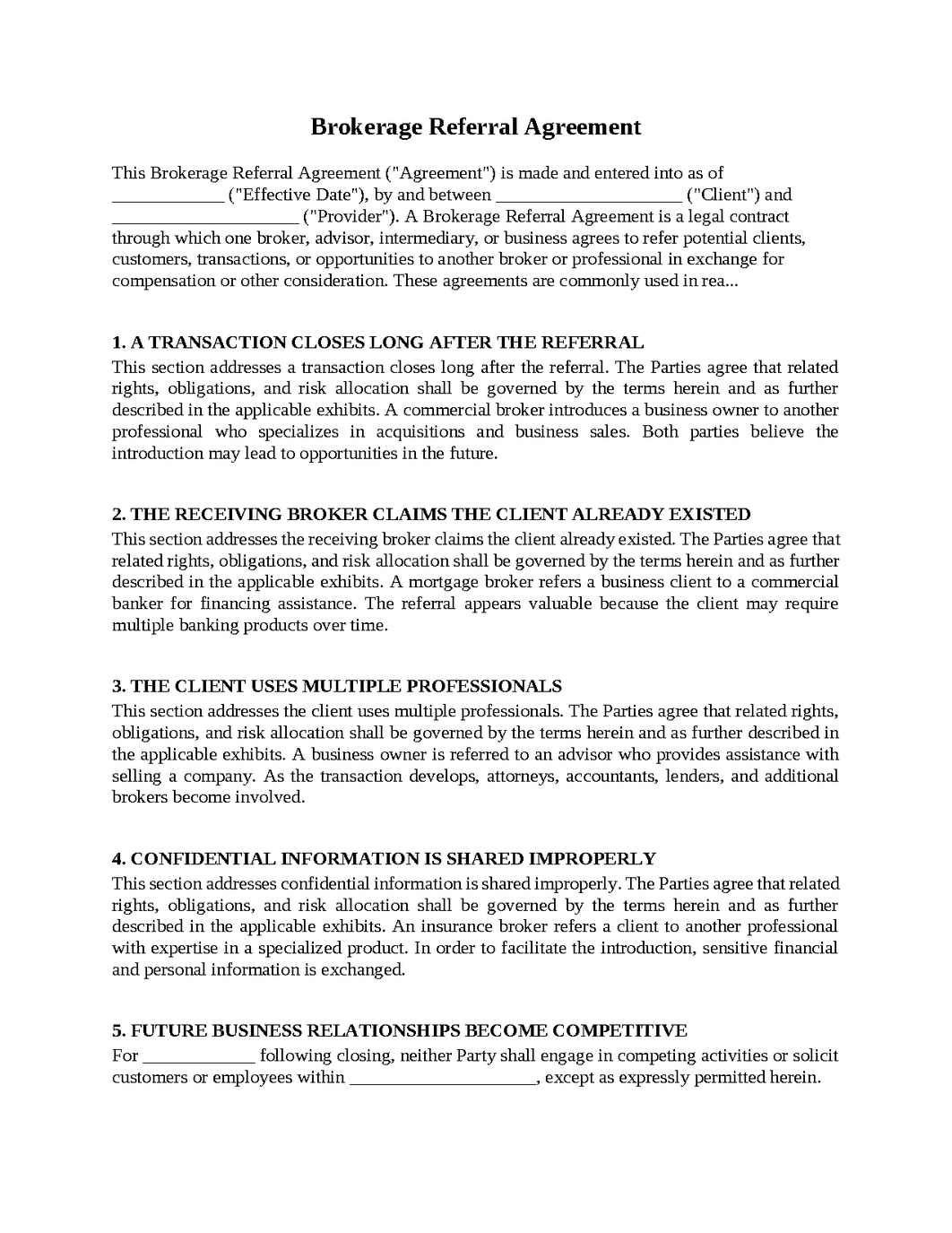
Brokerage Referral Agreement
A Brokerage Referral Agreement is a legal contract through which one broker, advisor, intermediary, or business agrees to refer potential clients, customers, transactions, or opportunities to another broker or professional in exchange for compensation or other consideration. These agreements are commonly used in real estate transactions, commercial finance, insurance placements, mergers and acquisitions, business brokerage, mortgage lending, recruiting, and professional services. A Brokerage Referral Agreement typically addresses the referral fee, qualifying transactions, payment timing, confidentiality obligations, exclusivity rights, and the responsibilities of each party. Because referral relationships often involve multiple participants and extended transaction timelines, disputes can arise when expectations regarding compensation and client ownership are not documented clearly. A carefully drafted Brokerage Referral Agreement helps establish certainty and preserve valuable professional relationships.
A Transaction Closes Long After the Referral
A commercial broker introduces a business owner to another professional who specializes in acquisitions and business sales. Both parties believe the introduction may lead to opportunities in the future.
Initial discussions take place, but no transaction occurs during the first several months. Eventually, everyone assumes the opportunity has faded and focuses on other projects.
Nearly a year later, the client completes a transaction with the receiving broker. The referring broker believes the introduction was the catalyst for the transaction and expects compensation. The receiving broker argues that so much time has passed that the original referral should no longer entitle anyone to a fee.
The disagreement centers on whether the referral remained effective long enough to support compensation after such a lengthy delay.
To help avoid this problem, a Brokerage Referral Agreement should clearly establish protection periods and define the circumstances under which referral fees remain payable after an extended period of time.
The Receiving Broker Claims the Client Already Existed
A mortgage broker refers a business client to a commercial banker for financing assistance. The referral appears valuable because the client may require multiple banking products over time.
Shortly after the introduction, the banker informs the referring broker that the client had already contacted the bank independently before the referral occurred. The banker believes the relationship existed before the introduction and therefore no referral fee is owed.
The referring broker argues that the introduction strengthened the relationship and accelerated the transaction. Both parties review prior communications and customer records in an effort to determine when the relationship actually began.
The disagreement becomes increasingly difficult because each side believes its version of events is accurate.
To help prevent these issues, a Brokerage Referral Agreement should clearly define what constitutes a qualifying referral and establish procedures for resolving disputes involving preexisting relationships.
The Client Uses Multiple Professionals
A business owner is referred to an advisor who provides assistance with selling a company. As the transaction develops, attorneys, accountants, lenders, and additional brokers become involved.
Each professional contributes in different ways and plays an important role in completing the transaction. Eventually, the deal closes successfully and compensation becomes payable.
Questions arise regarding whether the original referring party should receive the entire referral fee or whether compensation should be shared among multiple participants. Some advisors believe their contributions justify additional compensation.
The original referring broker believes the introduction created the opportunity and should therefore control the referral economics. Others believe the value of the completed transaction resulted from the combined efforts of several professionals.
To help avoid these problems, a Brokerage Referral Agreement should clearly establish how compensation will be allocated when multiple parties contribute to the same transaction.
Confidential Information Is Shared Improperly
An insurance broker refers a client to another professional with expertise in a specialized product. In order to facilitate the introduction, sensitive financial and personal information is exchanged.
Initially, both parties focus on serving the client and completing the transaction. Over time, however, concerns emerge regarding how information is being used and whether it has been shared with additional parties.
The referring broker becomes concerned that confidential information may be used to solicit unrelated business or disclosed to unauthorized individuals. The receiving broker believes the information was shared solely for legitimate business purposes.
The disagreement shifts away from compensation and toward privacy and confidentiality concerns.
To help prevent these issues, a Brokerage Referral Agreement should clearly establish confidentiality obligations and define permissible uses of client information.
Future Business Relationships Become Competitive
Two brokers develop a successful referral relationship and exchange opportunities regularly. Over several years, both parties benefit from the arrangement and develop trust.
Eventually, one broker begins contacting the other's clients directly and pursuing services that were previously outside the scope of the relationship. Concerns arise that the referral arrangement is evolving into direct competition.
The affected broker believes the relationship was intended to create mutual benefits rather than client poaching. The other broker argues that clients should remain free to choose whichever professional they prefer.
The disagreement creates tension and threatens to destroy a relationship that had been valuable to both parties.
To help avoid these problems, a Brokerage Referral Agreement should clearly address client ownership, non-solicitation obligations, and the parties' expectations regarding future business activities.
Brokerage Referral Agreements are important tools for expanding professional networks and creating opportunities through trusted relationships. However, issues involving delayed transactions, preexisting clients, multiple advisors, confidentiality concerns, and competitive activities can become significant sources of conflict when expectations are not documented clearly. A carefully drafted Brokerage Referral Agreement provides a structured framework for defining compensation rights and protecting business relationships. When prepared thoughtfully, it can reduce uncertainty, encourage collaboration, strengthen referral networks, and provide greater confidence for all parties involved.

Get started with Upsign today!
Easily send, sign and track your documents