

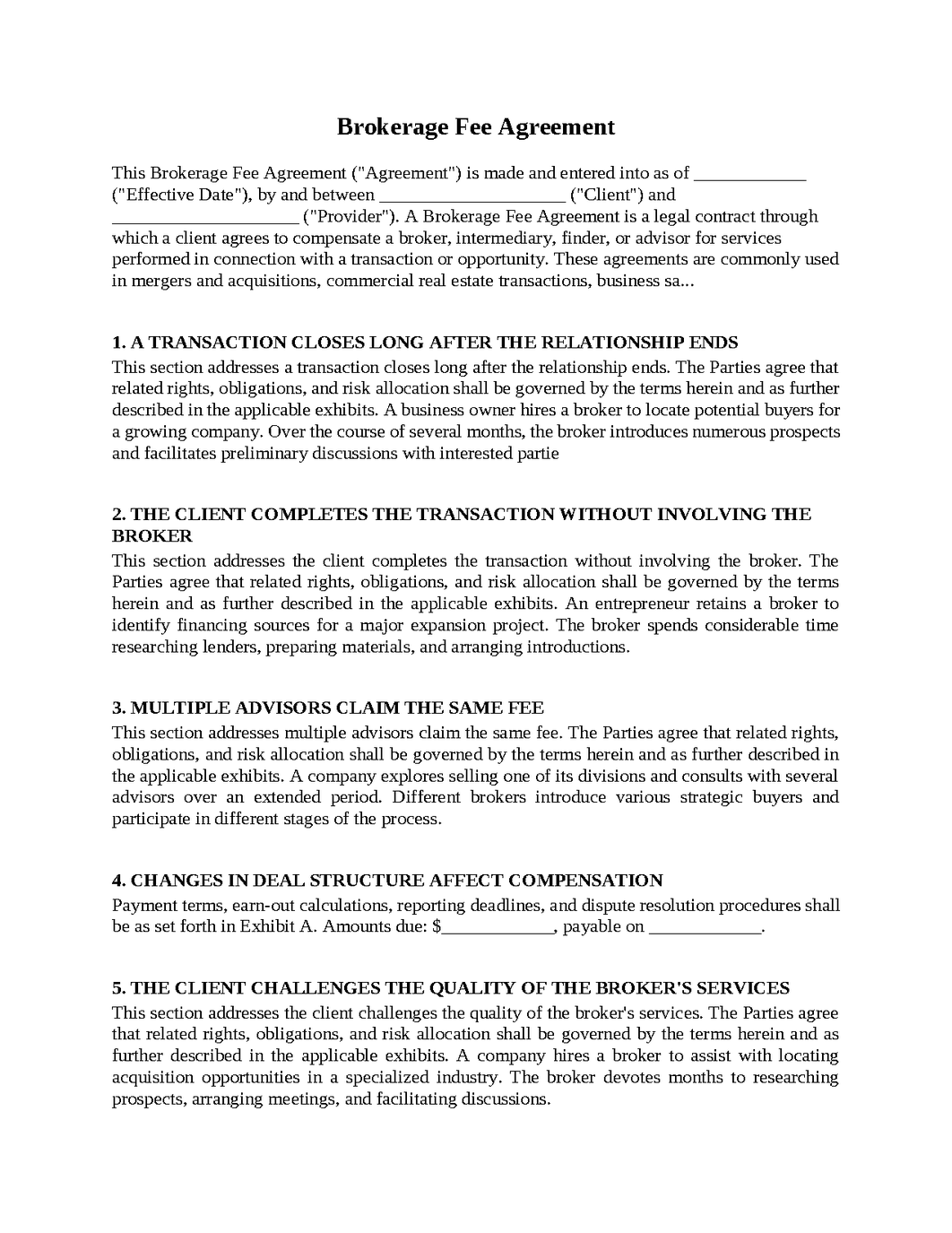
Brokerage Fee Agreement
A Brokerage Fee Agreement is a legal contract through which a client agrees to compensate a broker, intermediary, finder, or advisor for services performed in connection with a transaction or opportunity. These agreements are commonly used in mergers and acquisitions, commercial real estate transactions, business sales, financing arrangements, insurance placements, equipment purchases, and investment transactions. A Brokerage Fee Agreement typically addresses the amount of compensation, the events that trigger payment, the duration of the engagement, exclusivity rights, and the circumstances under which fees remain payable after the relationship ends. Because brokerage fees are often substantial and transactions may evolve over extended periods, disputes can arise when expectations regarding compensation and causation are not documented clearly. A carefully drafted Brokerage Fee Agreement helps establish certainty and protect the interests of both brokers and clients.
A Transaction Closes Long After the Relationship Ends
A business owner hires a broker to locate potential buyers for a growing company. Over the course of several months, the broker introduces numerous prospects and facilitates preliminary discussions with interested parties.
Eventually, the parties decide not to renew the engagement, and the relationship formally ends. Both sides assume the opportunity has passed and move on to other priorities.
Nearly a year later, one of the prospects originally introduced by the broker resumes discussions directly with the owner and completes the acquisition. The broker believes the transaction resulted from relationships created during the engagement, while the seller argues that the Brokerage Fee Agreement had expired long before closing occurred.
To help avoid this problem, a Brokerage Fee Agreement should clearly address post-termination protection periods and specify when commissions remain payable after the relationship ends.
The Client Completes the Transaction Without Involving the Broker
An entrepreneur retains a broker to identify financing sources for a major expansion project. The broker spends considerable time researching lenders, preparing materials, and arranging introductions.
As negotiations progress, the entrepreneur begins communicating directly with one of the lenders. Eventually, the financing transaction closes without further participation by the broker.
The entrepreneur believes the broker did not contribute to the final negotiations and therefore should not be compensated. The broker believes the opportunity would never have existed without the introductions and preparatory work provided during the engagement.
The disagreement centers on whether the broker's efforts were sufficiently connected to the completed transaction to justify compensation.
To help prevent these issues, a Brokerage Fee Agreement should clearly define when a fee becomes earned and address transactions completed directly between parties originally introduced by the broker.
Multiple Advisors Claim the Same Fee
A company explores selling one of its divisions and consults with several advisors over an extended period. Different brokers introduce various strategic buyers and participate in different stages of the process.
Eventually, the business reaches an agreement with a buyer that had been exposed to the opportunity through multiple channels. After the closing, more than one broker claims entitlement to compensation.
Each advisor believes that its efforts played an important role in producing the transaction. The company becomes frustrated because it faces competing demands and uncertainty regarding who should actually be paid.
The dispute becomes increasingly complicated as communications and timelines are examined to determine which advisor was responsible for the completed deal.
To help avoid these problems, a Brokerage Fee Agreement should clearly address exclusivity rights, protected parties, and the standards used to determine whether compensation has been earned.
Changes in Deal Structure Affect Compensation
A broker is engaged to assist with a transaction that initially appears to involve a straightforward cash purchase. At the outset, everyone expects calculating the fee to be relatively simple.
As negotiations continue, the structure becomes more complicated. Seller financing, earn-out payments, assumed liabilities, stock consideration, and deferred payments all become part of the final arrangement.
The broker believes compensation should be based upon the total economic value of the transaction. The client believes only immediate cash consideration should be included when calculating the fee.
The disagreement becomes significant because the difference in calculation methods substantially affects the amount owed.
To help prevent these issues, a Brokerage Fee Agreement should clearly define transaction value and explain how contingent, deferred, or non-cash consideration will affect compensation.
The Client Challenges the Quality of the Broker's Services
A company hires a broker to assist with locating acquisition opportunities in a specialized industry. The broker devotes months to researching prospects, arranging meetings, and facilitating discussions.
Although several opportunities are identified, the client becomes dissatisfied and believes the broker failed to provide the level of effort originally expected. When one of the opportunities eventually results in a transaction, the client argues that the fee should be reduced because the services provided were inadequate.
The broker believes compensation is tied to successful outcomes rather than subjective evaluations of effort. The client believes poor performance should affect the amount owed under the agreement.
The disagreement shifts from the transaction itself to the quality of the services performed during the engagement.
To help avoid these problems, a Brokerage Fee Agreement should clearly establish performance expectations, compensation triggers, and the circumstances under which fees become payable.
Brokerage Fee Agreements are important tools for defining compensation rights in transactions involving brokers and intermediaries. However, issues involving post-termination transactions, direct negotiations, competing advisors, evolving deal structures, and disagreements over performance can become significant sources of conflict when expectations are not documented clearly. A carefully drafted Brokerage Fee Agreement provides a structured framework for protecting the interests of both brokers and clients while supporting successful transactions. When prepared thoughtfully, it can reduce uncertainty, preserve valuable relationships, and provide the clarity necessary for all parties to move forward with confidence.

Get started with Upsign today!
Easily send, sign and track your documents