

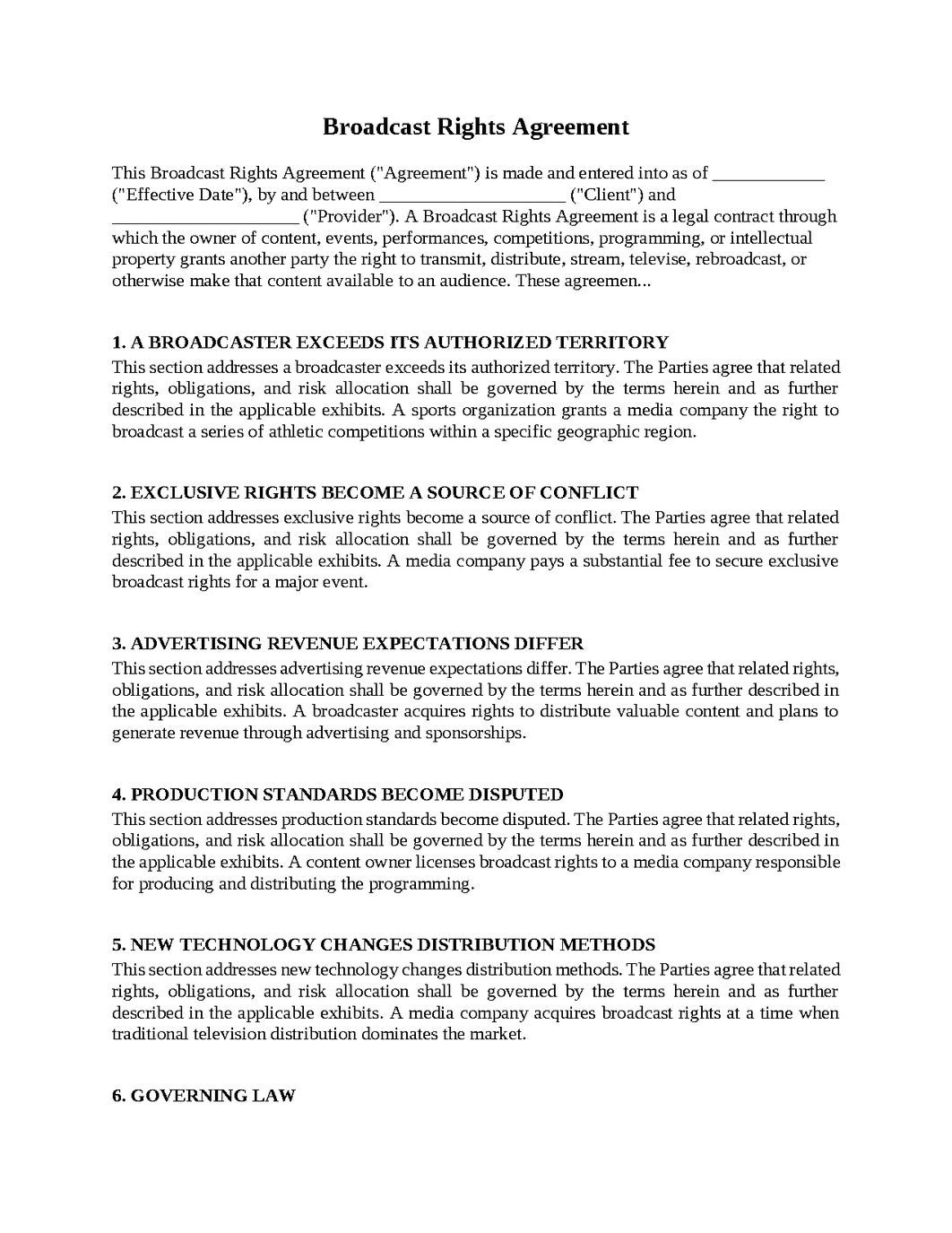
Broadcast Rights Agreement
A Broadcast Rights Agreement is a legal contract through which the owner of content, events, performances, competitions, programming, or intellectual property grants another party the right to transmit, distribute, stream, televise, rebroadcast, or otherwise make that content available to an audience. These agreements are commonly used in sports broadcasting, television programming, live events, concerts, esports, conferences, entertainment productions, educational programming, and digital streaming services. A Broadcast Rights Agreement typically addresses exclusivity, geographic territories, distribution channels, licensing fees, advertising rights, production standards, intellectual property ownership, and content usage restrictions. Because broadcast rights often involve significant financial investments and valuable audience access, disputes can arise when expectations regarding distribution rights and revenue opportunities are not documented clearly. A carefully drafted Broadcast Rights Agreement helps protect both content owners and broadcasters while establishing a framework for successful distribution.
A Broadcaster Exceeds Its Authorized Territory
A sports organization grants a media company the right to broadcast a series of athletic competitions within a specific geographic region.
The broadcaster invests heavily in production, marketing, and distribution efforts and begins delivering the events to viewers successfully. Both parties initially benefit from the arrangement.
As demand for the content grows, viewers outside the authorized territory begin accessing broadcasts through streaming platforms and digital distribution channels. The sports organization becomes concerned that the broadcaster is effectively reaching audiences beyond the scope of the agreement.
The broadcaster argues that modern technology makes geographic restrictions difficult to enforce completely. The content owner believes the unauthorized distribution undermines the value of rights sold to other partners.
The disagreement centers on whether the broadcaster exceeded the rights originally granted.
To help avoid this problem, a Broadcast Rights Agreement should clearly define authorized territories and establish procedures for monitoring and controlling access outside approved markets.
Exclusive Rights Become a Source of Conflict
A media company pays a substantial fee to secure exclusive broadcast rights for a major event.
The broadcaster expects to be the only authorized source of coverage and relies on that exclusivity when planning advertising sales and audience development strategies. The content owner benefits from the premium compensation associated with exclusive rights.
Later, the content owner enters into additional arrangements that permit highlights, clips, or alternative coverage through other outlets. The broadcaster believes these additional arrangements reduce the value of the exclusivity it purchased.
The content owner argues that limited secondary uses were never intended to violate the agreement. The broadcaster believes exclusivity should be interpreted broadly.
The disagreement focuses on the meaning and scope of exclusive broadcast rights.
To help prevent these issues, a Broadcast Rights Agreement should clearly define exclusivity and identify any exceptions relating to highlights, promotional use, social media content, or secondary distribution.
Advertising Revenue Expectations Differ
A broadcaster acquires rights to distribute valuable content and plans to generate revenue through advertising and sponsorships.
Both parties expect the arrangement to be profitable and anticipate strong audience engagement. As broadcasts begin, advertising opportunities become more valuable than originally anticipated.
Questions emerge regarding sponsorship rights, advertising inventory, branded content opportunities, and revenue-sharing arrangements. The broadcaster believes certain revenue streams belong exclusively to the distribution partner.
The content owner believes the popularity of the underlying content justifies a larger share of the financial benefits.
The disagreement develops because the parties have different expectations regarding ownership of advertising-related revenue.
To help avoid these problems, a Broadcast Rights Agreement should clearly address advertising rights, sponsorship opportunities, and any revenue-sharing arrangements.
Production Standards Become Disputed
A content owner licenses broadcast rights to a media company responsible for producing and distributing the programming.
The broadcaster controls camera operations, commentary, graphics, editing, and overall production quality. Initially, everyone expects the broadcasts to enhance the reputation of the content being distributed.
After several broadcasts, the content owner becomes dissatisfied with production quality and believes the broadcasts fail to meet professional standards. Complaints arise regarding technical issues, commentary, presentation style, and overall viewer experience.
The broadcaster argues that production decisions fall within its contractual authority. The content owner believes poor presentation harms the value of the underlying property.
The disagreement centers on who controls quality standards and how performance should be measured.
To help prevent these issues, a Broadcast Rights Agreement should clearly establish production requirements, approval rights, and performance expectations.
New Technology Changes Distribution Methods
A media company acquires broadcast rights at a time when traditional television distribution dominates the market.
Several years into the agreement, technological developments create new methods for reaching audiences through streaming services, mobile applications, social media platforms, and emerging digital channels.
Questions arise regarding whether these new distribution methods are included within the rights originally granted. The broadcaster believes the agreement should adapt to evolving technology.
The content owner argues that emerging platforms create separate commercial opportunities that were never included in the original arrangement.
The disagreement becomes increasingly important as audience behavior shifts toward newer forms of content consumption.
To help avoid these problems, a Broadcast Rights Agreement should clearly address future technologies and define how newly developed distribution channels will be treated during the term of the agreement.
Broadcast Rights Agreements are critical tools for distributing valuable content to audiences through television, streaming platforms, radio, and other media channels. However, issues involving territorial restrictions, exclusivity, advertising revenue, production standards, and evolving technology can become significant sources of conflict when expectations are not documented clearly. A carefully drafted Broadcast Rights Agreement provides a structured framework for allocating rights and responsibilities between content owners and broadcasters. When prepared thoughtfully, it can reduce uncertainty, support profitable distribution relationships, protect intellectual property, and maximize the value of media content for all parties involved.

Get started with Upsign today!
Easily send, sign and track your documents