

Breach Notice Agreement
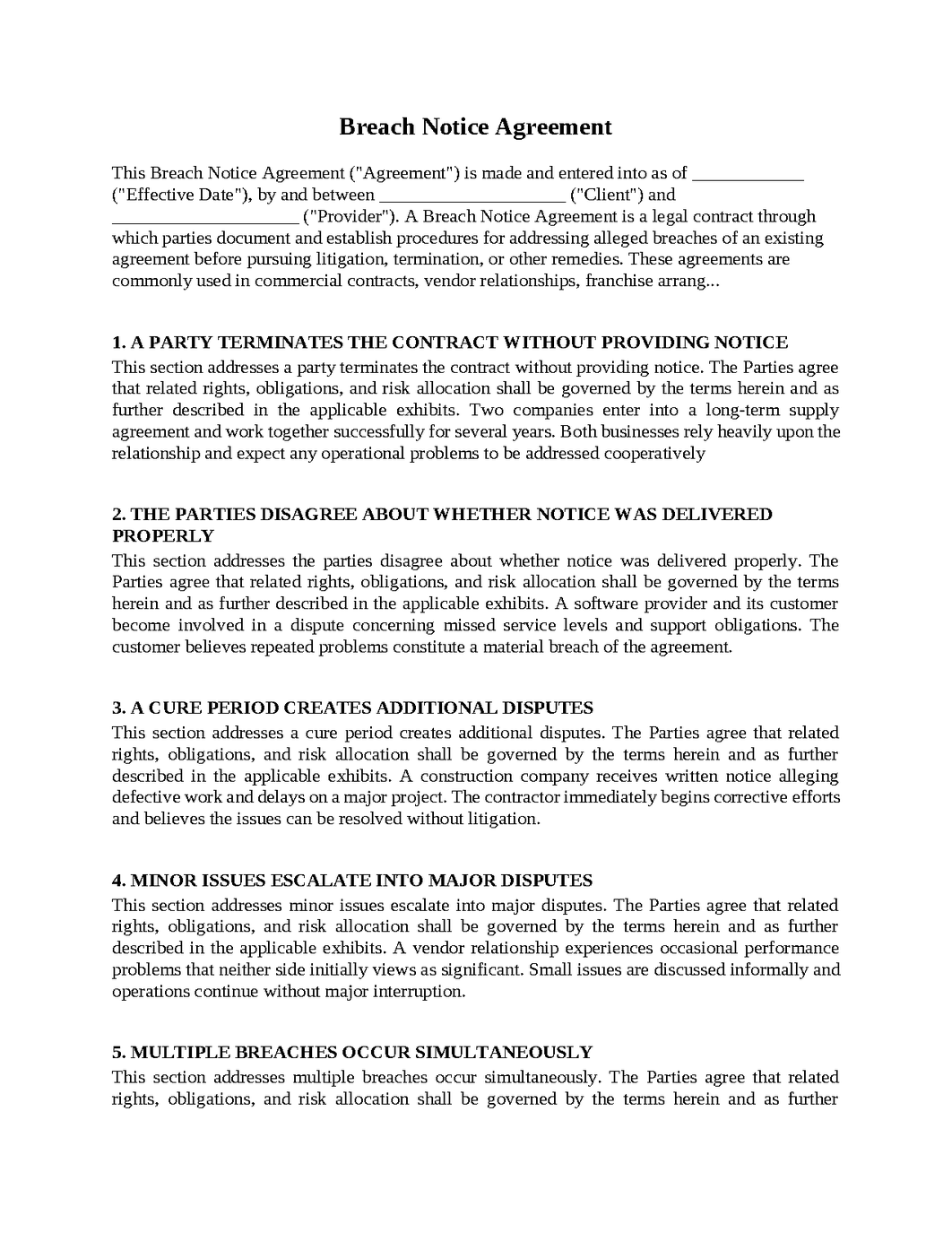
A Breach Notice Agreement is a legal contract through which parties document and establish procedures for addressing alleged breaches of an existing agreement before pursuing litigation, termination, or other remedies. These agreements are commonly used in commercial contracts, vendor relationships, franchise arrangements, licensing agreements, leases, construction contracts, service agreements, and business partnerships. A Breach Notice Agreement typically establishes how alleged defaults will be communicated, the time allowed to cure deficiencies, the parties responsible for receiving notices, and the consequences that may follow if the breach is not corrected. Because contract disputes often escalate when parties feel blindsided or deprived of opportunities to resolve problems, disagreements can arise when expectations regarding notice and cure rights are not documented clearly. A carefully drafted Breach Notice Agreement helps preserve business relationships while providing a structured process for addressing disputes.
A Party Terminates the Contract Without Providing Notice
Two companies enter into a long-term supply agreement and work together successfully for several years. Both businesses rely heavily upon the relationship and expect any operational problems to be addressed cooperatively.
Eventually, delays and quality concerns begin affecting performance. Frustrated by recurring issues, one company abruptly terminates the agreement and begins working with a different supplier without first providing formal notice.
The terminated party believes it should have received an opportunity to correct the problems before losing the business relationship. The terminating party argues that repeated disappointments justified immediate action and that further discussions would have been pointless.
To help avoid this problem, a Breach Notice Agreement should clearly establish notice procedures and provide reasonable opportunities to cure alleged defaults before termination rights arise.
The Parties Disagree About Whether Notice Was Delivered Properly
A software provider and its customer become involved in a dispute concerning missed service levels and support obligations. The customer believes repeated problems constitute a material breach of the agreement.
The customer sends emails describing its concerns and later assumes that sufficient notice has been provided. Months later, the software provider claims that it never received proper notice under the contract.
The customer argues that numerous communications made the concerns obvious. The provider maintains that informal communications did not satisfy the contractual requirements necessary to trigger cure periods and default remedies.
To help prevent these issues, a Breach Notice Agreement should clearly identify acceptable delivery methods and specify when notice is deemed received.
A Cure Period Creates Additional Disputes
A construction company receives written notice alleging defective work and delays on a major project. The contractor immediately begins corrective efforts and believes the issues can be resolved without litigation.
The property owner provides a thirty-day cure period and expects complete compliance before the deadline expires. As repairs progress, unexpected complications arise and additional work becomes necessary.
The contractor believes substantial progress demonstrates good faith and justifies additional time. The owner believes the original cure period controls and that further delays are unacceptable.
To help avoid these problems, a Breach Notice Agreement should clearly define cure periods and establish procedures for extending deadlines when corrective efforts are underway.
Minor Issues Escalate Into Major Disputes
A vendor relationship experiences occasional performance problems that neither side initially views as significant. Small issues are discussed informally and operations continue without major interruption.
Over time, frustrations accumulate and each side begins documenting past grievances. Eventually, one party issues a formal breach notice citing numerous events that occurred over several years.
The receiving party becomes surprised because many of the alleged problems were never raised formally when they occurred. The parties disagree about whether historical issues should be treated as unresolved breaches or waived through continued performance.
To help avoid this problem, a Breach Notice Agreement should establish clear timelines for reporting alleged breaches and specify the consequences of failing to provide timely notice.
Multiple Breaches Occur Simultaneously
A franchise relationship begins experiencing operational, financial, and reporting issues at the same time. The franchisor believes several provisions of the agreement have been violated and issues a comprehensive notice of default.
The franchisee acknowledges some problems but disputes others. Efforts to cure certain issues begin immediately, while disagreements continue regarding the remaining allegations.
The parties struggle to determine which cure periods apply, which defaults are material, and whether partial compliance is sufficient to preserve the relationship. Confusion over priorities and deadlines causes additional tension.
To help prevent these issues, a Breach Notice Agreement should clearly distinguish material and nonmaterial breaches and establish procedures for handling multiple defaults occurring at the same time.
Breach Notice Agreements are valuable tools for preserving contractual relationships and reducing the likelihood of unnecessary litigation. However, issues involving premature termination, defective notice procedures, cure periods, delayed complaints, and multiple simultaneous defaults can become significant sources of conflict when expectations are not documented clearly. A carefully drafted Breach Notice Agreement provides a structured framework for communicating concerns and resolving disputes before they escalate. When prepared thoughtfully, it can reduce uncertainty, preserve business relationships, support good-faith negotiations, and provide the clarity necessary for parties to address problems efficiently and move forward with confidence.

Get started with Upsign today!
Easily send, sign and track your documents