

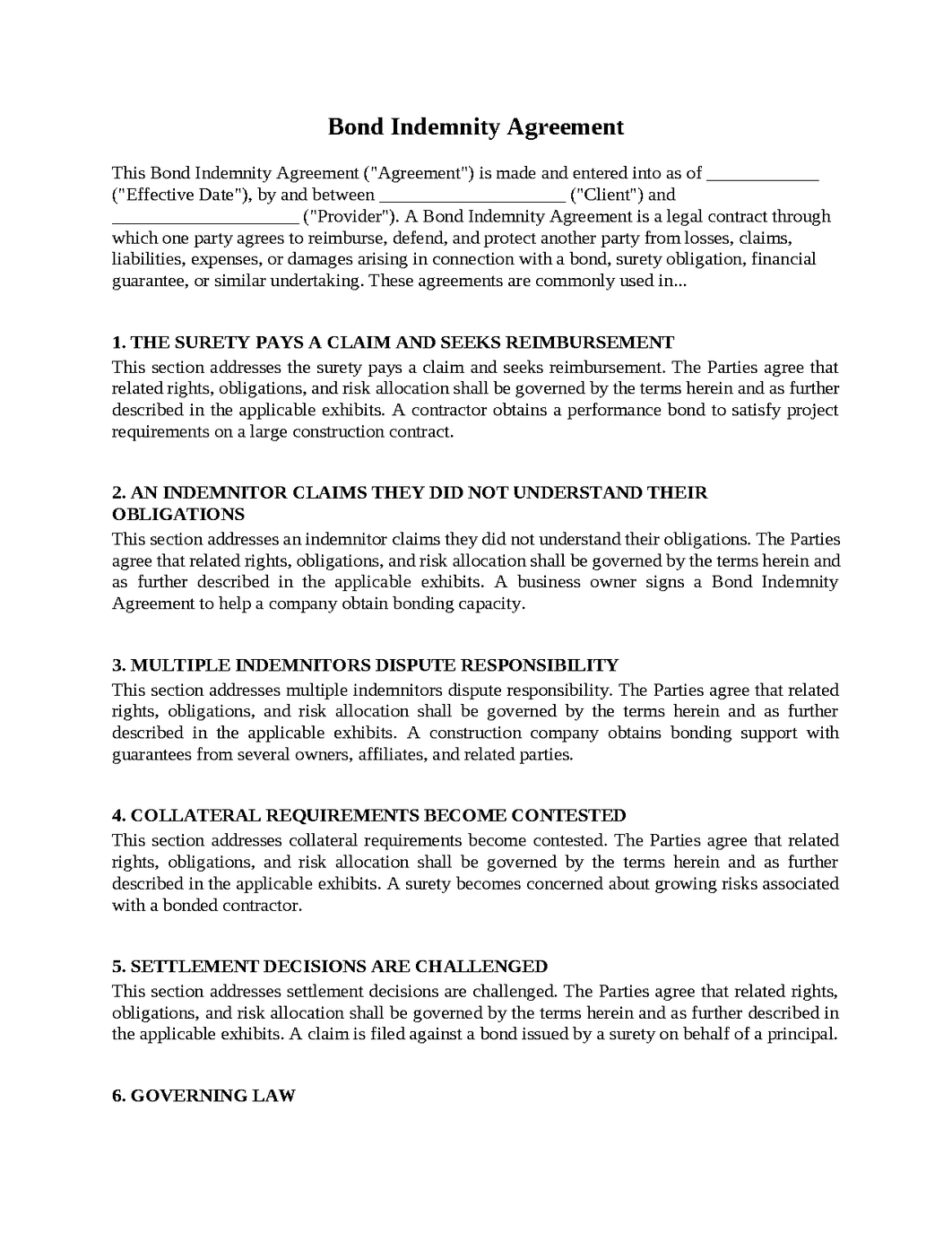
Bond Indemnity Agreement
A Bond Indemnity Agreement is a legal contract through which one party agrees to reimburse, defend, and protect another party from losses, claims, liabilities, expenses, or damages arising in connection with a bond, surety obligation, financial guarantee, or similar undertaking. These agreements are commonly used in construction projects, performance bonds, payment bonds, court bonds, fiduciary bonds, license and permit bonds, customs bonds, and various commercial surety arrangements. A Bond Indemnity Agreement is particularly important because a surety typically agrees to provide financial backing based upon the expectation that the principal and indemnitors will reimburse the surety if losses occur. Because bond claims can involve substantial financial exposure, disputes frequently arise when parties disagree regarding reimbursement obligations and the scope of indemnification responsibilities. A carefully drafted Bond Indemnity Agreement helps allocate risk clearly and protect all parties involved.
The Surety Pays a Claim and Seeks Reimbursement
A contractor obtains a performance bond to satisfy project requirements on a large construction contract.
The surety issues the bond after reviewing the contractor's financial condition and receiving a signed Bond Indemnity Agreement. Everyone expects the project to be completed successfully and assumes the bond will never be needed.
As construction progresses, disputes emerge regarding delays, performance issues, and contractual obligations. Eventually, the project owner submits a claim against the bond.
After investigating the matter, the surety pays a substantial amount to resolve the claim. The surety then seeks reimbursement from the contractor and other indemnitors as required under the Bond Indemnity Agreement.
The contractor believes the claim should never have been paid or believes the amount was excessive. The surety argues that reimbursement is required regardless of whether the contractor agrees with the claim decision.
The disagreement centers on the indemnitors' obligation to repay losses incurred by the surety.
To help avoid this problem, a Bond Indemnity Agreement should clearly define reimbursement obligations and establish the authority of the surety to investigate, settle, and pay claims.
An Indemnitor Claims They Did Not Understand Their Obligations
A business owner signs a Bond Indemnity Agreement to help a company obtain bonding capacity.
At the time, the owner views the document as a routine requirement and focuses primarily on securing the bond needed for the project. The project proceeds successfully for a period of time.
Years later, substantial bond claims arise and the surety seeks recovery from all indemnitors. The owner becomes surprised to learn that personal assets may be exposed to satisfy the reimbursement obligations.
The indemnitor argues that the financial consequences were never fully understood. The surety maintains that the agreement clearly established the indemnitor's responsibilities.
The disagreement develops because the long-term risk associated with the agreement was underestimated.
To help prevent these issues, a Bond Indemnity Agreement should clearly explain the scope of indemnification obligations and the potential financial consequences of signing the agreement.
Multiple Indemnitors Dispute Responsibility
A construction company obtains bonding support with guarantees from several owners, affiliates, and related parties.
Each indemnitor signs the Bond Indemnity Agreement and agrees to support the company's obligations. Initially, everyone assumes the project will conclude without incident.
When a major claim arises, the surety seeks reimbursement from all indemnitors. Some indemnitors believe responsibility should be allocated according to ownership percentages or involvement in the project.
Others argue that certain parties benefited more from the bonded work and should bear a larger share of the losses. The surety believes all indemnitors remain jointly responsible under the agreement.
The dispute shifts from the bond claim itself to the allocation of responsibility among the indemnitors.
To help avoid these problems, a Bond Indemnity Agreement should clearly address joint and several liability and explain how obligations apply to multiple indemnitors.
Collateral Requirements Become Contested
A surety becomes concerned about growing risks associated with a bonded contractor.
The Bond Indemnity Agreement permits the surety to request collateral if circumstances suggest that future claims may arise. As project difficulties increase, the surety exercises its contractual rights and demands additional security.
The contractor believes the demand is unnecessary because no final claim determination has been made. The surety argues that collateral is necessary to protect against potential exposure.
The disagreement becomes significant because providing collateral places financial pressure on the contractor and business operations.
Both parties interpret the surety's rights differently.
To help prevent these issues, a Bond Indemnity Agreement should clearly define collateral rights and establish the circumstances under which security may be required.
Settlement Decisions Are Challenged
A claim is filed against a bond issued by a surety on behalf of a principal.
After reviewing the available information, the surety determines that settling the claim is the most practical course of action. The principal strongly disagrees and believes the claim could be defeated through litigation.
Despite the principal's objections, the surety resolves the claim and later seeks reimbursement under the Bond Indemnity Agreement. The principal argues that the settlement was unnecessary and financially unreasonable.
The surety maintains that the agreement grants discretion to investigate, compromise, and settle claims as it deems appropriate.
The disagreement focuses on whether the principal may challenge the surety's claim-handling decisions after payment has been made.
To help avoid these problems, a Bond Indemnity Agreement should clearly define the surety's settlement authority and explain the effect of claim payments on indemnification obligations.
Bond Indemnity Agreements are fundamental risk-management tools in surety and bonding relationships because they provide the financial protections that allow sureties to issue bonds in the first place. However, issues involving reimbursement obligations, misunderstood liability, multiple indemnitors, collateral demands, and settlement authority can become significant sources of conflict when expectations are not documented clearly. A carefully drafted Bond Indemnity Agreement provides a structured framework for allocating risk and defining the responsibilities of principals and indemnitors. When prepared thoughtfully, it can reduce uncertainty, strengthen surety relationships, facilitate bonding transactions, and provide greater confidence for all parties involved.

Get started with Upsign today!
Easily send, sign and track your documents