

Assignment of Website Agreement
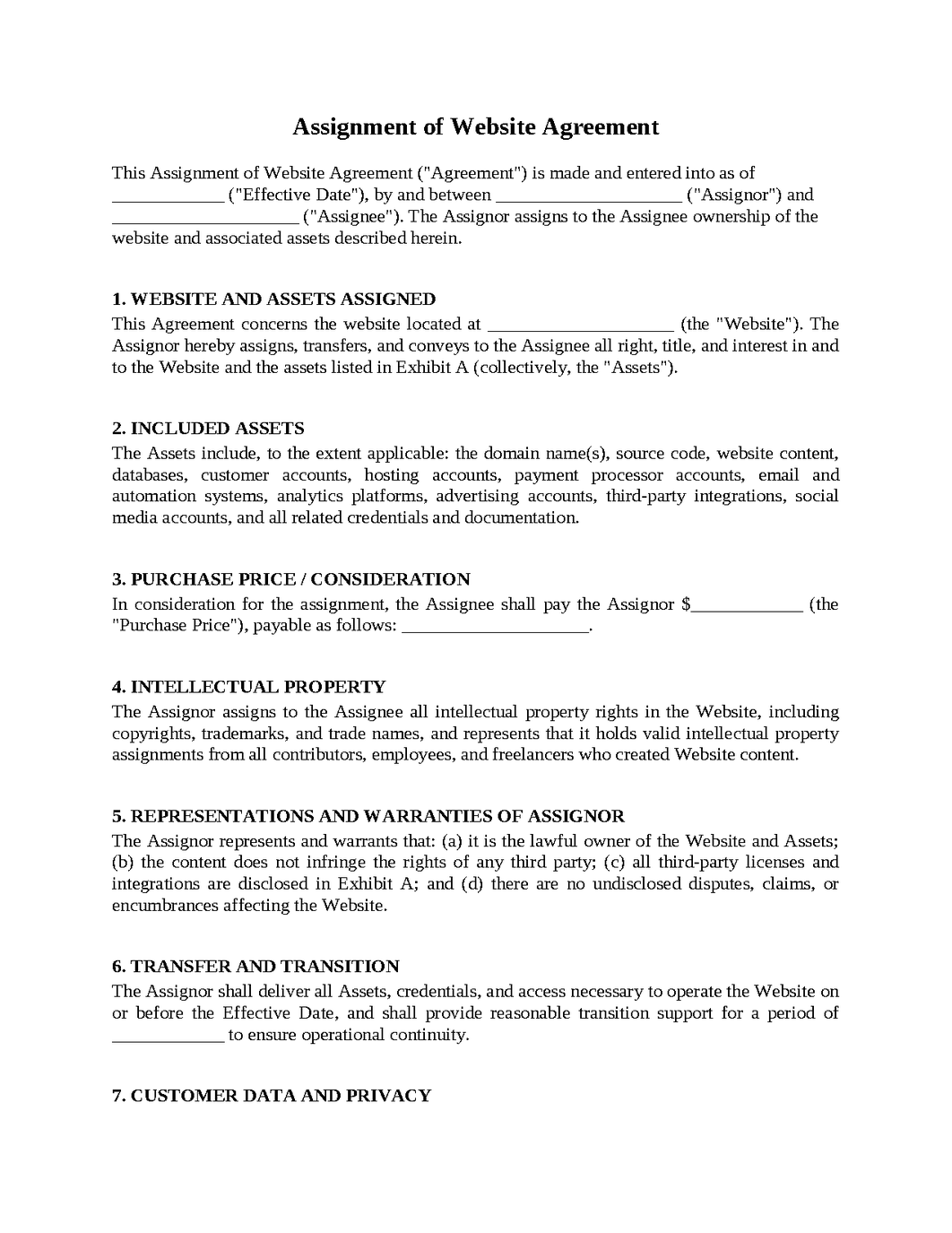
An Assignment of Website Agreement is a legal contract used when ownership of a website is transferred from one person or business to another. The party transferring ownership is known as the assignor, while the recipient is known as the assignee. Website assignments commonly occur during business acquisitions, asset sales, mergers, startup exits, succession planning, intellectual property transactions, and online business sales. A website often consists of far more than a domain name. It may include source code, content, customer accounts, databases, analytics data, hosting environments, search engine rankings, advertising accounts, integrations, and intellectual property rights. Because websites frequently serve as the primary revenue-generating asset of a business, ownership disputes can have significant financial consequences. An Assignment of Website Agreement helps establish who owns the website and what assets are included in the transfer.
The Buyer Acquires the Website but Cannot Operate It
An entrepreneur purchases a successful e-commerce business whose website generates most of its revenue.
The transaction appears straightforward.
The seller transfers the website files and provides access to the hosting account. The buyer assumes everything necessary to operate the business has been included.
Within days of closing, problems begin appearing.
Certain payment gateway credentials are missing. Key third-party integrations no longer function. Customer email automation systems remain under the seller's control. Inventory management tools cannot be accessed without passwords that were never delivered.
The website technically exists, but critical business functions stop working.
Sales decline immediately.
The buyer becomes frustrated because the value of the business depended on far more than the website's visual appearance. The seller argues that the website itself was transferred and that certain operational tools were never specifically included.
The dispute quickly becomes expensive.
This situation occurs frequently because websites often rely on dozens of connected systems that are easy to overlook during a transaction.
To avoid this problem, an Assignment of Website Agreement should identify all assets necessary to operate the website, including hosting accounts, databases, payment processors, email systems, integrations, customer management tools, analytics platforms, and third-party services. The agreement should also require cooperation during the transition period to ensure operational continuity.
The Seller Does Not Actually Own All Website Content
A digital media company builds a popular website featuring articles, photographs, videos, and educational resources.
Several years later, the company agrees to sell the website to a larger publisher.
During due diligence, the buyer reviews traffic statistics, advertising revenue, and subscriber growth. Everything appears attractive.
After closing, copyright complaints begin arriving.
Certain photographs were licensed rather than owned. Several articles were created by freelancers who never signed intellectual property assignments. Portions of the website incorporate content obtained from third-party sources under limited-use licenses.
The buyer becomes alarmed.
Instead of acquiring complete ownership of the website's content, the buyer discovers that significant portions may not belong to the seller at all.
The value of the acquisition becomes uncertain.
Content ownership issues are common because websites frequently evolve over many years and may involve numerous contributors.
To reduce these risks, an Assignment of Website Agreement should include representations regarding ownership of website content, intellectual property assignments from contributors, third-party licenses, and any restrictions affecting future use of the website's materials.
Search Rankings Collapse After the Transfer
A company purchases a niche website that generates substantial traffic through search engines.
The website's value is heavily dependent on its strong rankings for important industry keywords.
Shortly after the acquisition closes, the buyer begins making changes.
Hosting providers are switched. Website architecture is modified. Existing URLs are reorganized. Certain pages are removed.
Within months, organic traffic declines dramatically.
Search engine rankings fall, advertising revenue drops, and lead generation slows significantly.
The buyer blames the seller for failing to explain the importance of certain technical configurations. The seller argues that the rankings existed at closing and that post-closing decisions caused the decline.
The disagreement centers on expectations and operational knowledge.
Website value often depends on factors that are not immediately visible, including search engine optimization, backlinks, site structure, technical configurations, and historical performance.
To help avoid these disputes, an Assignment of Website Agreement should clearly identify critical website assets and require disclosure of material traffic sources, ranking dependencies, and technical configurations that significantly affect performance. Transition support provisions can also help preserve website value after closing.
The Seller Launches a Nearly Identical Website
A software review website is sold to a strategic buyer that intends to expand the platform.
The buyer pays a premium price based largely on the site's reputation, traffic, and market position.
Several months later, the seller launches a new website targeting the same audience.
Although the design differs slightly, the content strategy, keyword focus, business model, and customer messaging are remarkably similar.
Traffic begins shifting.
Advertisers become confused. Industry participants assume the businesses remain connected. The buyer worries that the goodwill purchased through the transaction is being diluted.
The seller insists that no restrictions prohibit operating another website in the same industry.
The dispute escalates quickly.
This issue arises frequently when website sales occur without clear post-closing restrictions.
To avoid these problems, an Assignment of Website Agreement should address non-compete obligations where appropriate, restrict use of transferred content and branding, and clearly define what activities the assignor may continue pursuing after the transaction closes.
A Data Privacy Problem Surfaces After the Sale
A company acquires a membership website with thousands of registered users.
The website includes customer accounts, email addresses, purchase histories, subscription information, and behavioral data collected over many years.
The buyer assumes these assets transfer automatically with the website.
Following closing, legal advisors identify potential problems.
Certain privacy policies never disclosed that customer data could be transferred during a sale. Regulatory requirements may apply in multiple jurisdictions. Some customer consents may be inadequate for the buyer's intended uses.
The buyer becomes concerned.
The customer database was one of the most valuable assets involved in the transaction, yet legal restrictions may affect how the information can be used.
What appeared to be a routine website acquisition now involves privacy, compliance, and regulatory risks.
To reduce these issues, an Assignment of Website Agreement should specifically address customer data ownership, privacy obligations, consent requirements, applicable regulations, and post-transfer data usage rights. The agreement should also require disclosure of any known privacy-related concerns that could materially affect the value of the website.

Get started with Upsign today!
Easily send, sign and track your documents