

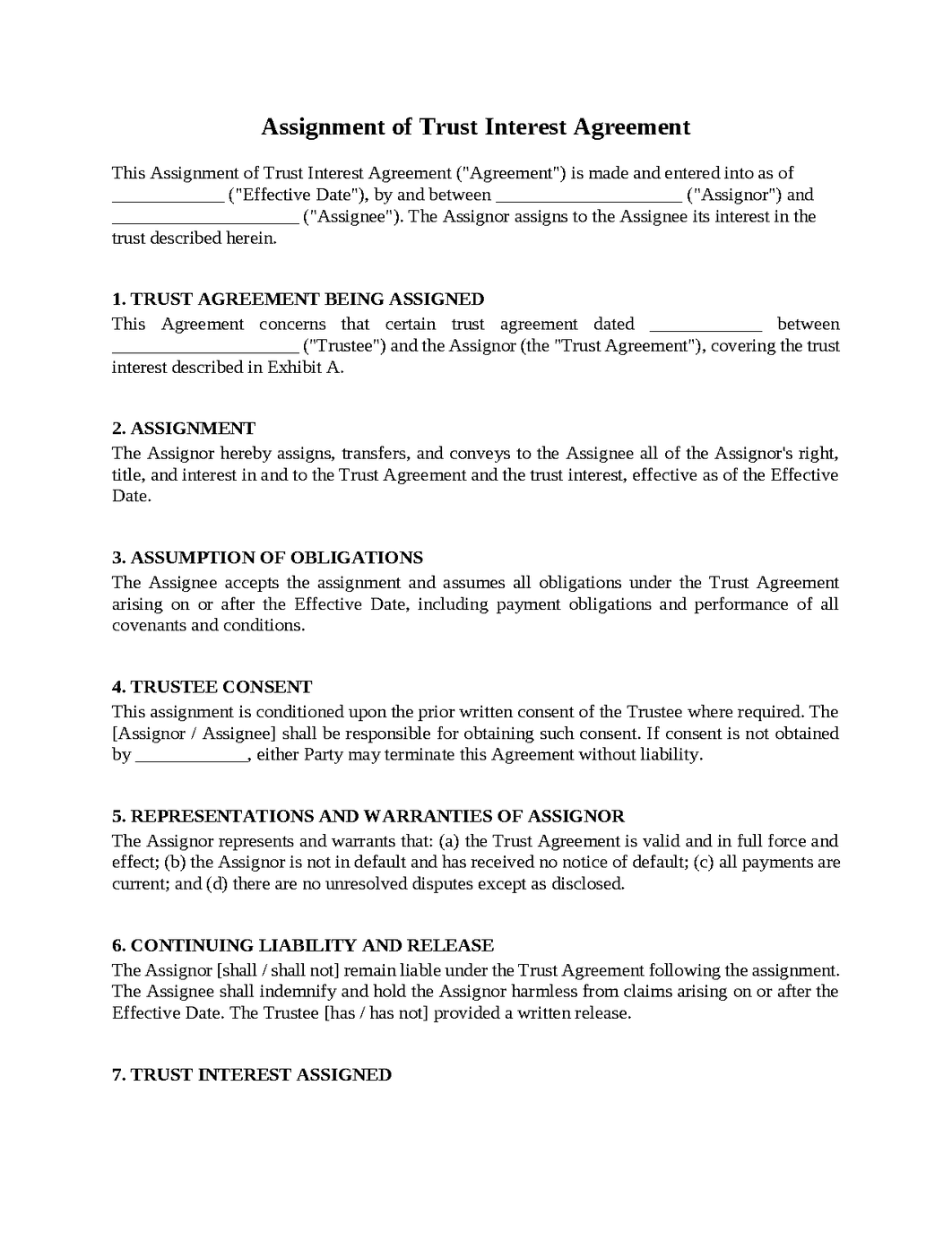
Assignment of Trust Interest Agreement
An Assignment of Trust Interest Agreement is a legal contract used when a beneficiary transfers some or all of their interest in a trust to another person or entity. The person transferring the interest is known as the assignor, while the recipient is known as the assignee. Trust interests may include rights to receive income distributions, principal distributions, future trust benefits, or other economic interests established under the trust agreement. Assignment of trust interests commonly occurs during estate planning, family wealth transfers, divorce settlements, debt settlements, business transactions, charitable planning, and investment arrangements. Because trusts often contain unique restrictions regarding transferability, assignments can create significant legal and practical complications. An Assignment of Trust Interest Agreement helps document the transfer, define the rights being assigned, and establish expectations among beneficiaries, trustees, and assignees.
A Beneficiary Tries to Assign an Interest That the Trust Prohibits
A beneficiary of a family trust expects to receive substantial future distributions and decides to sell a portion of that interest to an investor in exchange for immediate cash.
The arrangement appears attractive to both parties. The beneficiary receives liquidity, and the investor gains access to a future stream of trust distributions.
Before completing the transaction, however, the trustee reviews the trust agreement and discovers a spendthrift provision that restricts assignments by beneficiaries. The beneficiary assumed the interest could be transferred freely. The investor never considered that the trust itself might limit transfer rights.
The trustee refuses to recognize the assignment.
What initially appeared to be a simple financial transaction becomes a complicated legal dispute regarding whether the transfer is valid at all. The investor demands answers, the beneficiary seeks alternatives, and legal expenses begin to accumulate.
To help avoid this situation, an Assignment of Trust Interest Agreement should specifically identify any restrictions contained in the trust instrument and require the assignor to disclose those restrictions. The agreement should also make the transfer contingent upon obtaining any required trustee approvals or confirmations before funds change hands.
An Assignee Believes They Have Become a Beneficiary
A trust established by a successful business owner provides income distributions to several family members. One beneficiary assigns a portion of their trust interest to a sibling as part of a family financial arrangement.
After the assignment is completed, the sibling begins communicating directly with the trustee regarding trust investments, administration decisions, and future distribution planning.
The trustee is surprised.
According to the trust agreement, the sibling may have acquired certain economic rights, but they have not automatically become a beneficiary with authority to participate in trust administration.
The sibling disagrees and argues that ownership of the assigned interest should provide broader rights.
The misunderstanding quickly creates tension within the family. Existing beneficiaries become concerned about outside involvement in trust matters, while the sibling feels excluded despite acquiring an interest in the trust.
This issue arises frequently because trust interests often involve economic rights without corresponding governance or beneficiary rights. Receiving the right to future distributions is not always the same as becoming a beneficiary under the trust agreement.
To reduce confusion, an Assignment of Trust Interest Agreement should clearly describe exactly what rights are being transferred. The agreement should distinguish between economic interests, distribution rights, beneficiary status, information rights, and any limitations imposed by the trust itself.
The Parties Disagree About the Value of the Trust Interest
A beneficiary expects to receive future distributions from a trust holding commercial real estate, investment accounts, and private business interests. An investor offers to purchase the beneficiary's interest for a lump-sum payment.
The challenge quickly becomes determining value.
The beneficiary believes the trust assets will appreciate significantly over time and expects future distributions to increase. The investor focuses on uncertainty, administrative expenses, market conditions, and the possibility that future distributions may be delayed or reduced.
Both sides hire financial advisors.
The beneficiary's valuation expert estimates the interest is worth nearly $2 million. The investor's expert concludes that a fair value is closer to $1.3 million.
Negotiations become difficult.
The beneficiary believes the investor is taking advantage of uncertainty. The investor argues that significant risks justify a lower valuation.
Valuation disputes are particularly common when trust interests are involved because future distributions may depend on trustee discretion, investment performance, tax considerations, and other factors that are difficult to predict.
To help prevent these disagreements, an Assignment of Trust Interest Agreement should incorporate a clearly defined valuation process whenever possible. The agreement may reference appraisals, financial assumptions, discount methodologies, or independent valuation procedures that provide a framework for determining value.
A Divorce Creates Complications for the Trust
A beneficiary of a substantial trust becomes involved in a divorce proceeding. During settlement negotiations, attorneys identify the trust interest as one of the most valuable assets available for division.
The spouse argues that a portion of the trust interest should be transferred as part of the settlement.
The trustee immediately becomes concerned.
The trust was created to benefit a specific group of beneficiaries, and the trustee worries that transferring interests to a former spouse could undermine the trust's long-term purpose.
Other beneficiaries share similar concerns.
Questions arise regarding whether the trust permits such transfers, whether court orders override trust restrictions, and what rights the former spouse would receive if the assignment proceeds.
The uncertainty affects the entire family.
Trust-related divorce disputes occur regularly because trust interests often represent substantial wealth while simultaneously being subject to complex restrictions.
To reduce these risks, an Assignment of Trust Interest Agreement should work in conjunction with trust provisions governing divorce-related transfers. The agreement should clearly define the assigned rights, identify applicable restrictions, and address whether buyout provisions, trustee approvals, or beneficiary consent requirements apply.
A Former Beneficiary Is Pulled Into Litigation Years Later
A beneficiary assigns their trust interest to an investor and receives a substantial lump-sum payment. The transaction closes successfully, and the beneficiary assumes their involvement with the trust has ended permanently.
Several years later, litigation arises concerning trust administration decisions that occurred before the assignment.
The lawsuit alleges that certain trust assets were mismanaged and that prior distributions were calculated incorrectly.
Although the former beneficiary no longer has any ownership interest, attorneys request records, testimony, and information regarding events that occurred while they were still connected to the trust.
The former beneficiary becomes frustrated.
They believed selling the interest would eliminate future involvement in trust matters.
Unfortunately, ownership transfers do not necessarily eliminate responsibilities relating to prior events. Historical disputes may still require participation from individuals who were involved before the assignment occurred.
The costs and inconvenience can be significant, particularly when litigation extends over multiple years.
To help address these concerns, an Assignment of Trust Interest Agreement should contain indemnification provisions, cooperation requirements, record-retention obligations, and procedures for handling future claims relating to events that occurred before the transfer date.
Trust interests often represent valuable financial rights that may continue for many years. Whether assignments occur because of estate planning, financial transactions, family arrangements, divorce proceedings, or investment opportunities, significant legal and practical issues can arise if the transfer is not documented carefully. An Assignment of Trust Interest Agreement provides a structured framework for documenting these transfers and clarifying expectations for assignors, assignees, trustees, and beneficiaries. When drafted properly, it can help reduce disputes, facilitate ownership transfers, and provide greater certainty regarding the rights and obligations associated with the assigned trust interest.
:::

Get started with Upsign today!
Easily send, sign and track your documents