

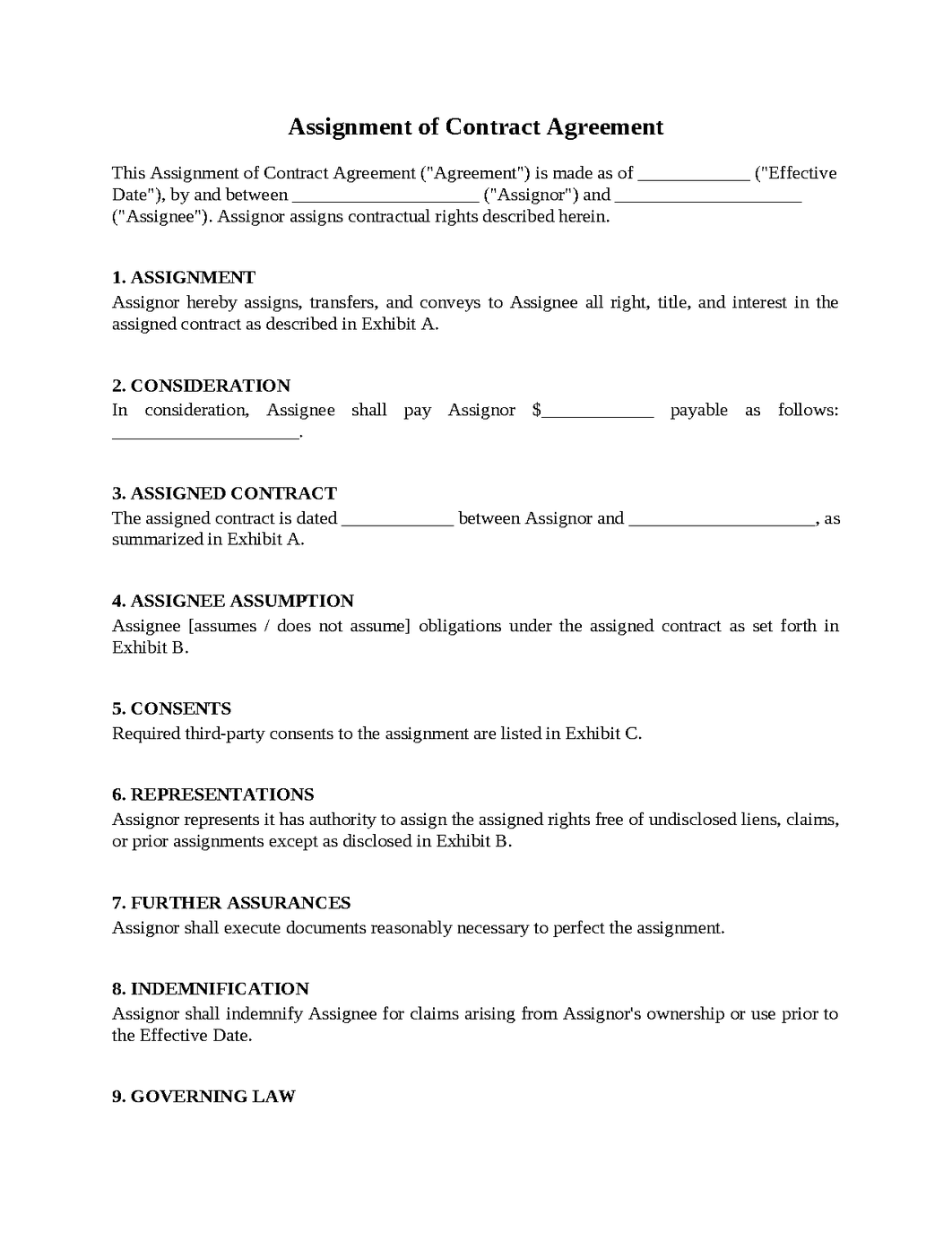
Assignment of Contract Agreement
An Assignment of Contract Agreement is a legal document used when one party transfers its rights, interests, and sometimes obligations under an existing contract to another party. Unlike a general assignment agreement that may involve a wide range of rights or assets, an Assignment of Contract Agreement focuses specifically on an existing contract and the legal relationship created by that contract. Businesses frequently use these agreements during acquisitions, business sales, subcontracting arrangements, real estate transactions, financing deals, and organizational restructurings. While contract assignments can provide flexibility and create valuable opportunities, they often raise questions regarding consent requirements, performance obligations, liability, and the scope of the transfer. When drafted carefully, an Assignment of Contract Agreement helps clarify expectations and reduce uncertainty. When important issues are overlooked, disputes can arise long after the assignment takes place.
The Other Party Refuses to Recognize the Assignment
A commercial cleaning company enters into a three-year service contract with a large office complex. After one year, the cleaning company sells part of its business and assigns the service contract to another cleaning provider.
The new provider assumes it can immediately step into the existing relationship and continue performing services. However, the property manager refuses to recognize the assignment and insists that the original cleaning company remains responsible.
The disagreement centers on the original contract language. A review reveals that the agreement prohibits assignments without prior written consent from the customer.
The new provider argues that service quality will remain unchanged and that the customer should not object. The property manager disagrees and explains that the original company was selected based on its specific reputation, staffing model, and management team.
Situations like this occur frequently because many contracts restrict assignment rights. Customers, vendors, and service recipients often want control over who performs contractual obligations.
Ignoring assignment restrictions can create significant problems. Payments may be delayed, performance may be rejected, and disputes may arise regarding who remains responsible under the contract.
An Assignment of Contract Agreement helps identify consent requirements and encourages parties to verify whether approvals are needed before the transfer occurs.
The Parties Disagree About Whether Obligations Were Transferred
A software developer assigns a long-term maintenance contract to another technology company. The assignee expects to receive the recurring monthly revenue generated by the agreement.
Several weeks after the transfer, the customer reports a system failure and demands immediate support. The assignee argues that it received payment rights but did not agree to assume responsibility for technical support obligations.
The assignor strongly disagrees and insists that both rights and responsibilities were transferred together.
The dispute highlights a common misunderstanding. Contracts often contain both benefits and obligations. Revenue rights, payment streams, service duties, warranties, reporting obligations, and compliance requirements may all exist within the same agreement.
When assignment documents fail to address these issues clearly, parties may discover that they have very different expectations regarding what was transferred.
Customers may also become confused regarding who is responsible for performance after the assignment takes place.
An Assignment of Contract Agreement helps clarify whether obligations transfer alongside rights and identifies any responsibilities that remain with the assignor.
The Assigned Contract Is Less Valuable Than Expected
A transportation company purchases several customer contracts from a competitor. The acquiring company reviews historical revenue and believes the contracts will generate significant profits.
After closing, however, the company discovers that many customers are nearing the end of their contract terms and are not obligated to renew. Several customers terminate their relationships shortly after the assignment becomes effective.
The buyer becomes frustrated because the contracts appear far less valuable than expected.
This situation occurs frequently when parties focus on historical performance rather than carefully reviewing the actual terms of the assigned agreements.
For example, a contract may be cancellable on short notice. It may contain pricing restrictions that reduce profitability. It may require expensive performance obligations that were overlooked during due diligence.
Without a thorough understanding of the contract itself, the assignee may acquire rights that provide less value than anticipated.
An Assignment of Contract Agreement helps identify exactly what is being transferred, but the parties should also review the underlying contract carefully to understand its practical and financial implications.
A Customer Claims the Assignment Changed the Quality of Service
A regional landscaping company assigns several maintenance contracts to another service provider. The customer relationships transfer successfully, and operations continue without interruption.
Within a few months, however, customers begin complaining. They believe the new provider's service quality is lower than what they received previously.
Some customers threaten to terminate their agreements. Others demand price reductions. Several argue that they never agreed to work with the replacement provider in the first place.
These concerns are common when service contracts are assigned. Customers often develop trust and familiarity with a particular company, team, or individual. Even if the replacement provider is qualified, customers may view the change negatively.
The resulting dissatisfaction can affect contract value significantly. Revenue may decline, relationships may deteriorate, and disputes may arise regarding performance standards.
An Assignment of Contract Agreement helps establish the legal framework for the transfer, but successful assignments often require proactive communication with customers regarding expectations and continuity of service.
The Assignor Believes Liability Ended Automatically
A subcontractor assigns a construction contract to another contractor midway through a large project. The original subcontractor assumes that once the assignment is completed, all future liability disappears automatically.
Several months later, construction defects are discovered. The project owner seeks compensation from both the replacement contractor and the original subcontractor.
The original subcontractor is surprised and argues that the assignment transferred all obligations and risks.
The project owner responds that no formal release was ever provided and that the assignor remains responsible for certain obligations under the original contract.
This misunderstanding occurs frequently because many parties assume that assigning a contract automatically eliminates liability. In reality, the effect of an assignment often depends on the language of the agreements involved and whether other parties consent to release the assignor.
Without careful drafting, assignors may remain exposed to claims long after they believe their involvement has ended.
An Assignment of Contract Agreement helps address these concerns by clearly identifying what obligations transfer, what liabilities remain, and whether any releases are being granted as part of the transaction.
Contract assignments allow businesses and individuals to transfer valuable contractual rights efficiently, creating flexibility and facilitating transactions that might otherwise be difficult to accomplish. However, questions regarding consent, obligations, value, customer expectations, and liability frequently arise when contracts are assigned. An Assignment of Contract Agreement provides a practical framework for documenting these transfers and establishing expectations for everyone involved. When drafted carefully and supported by a thorough review of the underlying contract, the agreement can help reduce uncertainty, facilitate smooth transitions, and provide greater confidence to all parties affected by the assignment.
:::

Get started with Upsign today!
Easily send, sign and track your documents