

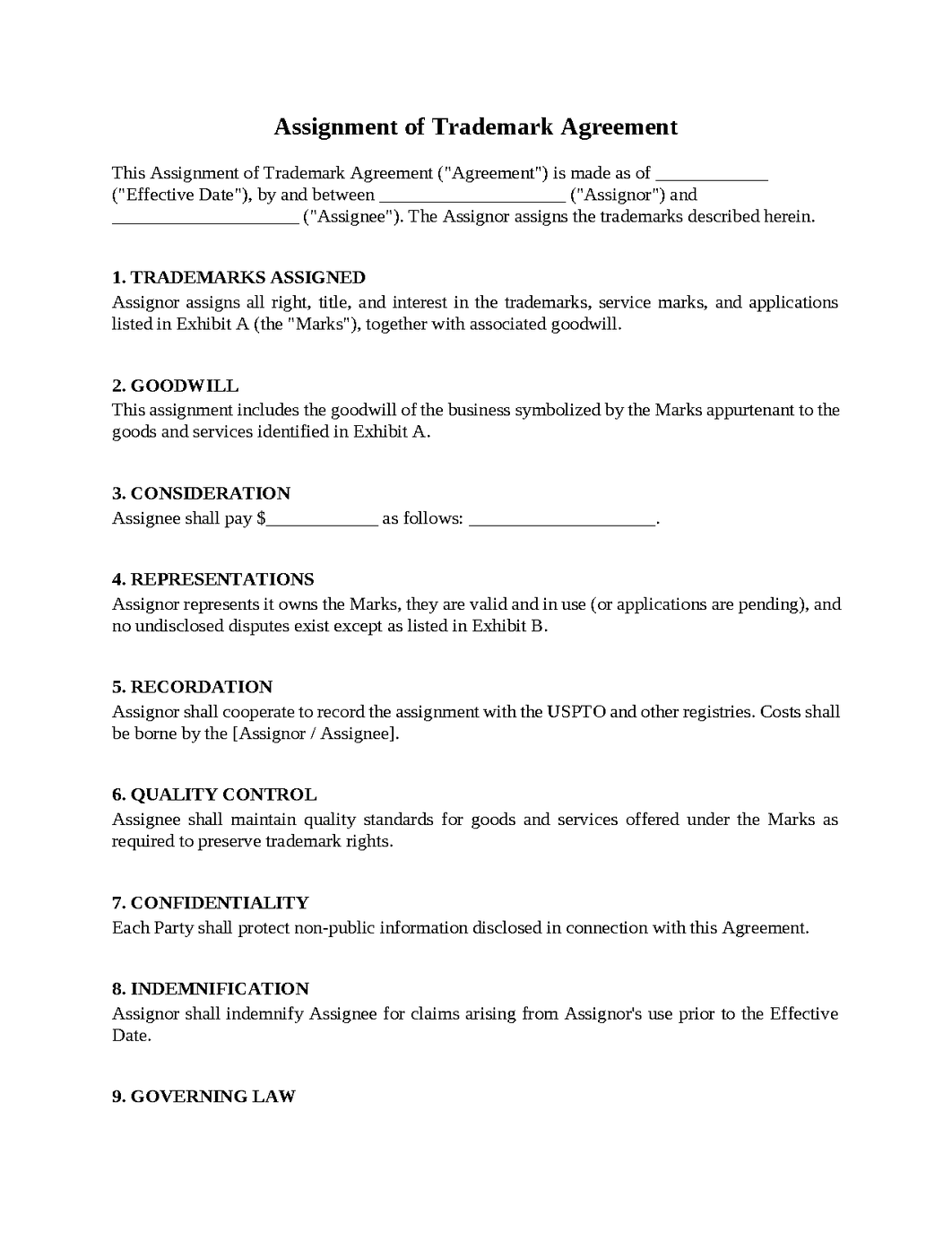
Assignment of Trademark Agreement
An Assignment of Trademark Agreement is a legal contract used when the owner of a trademark transfers ownership of that trademark to another person or business. The party transferring the trademark is known as the assignor, while the recipient is known as the assignee. Trademarks can include business names, logos, slogans, product names, service marks, trade dress, and other branding elements that identify the source of goods or services. Trademark assignments commonly occur during business acquisitions, asset sales, mergers, franchise transactions, succession planning, intellectual property transfers, and corporate restructurings. Because trademarks often represent years of brand recognition, customer trust, and market goodwill, ownership disputes can have significant financial consequences. An Assignment of Trademark Agreement helps establish who owns the trademark, what rights are being transferred, and what obligations remain after the transfer occurs.
A Business Sells the Trademark but Keeps Using the Brand
A regional beverage company develops a popular product line that gains significant market recognition. After several successful years, the company sells the trademark rights associated with the brand to a larger national competitor.
The buyer expects to acquire exclusive ownership of the trademark and all associated branding rights.
Initially, the transition appears successful.
Several months after closing, however, the seller launches a new beverage line using branding that closely resembles the trademark that was sold. While the name is not identical, the logos, packaging style, colors, and marketing themes are strikingly similar.
Customers begin expressing confusion.
Retailers mistakenly assume the products originate from the same source. Social media discussions frequently reference both brands interchangeably.
The buyer becomes concerned that years of goodwill acquired through the transaction are being diluted.
The seller argues that it has the right to continue operating in the industry and that the new branding is sufficiently different.
The disagreement escalates into a costly dispute regarding the scope of the trademark transfer.
To help avoid this problem, an Assignment of Trademark Agreement should clearly define the trademark rights being transferred and address post-closing use restrictions. The agreement should prohibit confusingly similar uses, require the assignor to discontinue use of the transferred mark, and establish remedies if future branding activities create marketplace confusion.
The Trademark Is Assigned Without the Associated Goodwill
A manufacturing company sells one of its product lines to a strategic buyer. The transaction includes the trademark used to market the products.
Both parties assume ownership of the trademark has transferred successfully.
Years later, the buyer attempts to enforce the trademark against a competitor and discovers a potential problem.
Trademark law generally requires that trademark assignments include the goodwill associated with the mark. The buyer learns that the transaction documents focused heavily on the trademark registration itself but said very little about customer relationships, brand reputation, and goodwill.
Attorneys begin questioning whether the assignment was structured properly.
The buyer becomes concerned that the transfer may not provide the level of legal protection expected.
What initially seemed like a technical drafting issue now threatens the value of the acquired intellectual property.
This problem occurs because trademarks are different from many other assets. Their value is tied closely to the goodwill and reputation they represent.
To reduce these risks, an Assignment of Trademark Agreement should expressly transfer both the trademark and all associated goodwill. The agreement should clearly state that the assignor is transferring the reputation, customer recognition, and business value connected to the mark rather than merely transferring a registration number.
The Buyer Assumes International Rights Are Included
A software company purchases a successful brand from another business. The trademark is registered in the United States and has developed a strong reputation within its market.
The buyer assumes ownership includes worldwide rights.
Several months later, the buyer begins expanding internationally and discovers that trademark registrations in several foreign countries remain in the seller's name or were never transferred at all.
The buyer is surprised.
From its perspective, the transaction was intended to acquire the entire brand. The seller responds that only specific registrations identified in the agreement were included.
The parties disagree regarding the scope of the transaction.
Expansion plans are delayed while attorneys review trademark filings, registration records, and assignment language.
The buyer faces additional costs and administrative burdens that could have been avoided.
This situation occurs frequently because trademark rights often exist across multiple jurisdictions. Domestic registrations, international registrations, pending applications, and common-law rights may all require separate consideration.
To prevent these disputes, an Assignment of Trademark Agreement should identify all trademarks being transferred, including domestic registrations, foreign registrations, pending applications, domain names, social media assets, and related intellectual property. The agreement should also require cooperation with future filing and registration activities.
A Franchise System Discovers Ownership Records Are Incomplete
A private equity firm acquires a regional franchise system with dozens of operating locations.
One of the most valuable assets involved in the transaction is the franchise brand and trademark portfolio.
During due diligence, attorneys begin reviewing ownership records.
Most registrations appear valid, but several issues quickly emerge. Historical assignment documents cannot be located. Certain trademark renewals were filed inconsistently. Some marks appear to have been transferred between affiliated entities without proper documentation.
The private equity firm becomes concerned.
Without a clear chain of ownership, enforcing trademark rights may become more difficult. Future franchise sales, licensing arrangements, and litigation efforts could all be affected.
The acquisition timeline slows as attorneys attempt to reconstruct years of trademark history.
What initially appeared to be a mature brand portfolio now contains significant uncertainty.
To reduce these risks, an Assignment of Trademark Agreement should establish a clear chain of title, identify all transferred marks precisely, require delivery of supporting records, and obligate the assignor to assist with future ownership confirmations. Proper documentation is often just as important as the trademark itself.
A Trademark Infringement Lawsuit Raises Questions About Past Claims
A consumer products company acquires ownership of a trademark through an asset purchase transaction.
Several years later, the company discovers that a competitor has been using a confusingly similar mark for a considerable period of time.
Management immediately begins evaluating potential trademark infringement claims.
During legal review, an important question arises.
Who owns the right to pursue infringement claims that occurred before the trademark assignment?
The buyer assumes ownership of the trademark includes all enforcement rights. The seller argues that claims arising before the transfer remain with the original trademark owner unless assigned explicitly.
The disagreement creates uncertainty regarding litigation strategy and potential damages.
Attorneys spend months reviewing transaction documents and trademark law principles.
The value of the lawsuit depends heavily on the answer.
This issue occurs regularly because ownership of a trademark and ownership of historical infringement claims are not always identical. Past claims, future claims, settlement authority, and litigation recoveries may require separate treatment.
To avoid these disputes, an Assignment of Trademark Agreement should expressly address enforcement rights. The agreement should identify who owns past infringement claims, future infringement claims, settlement rights, litigation authority, and any recoveries arising from enforcement actions.
Trademarks often represent some of the most valuable assets a business owns because they embody customer recognition, goodwill, and brand reputation. Whether trademarks are transferred through acquisitions, asset sales, franchise transactions, or intellectual property restructurings, ownership must be documented carefully. An Assignment of Trademark Agreement provides a structured framework for transferring trademark rights and clarifying expectations regarding goodwill, future use, enforcement rights, and ownership documentation. When drafted properly, it can help reduce disputes, preserve brand value, and provide confidence regarding ownership and control of valuable trademark assets.
:::

Get started with Upsign today!
Easily send, sign and track your documents