

Assignment of Settlement Proceeds Agreement
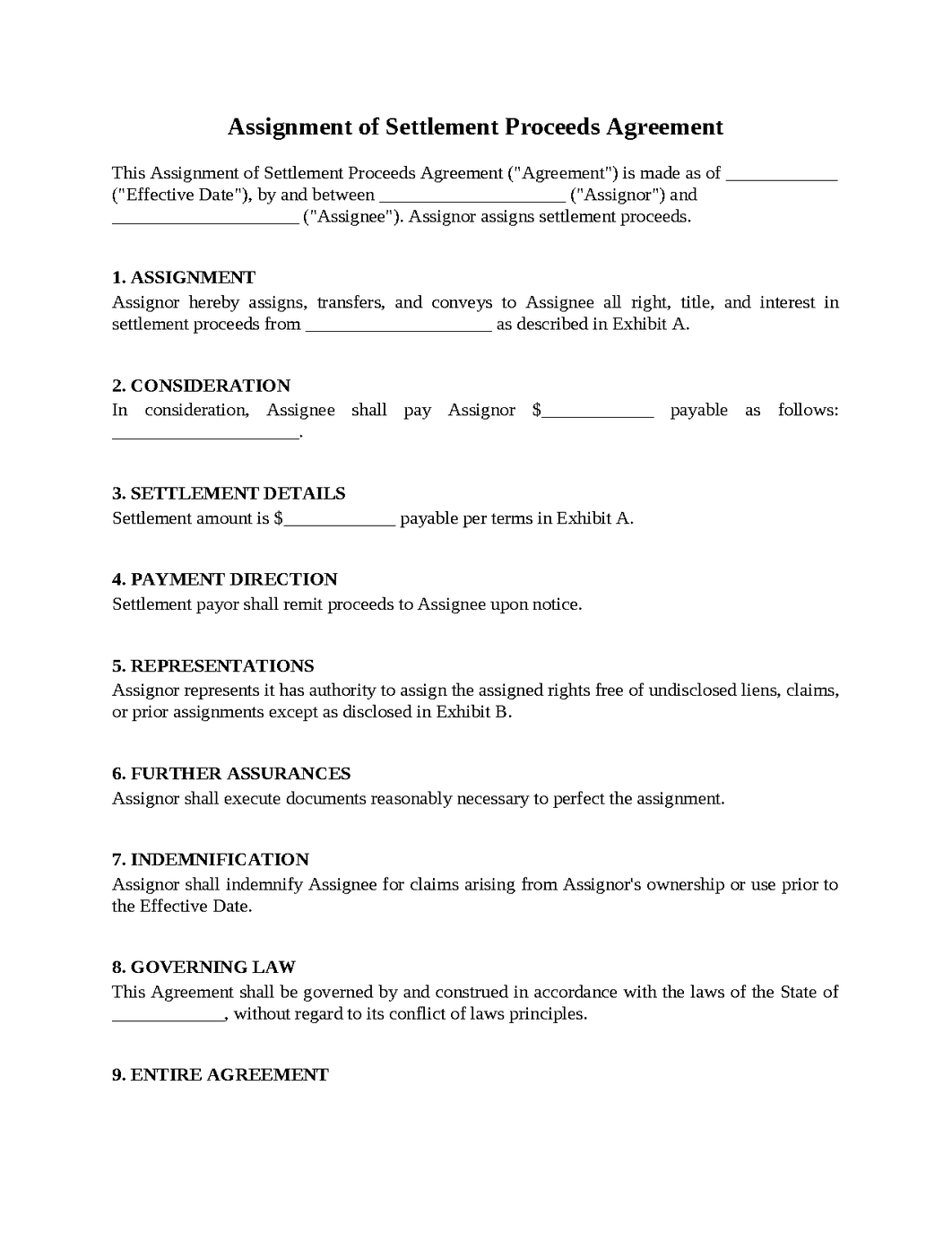
An Assignment of Settlement Proceeds Agreement is a legal contract used when a person or entity transfers the right to receive some or all of the proceeds from a legal settlement to another party. The party transferring the rights is known as the assignor, while the recipient is known as the assignee. Settlement proceeds may arise from personal injury claims, commercial litigation, insurance disputes, employment matters, contract claims, class action settlements, business disputes, and many other forms of legal proceedings. Individuals and businesses often assign settlement proceeds to obtain immediate liquidity, secure financing, satisfy debts, fund litigation expenses, or facilitate business transactions. Because settlement proceeds may not yet have been paid, and because multiple parties often claim an interest in the recovery, disputes can arise regarding ownership, payment priority, settlement terms, and future obligations. An Assignment of Settlement Proceeds Agreement helps establish who is entitled to receive the settlement funds and under what conditions.
The Settlement Check Is Sent to the Wrong Party
A business owner successfully resolves a lawsuit against a former supplier and negotiates a settlement agreement providing for payment over the next twelve months. Before the first installment is received, the business owner assigns the settlement proceeds to an investor in exchange for immediate cash.
Both parties are satisfied with the arrangement.
The investor expects the settlement payments to arrive directly from the defendant according to the agreed schedule. The business owner receives liquidity without having to wait for future installments.
Several months later, however, the first settlement payment is issued.
The defendant sends the payment to the business owner because that is the party identified in the original settlement agreement. The defendant is either unaware of the assignment or does not fully understand where payment should now be directed.
The investor quickly notices that expected funds have not arrived.
Confusion follows as the parties attempt to trace the payment and determine who should receive future installments. Relationships become strained, and the administrative burden grows.
To help avoid this problem, an Assignment of Settlement Proceeds Agreement should clearly identify the settlement, establish the effective date of the assignment, require notice to the settlement payor, and provide detailed instructions regarding future payments. The agreement should also address what happens if settlement proceeds are mistakenly sent to the assignor after the transfer becomes effective.
The Assignee Learns Other Parties Have Claims Against the Settlement
An employee resolves a wrongful termination claim and agrees to receive a substantial settlement from a former employer. Before payment is made, the employee assigns a portion of the settlement proceeds to a lender in exchange for immediate funding.
The lender reviews the settlement amount and believes repayment is well protected.
Shortly before the settlement funds are distributed, however, additional claims emerge.
The employee's attorney asserts a contractual right to legal fees. A medical provider claims reimbursement rights. Tax authorities raise questions regarding certain obligations. Another creditor argues that it previously obtained a lien against any recovery.
The lender is surprised.
From its perspective, the settlement proceeds appeared available and unencumbered. Instead, multiple parties are now competing for the same funds.
The anticipated recovery becomes far more uncertain than expected.
This situation occurs frequently because settlement proceeds often attract competing claims from attorneys, medical providers, lenders, judgment creditors, government agencies, and other interested parties.
To reduce these risks, an Assignment of Settlement Proceeds Agreement should require disclosure of known liens, attorney fee arrangements, reimbursement obligations, and competing claims. The agreement should also contain representations regarding the assignor's authority to transfer the proceeds and identify how priority disputes will be handled.
The Settlement Amount Changes After the Assignment
A commercial contractor wins a favorable mediation and expects to receive a $1 million settlement payment. Before the settlement documents are finalized, the contractor assigns the anticipated proceeds to an investment company.
The investment company values the assignment based on the expected settlement amount.
Everything appears straightforward until final negotiations resume.
Unexpected issues arise between the litigants. Certain claims are withdrawn. Additional concessions are requested. Tax treatment becomes part of the discussion.
By the time the settlement is finalized, the amount being paid is significantly lower than everyone expected.
The investment company becomes concerned because the value of the assigned proceeds has changed materially.
The contractor argues that settlement negotiations are inherently uncertain and that no final agreement existed when the assignment occurred.
The disagreement centers on expectations.
Future settlement proceeds are often uncertain until all documents are signed and all parties agree to final terms. Even seemingly settled cases can change substantially before payment occurs.
To help avoid these disputes, an Assignment of Settlement Proceeds Agreement should define precisely what proceeds are being assigned, address the possibility of settlement modifications, and allocate the risk of reductions, delays, or changes in the ultimate recovery amount.
The Assignor Settles the Case on Different Terms
A business transfers anticipated settlement proceeds arising from a contract dispute to an investor that helped finance the litigation.
The investor expects to receive a portion of any future recovery.
Several months later, settlement negotiations intensify.
The defendant approaches the business directly and proposes a creative settlement structure involving cash payments, future business opportunities, inventory transfers, and non-cash consideration.
The business views the proposal favorably and accepts the arrangement.
The investor is furious.
From the investor's perspective, the settlement should have been structured to maximize cash proceeds because those proceeds were assigned. The business responds that resolving the litigation successfully was always the primary objective.
The parties now disagree about whether the settlement violated the assignment arrangement.
Disputes like this occur because settlements often involve much more than cash. Parties may negotiate future contracts, property transfers, licensing arrangements, confidentiality provisions, or other forms of consideration.
To prevent these problems, an Assignment of Settlement Proceeds Agreement should clearly address settlement authority and define what constitutes settlement proceeds. The agreement should explain how non-cash consideration will be treated and whether the assignor must obtain consent before accepting alternative settlement structures.
The Assignee Wins the Payment Fight but Cannot Prove Its Rights
A litigation finance company acquires rights to future settlement proceeds arising from a complex commercial lawsuit. Several years later, the dispute finally resolves and a substantial settlement fund is created.
When payment time arrives, questions emerge regarding ownership of the proceeds.
The defendant requests documentation showing that the finance company is entitled to receive payment. Other parties involved in the litigation raise similar questions.
The finance company produces assignment documents, but certain supporting records are incomplete. Portions of the transaction history are unclear, and the settlement administrator requests additional evidence.
Payment is delayed while ownership questions are investigated.
The delay frustrates everyone involved because the underlying dispute has already been resolved.
What should have been a straightforward distribution process becomes another documentation exercise.
Ownership issues often emerge at the worst possible time—when money is finally available to distribute. If assignment records are incomplete, settlement administrators, courts, and payors may hesitate before releasing funds.
To reduce this risk, an Assignment of Settlement Proceeds Agreement should clearly identify the underlying case, define the assigned proceeds, include supporting schedules where appropriate, and establish a complete documentary record of the transfer. Careful drafting and recordkeeping can help ensure that settlement funds are distributed efficiently when the case concludes.
Settlement proceeds often represent valuable financial assets that may be assigned for a variety of business, financing, and personal reasons. However, assigning rights to future settlement payments can create significant challenges involving payment administration, competing claims, settlement modifications, ownership documentation, and recovery allocation. An Assignment of Settlement Proceeds Agreement provides a structured framework for documenting these transfers and clarifying the rights and obligations of everyone involved. When drafted carefully, it can help reduce disputes, facilitate transactions, and provide confidence regarding who is entitled to receive settlement proceeds when payment is ultimately made.
:::

Get started with Upsign today!
Easily send, sign and track your documents