

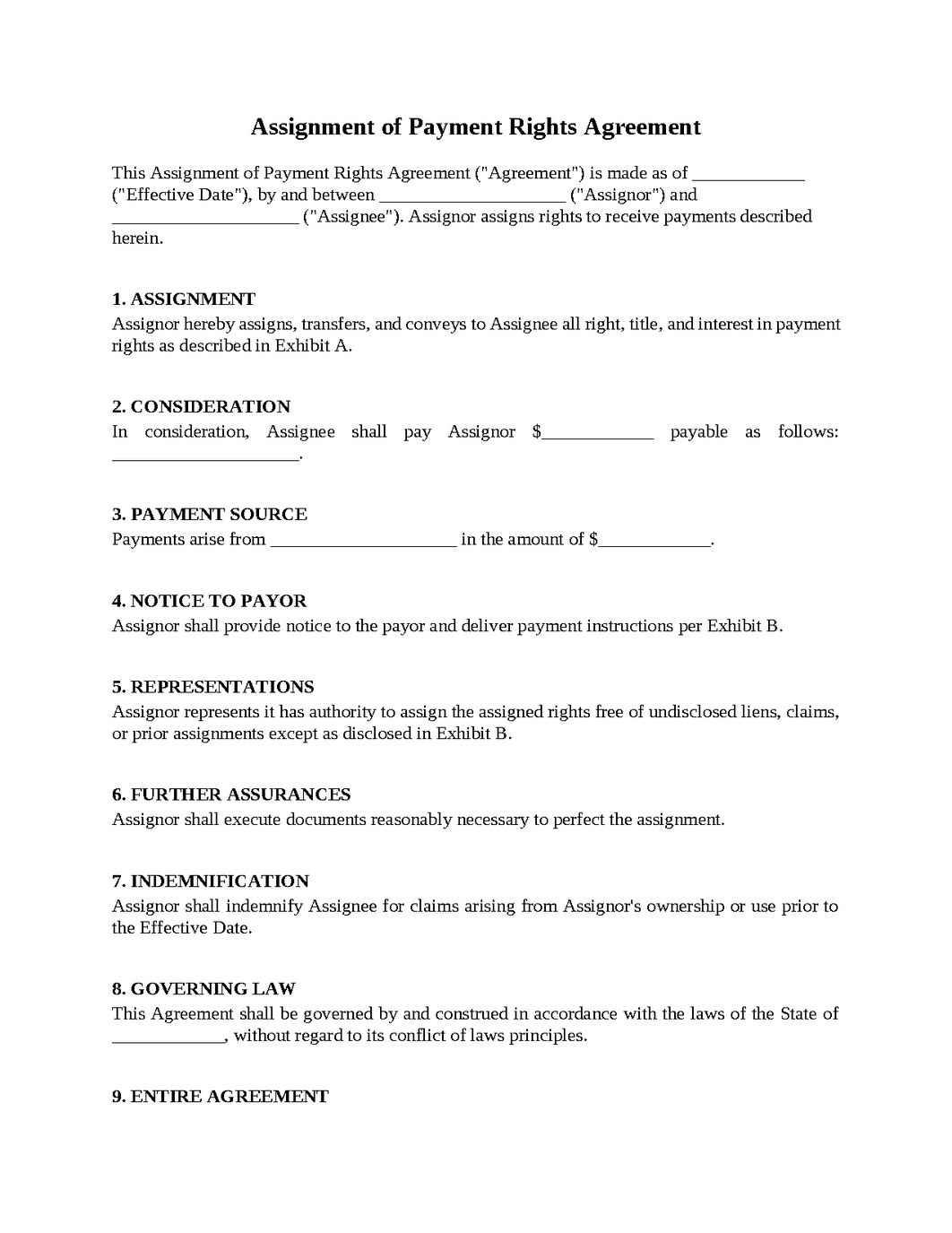
Assignment of Payment Rights Agreement
An Assignment of Payment Rights Agreement is a legal contract used when a person or business transfers the right to receive future payments from a contract, transaction, account, project, settlement, or other financial arrangement to another party. The party transferring the payment rights is known as the assignor, while the recipient is known as the assignee. These agreements are commonly used in financing transactions, factoring arrangements, construction projects, government contracts, business sales, settlement agreements, licensing deals, and commercial lending relationships. Because payment rights often involve future money that has not yet been received, disputes can arise regarding ownership, timing, collection authority, offsets, and competing claims. An Assignment of Payment Rights Agreement helps establish who is entitled to receive the payments and what rights are transferred as part of the transaction.
The Customer Keeps Paying the Original Business
A software development company enters into a multi-year support agreement with a large corporate customer. Under the contract, the customer is required to make monthly payments for maintenance and support services.
To improve cash flow, the software company assigns its right to receive future payments to a finance company in exchange for an immediate lump-sum payment.
Both parties expect the arrangement to work smoothly.
Several months later, however, the customer continues sending payments directly to the software company. The customer was never properly informed about the assignment and simply follows the same payment procedures it has always used.
The finance company quickly notices that expected payments are missing. The software company insists the payments were received accidentally and agrees to forward them, but significant administrative work is required to reconcile accounts and correct records.
The customer becomes frustrated after receiving conflicting instructions from multiple parties.
To avoid this situation, an Assignment of Payment Rights Agreement should clearly identify the payment obligations being assigned, require prompt notice to the payor, establish detailed payment instructions, and specify how payments received by mistake will be handled. The agreement should also obligate the assignor to cooperate in redirecting future payments if confusion arises.
The Assignee Learns the Customer Has a Right to Reduce Payments
A manufacturing company assigns its right to receive future payments under a supply contract to an investor.
The investor reviews the contract and sees a steady stream of anticipated payments over the next three years. Based on those projections, the investor agrees to purchase the payment rights.
Several months later, the customer begins reducing payments.
The investor is surprised and immediately contacts the manufacturer.
The customer explains that the supply agreement permits deductions for defective products, shipping errors, warranty claims, and pricing adjustments. Because several disputes arose during the relationship, the customer exercised its contractual rights to reduce the amounts owed.
The investor realizes that the payment rights are worth far less than originally expected.
This situation occurs frequently because assignees often focus on gross payment amounts without fully understanding the underlying contract. A right to payment may be subject to offsets, credits, adjustments, defenses, or counterclaims that significantly affect value.
To reduce this risk, an Assignment of Payment Rights Agreement should require disclosure of customer disputes, offsets, credits, and contractual adjustment rights. The agreement should also contain representations regarding the status of the underlying contract and establish remedies if material payment issues were not disclosed.
Multiple Parties Claim the Same Payment Stream
A transportation company enters into several financing arrangements while attempting to expand its operations.
At one point, the company assigns future payment rights under a government contract to a lender. Several months later, management enters into another financing transaction involving many of the same payment rights.
Initially, no one notices a problem.
The issue surfaces when a large payment becomes due.
Two separate lenders claim ownership of the same payment stream. Each insists that the funds belong to them. The government agency responsible for making payment receives conflicting instructions and refuses to release funds until ownership is clarified.
The transportation company finds itself defending accusations that it improperly assigned the same asset multiple times.
The dispute becomes expensive, time-consuming, and disruptive to all parties involved.
Competing claims are particularly common when businesses use future payment rights as collateral or financing tools without maintaining clear records of prior transactions.
To help avoid these disputes, an Assignment of Payment Rights Agreement should contain representations regarding ownership, prior assignments, liens, and security interests. The agreement should require disclosure of existing encumbrances and provide indemnification if competing ownership claims arise later.
The Assignee Expects More Control Than the Parties Intended
A consulting company assigns future payment rights under a long-term client agreement to an investor.
The investor's expectation is simple: receive future payments and earn a return on the investment.
After the assignment closes, however, the investor begins contacting the client directly regarding project performance, contract amendments, and billing procedures.
The consulting company objects immediately.
According to management, only the right to receive payments was transferred. Operational control over the client relationship was never intended to change.
The client becomes uncomfortable after receiving communications from a third party that appears to have authority over the contract.
What began as a financing arrangement now threatens an important customer relationship.
This issue occurs because payment rights and management rights are often very different things. A party may acquire the right to receive money without acquiring authority to manage the underlying contract.
To prevent these misunderstandings, an Assignment of Payment Rights Agreement should clearly define the scope of the assignment. The agreement should specify whether the assignee receives only payment rights or whether any authority over contract administration, customer communications, settlements, amendments, or disputes is also being transferred.
The Underlying Contract Is Terminated
A staffing company assigns future payment rights arising from a three-year service agreement with a major customer.
The assignee values the transaction based on the expectation that payments will continue throughout the remaining contract term.
One year later, the customer terminates the service agreement.
The termination is permitted under the contract and occurs because the customer decides to bring the services in-house.
Future payments immediately stop.
The assignee becomes frustrated because the value of the assigned payment rights disappears almost overnight. The staffing company points out that the assignment transferred payment rights, not a guarantee that the contract would remain in force indefinitely.
The disagreement centers on risk allocation.
Many payment rights depend entirely on the continued existence of an underlying agreement. If that agreement ends, the payment stream may disappear as well.
To reduce these risks, an Assignment of Payment Rights Agreement should address contract termination scenarios directly. The agreement should disclose termination rights contained in the underlying contract, allocate the risk of cancellation, and specify whether the assignor has any obligation if future payments cease because the underlying agreement ends.
Payment rights are valuable financial assets that are frequently assigned as part of financing, investment, and business transactions. However, transferring the right to receive future payments can create significant challenges involving customer communications, contractual offsets, competing claims, authority disputes, and contract termination risks. An Assignment of Payment Rights Agreement provides a structured framework for documenting these transfers and clarifying the expectations of everyone involved. When drafted carefully, it can help reduce disputes, protect payment streams, and provide confidence regarding who is entitled to receive future payments and under what circumstances.
:::

Get started with Upsign today!
Easily send, sign and track your documents