

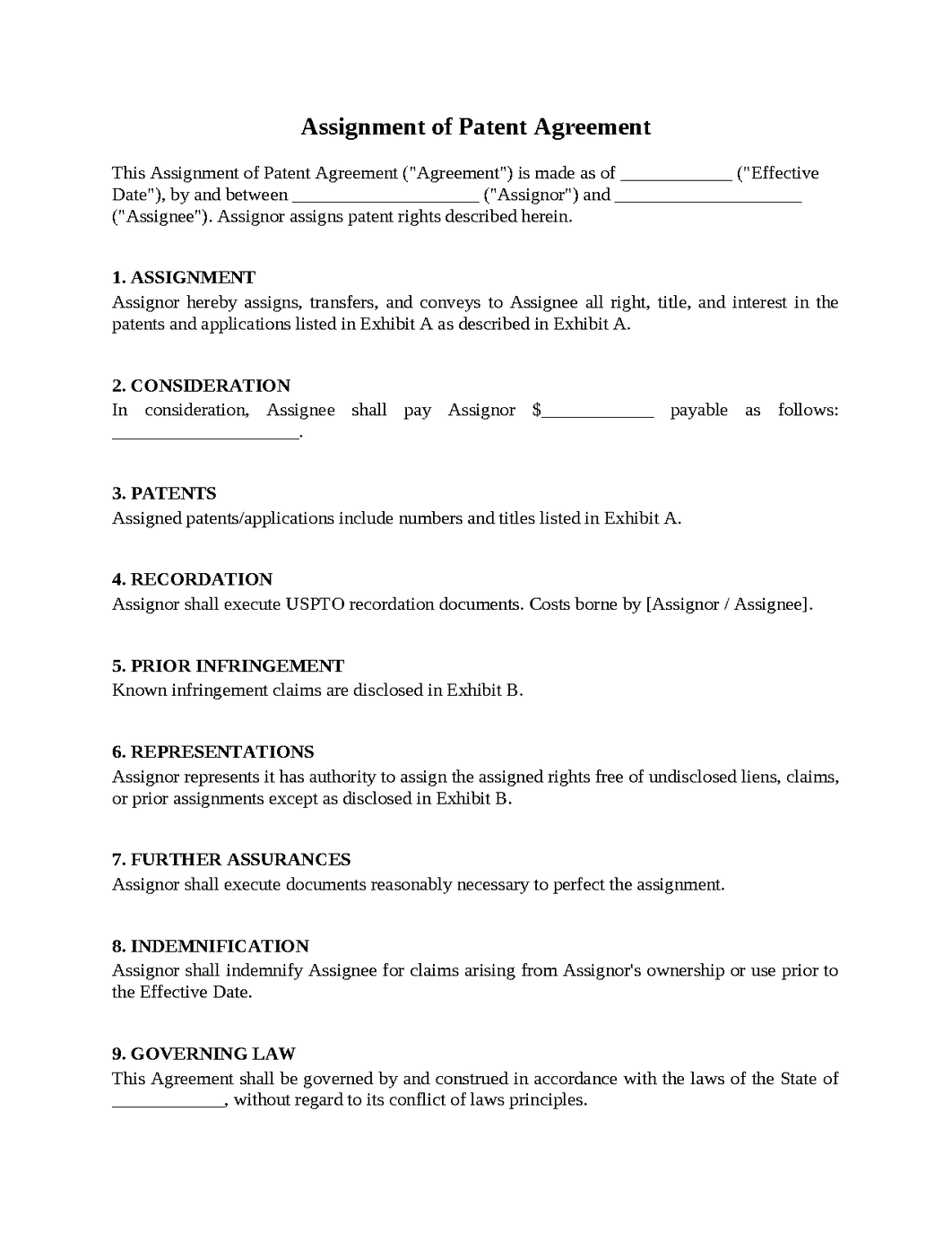
Assignment of Patent Agreement
An Assignment of Patent Agreement is a legal contract used to transfer ownership of a patent or patent rights from one party to another. The party transferring ownership is known as the assignor, while the party receiving ownership is known as the assignee. Patents can represent tremendous value because they provide exclusive rights to inventions, processes, technologies, designs, and innovations. Businesses, inventors, research institutions, universities, investors, and technology companies frequently use Assignment of Patent Agreements during acquisitions, financing transactions, employment relationships, joint ventures, succession planning, and intellectual property sales. Because patents often serve as a company's most valuable assets, disputes regarding ownership can have significant financial consequences. An Assignment of Patent Agreement helps establish who owns the patent, who may enforce it, and who is entitled to benefit from its commercial value. Without proper documentation, ownership questions can emerge years after an invention is created.
An Inventor Leaves the Company and Claims Ownership of the Invention
A small medical device company spends years developing a breakthrough product designed to improve patient outcomes. One of the lead engineers plays a major role in creating the technology and becomes closely associated with the project.
Several years later, the engineer leaves the company and joins a competitor.
Shortly afterward, the former employee begins claiming that they personally own certain patent rights relating to the invention. According to the engineer, the company never obtained a proper assignment transferring ownership of the patent.
The company is stunned.
Management always assumed the invention belonged to the business because development occurred during employment and company resources were used throughout the project. Investors shared the same assumption.
The ownership dispute creates immediate uncertainty. Potential investors begin asking questions. Competitors take notice. Attorneys are hired to review employment agreements, patent filings, and historical records.
The issue becomes especially complicated because the engineer genuinely contributed to the invention and is listed as an inventor on patent applications.
Many companies mistakenly assume that being the employer automatically guarantees patent ownership. In reality, inventorship and ownership are not always the same thing. An inventor may initially own rights unless those rights are properly assigned.
An Assignment of Patent Agreement helps eliminate this uncertainty by documenting the transfer of ownership from the inventor to the company and establishing who controls the patent going forward.
A Startup Cannot Raise Funding Because Patent Ownership Is Unclear
A technology startup develops an innovative manufacturing process with the potential to disrupt an established industry. The founders file patent applications and begin seeking outside investment to scale the business.
Interest from investors is strong.
As part of the due diligence process, however, investors request documentation proving ownership of the patent rights. The founders confidently provide copies of the patent filings.
The investors' attorneys identify a problem almost immediately.
Several inventors contributed to the technology, including a consultant who worked with the company during its early development stages. While the consultant helped create key aspects of the invention, no formal assignment agreement can be located.
Questions arise regarding whether the startup actually owns all of the patent rights necessary to commercialize the technology.
The funding process stalls.
Potential investors become reluctant to commit capital until ownership issues are resolved. The startup must locate the consultant, negotiate an assignment, and address legal concerns before financing can proceed.
This situation occurs frequently in early-stage companies where founders focus heavily on product development and less on documentation. Consultants, advisors, contractors, and outside collaborators may all contribute to inventions without formal ownership agreements being completed.
An Assignment of Patent Agreement helps establish a clear chain of ownership and provides investors with confidence that the company actually owns the intellectual property upon which the business depends.
Two Companies Dispute Ownership After a Joint Development Project
A manufacturing company and an engineering firm enter into a collaborative project to develop a new industrial technology. Both organizations contribute expertise, personnel, and resources to the effort.
The project is successful.
Several patent applications are filed, and the technology shows significant commercial promise. Initially, both companies are focused on development and pay little attention to long-term ownership issues.
As commercialization opportunities emerge, disagreements begin.
Each company believes it should control the patents. The manufacturing company argues that it funded most of the project. The engineering firm points out that many of the technical innovations originated from its personnel.
The relationship deteriorates rapidly.
Potential licensing opportunities are delayed while ownership questions remain unresolved. Customers hesitate to commit to long-term agreements because they are uncertain who controls the technology.
Joint development projects frequently create patent ownership disputes because multiple parties contribute to the invention process. Without clear agreements established at the beginning of the relationship, determining ownership later can become difficult.
What started as a productive collaboration may eventually result in litigation over intellectual property rights worth millions of dollars.
An Assignment of Patent Agreement helps address these concerns by documenting ownership rights clearly and ensuring that all parties understand who controls the resulting patents before disputes arise.
A Business Acquisition Reveals Missing Patent Transfers
A large technology company acquires a smaller software developer whose value is largely based on its patented technology. The acquisition price reflects the assumption that the buyer will receive ownership of all related intellectual property.
During due diligence, attorneys begin reviewing the patent portfolio.
Most records appear complete. However, several critical patents involve inventors who worked for acquired subsidiaries years earlier. Assignment documents are missing for certain patents, and ownership records appear inconsistent.
The buyer becomes concerned.
Without proper assignments, questions may exist regarding whether ownership transferred successfully through multiple acquisitions and corporate restructurings.
The issue threatens to delay the transaction.
Attorneys must review decades of records, trace historical ownership chains, and determine whether corrective assignments are necessary. The seller scrambles to locate documentation that may no longer exist.
Patent ownership issues frequently surface during acquisitions because intellectual property portfolios often evolve over many years. Mergers, restructurings, and employee turnover can create gaps in documentation that remain unnoticed until a major transaction occurs.
An Assignment of Patent Agreement helps preserve a clear chain of title and provides evidence supporting ownership throughout the life of the patent.
An Inventor Sells Patent Rights and Later Regrets the Decision
An independent inventor develops a specialized agricultural technology and obtains patent protection. Shortly afterward, a larger company offers to purchase the patent rights outright.
The inventor accepts the offer.
At the time, the payment appears generous and provides immediate financial security. The inventor signs documents transferring ownership and moves on to other projects.
Several years later, the patented technology becomes enormously successful.
The acquiring company generates millions of dollars in revenue from products based on the invention. Industry publications highlight the innovation, and competitors begin licensing the technology.
The inventor watches from the sidelines and begins questioning whether selling the patent was the right decision.
While the inventor remains proud of the creation, they no longer control the patent, receive licensing revenue, or participate in future decisions regarding the technology.
Patent assignments are often permanent transfers of ownership. Once rights are assigned, the inventor generally loses the ability to control or benefit from future commercialization unless specific rights were retained in the transaction.
This reality surprises many inventors who focus primarily on immediate financial considerations rather than long-term value.
An Assignment of Patent Agreement helps ensure that both parties understand exactly what rights are being transferred and whether any future interests, royalties, or retained rights will remain with the inventor.
Patents often represent some of the most valuable assets a business or inventor can own. Whether the technology is being transferred as part of an employment relationship, financing transaction, joint venture, acquisition, or intellectual property sale, ownership must be documented carefully. Questions regarding inventorship, commercialization rights, investor confidence, acquisition readiness, and future revenue frequently arise when patent ownership changes hands. An Assignment of Patent Agreement provides a structured framework for transferring those rights and establishing a clear chain of ownership. When prepared properly, it can help reduce disputes, facilitate business transactions, and provide inventors, companies, investors, and courts with confidence regarding who owns and controls the patented technology.
:::

Get started with Upsign today!
Easily send, sign and track your documents