

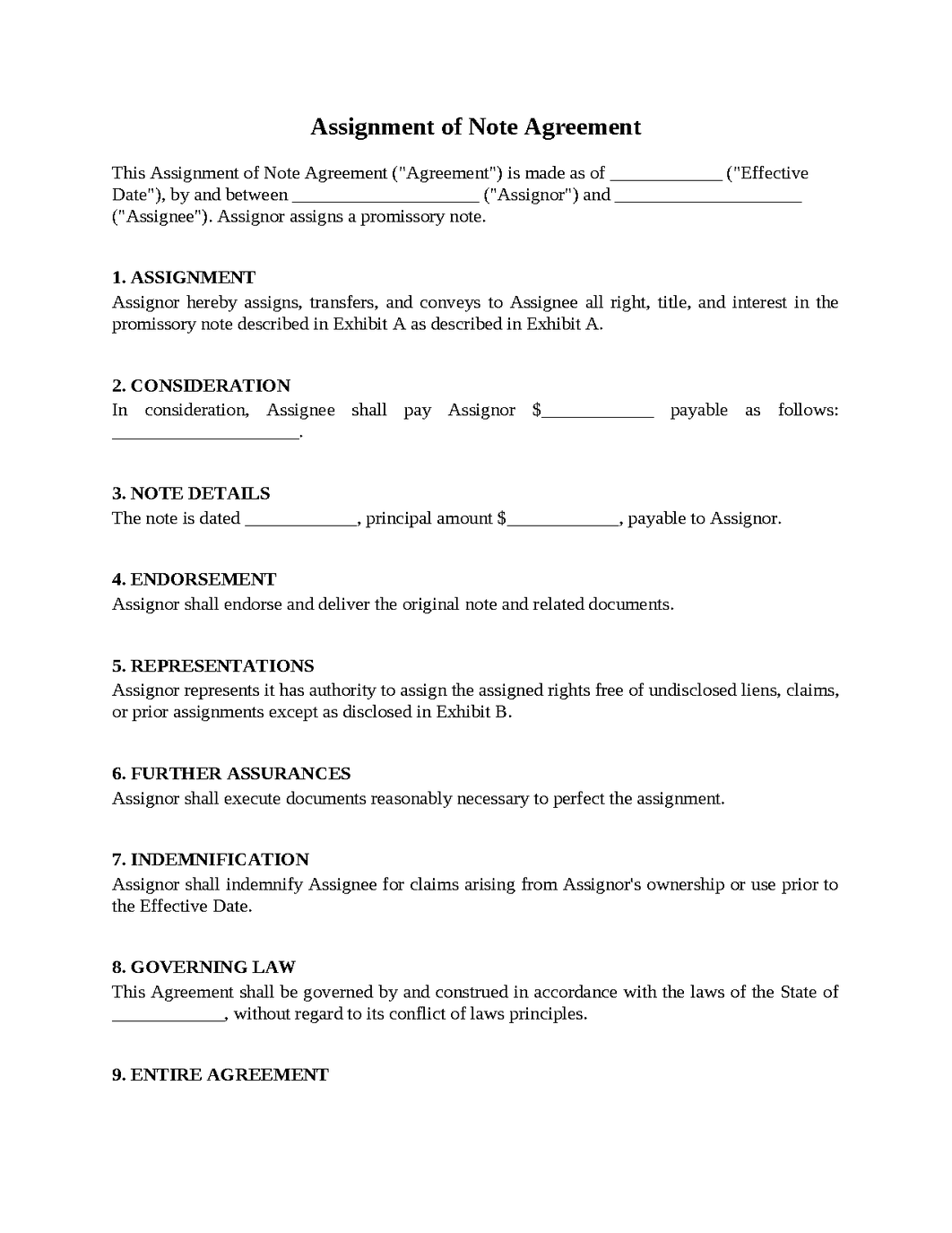
Assignment of Note Agreement
An Assignment of Note Agreement is a legal contract used when ownership of a promissory note is transferred from one party to another. The party transferring the note is known as the assignor, while the recipient is known as the assignee. Promissory notes are commonly used in business loans, seller-financed real estate transactions, private lending arrangements, equipment financing, and commercial transactions. Because a promissory note represents a borrower's promise to repay a debt, ownership of the note can have substantial financial value. Investors frequently purchase notes to generate income, lenders often sell notes to improve liquidity, and businesses may transfer notes as part of larger transactions. An Assignment of Note Agreement helps establish who owns the note, who is entitled to receive payments, and what rights are being transferred. Without proper documentation, disputes regarding ownership, collection authority, and payment rights can emerge long after the assignment occurs.
The Borrower Continues Paying the Original Note Holder
A private lender provides a $250,000 loan to a small business owner and receives a promissory note documenting the repayment terms. Several years later, the lender decides to sell the note to an investor in exchange for an immediate lump-sum payment.
The investor purchases the note expecting to receive future monthly payments from the borrower.
Unfortunately, the borrower is never notified that ownership of the note has changed. As a result, monthly payments continue being sent to the original lender.
The investor quickly notices that expected payments are not arriving. The original lender insists the payments were received by mistake and promises to forward them. Meanwhile, the borrower becomes confused after receiving conflicting communications from two different parties claiming an interest in the loan.
What should have been a straightforward investment transaction turns into an accounting and administrative problem.
To help avoid this situation, an Assignment of Note Agreement should clearly identify the note being transferred, establish the effective date of the assignment, require notice to the borrower, and specify how payments mistakenly sent to the assignor will be handled after the transfer. Including these provisions helps ensure that everyone understands who owns the note and who should receive future payments.
The New Owner Cannot Prove Ownership of the Note
A real estate investor purchases a portfolio of seller-financed promissory notes from a retiring lender. The investor pays a substantial amount of money and assumes ownership has transferred properly.
Several years later, one of the borrowers defaults.
The investor begins collection efforts and eventually files a lawsuit seeking repayment. During the litigation, the borrower demands proof that the investor actually owns the note.
At first, the request seems simple. However, when attorneys begin reviewing records, they discover that documentation is incomplete. Some assignment records are missing, supporting documents are difficult to locate, and ownership history is not as clear as anyone expected.
The borrower argues that the investor lacks authority to enforce the debt because ownership cannot be established with certainty.
The court requires additional evidence before allowing the case to proceed.
Months of delays follow while attorneys reconstruct transaction histories and search for historical records. Legal expenses increase rapidly, and collection efforts remain stalled.
Ownership disputes like this are surprisingly common when notes are bought and sold multiple times over many years. A note may pass through several owners, and gaps in documentation can create uncertainty regarding who possesses enforcement rights.
To reduce this risk, an Assignment of Note Agreement should clearly identify the note being assigned, reference the original loan documents, require delivery of the original note whenever possible, and establish a documented chain of ownership. Proper recordkeeping can make the difference between a successful enforcement action and a costly dispute.
The Buyer Discovers the Note Is Worth Less Than Expected
A private investor purchases a promissory note secured by a small commercial property. The borrower has made timely payments for several years, and the note appears to be a reliable income-producing asset.
The investor reviews payment histories and feels confident about the purchase.
Several months after closing, however, the borrower begins missing payments. The investor investigates further and discovers that the borrower's business has been struggling for quite some time.
Additional problems emerge.
The collateral securing the note is worth less than originally believed. Property values have declined, deferred maintenance has accumulated, and the borrower's financial condition is deteriorating.
The investor becomes frustrated and argues that important information should have been disclosed before the sale.
The seller responds that the buyer had an opportunity to conduct due diligence and that future performance was never guaranteed.
Disputes like this frequently arise because the value of a note depends on much more than the face amount shown on paper. Borrower credit quality, collateral value, payment history, and market conditions all affect collectability.
To help avoid these problems, an Assignment of Note Agreement should include representations regarding payment status, known defaults, collateral information, pending disputes, and other material facts affecting the note. The agreement should clearly allocate risk and establish remedies if material information proves inaccurate.
The Same Note Is Sold to Multiple Parties
A lender experiences cash flow challenges and begins raising money through several financing arrangements.
In one transaction, the lender pledges a portfolio of notes as collateral for a loan. Months later, management enters into another deal involving some of the same notes.
Initially, nobody realizes there is a problem.
The issue surfaces when a borrower requests a payoff statement. Two separate parties claim ownership of the same note and each insists that future payments belong to them.
The borrower becomes confused and refuses to make payment until ownership is clarified.
Both claimants begin asserting legal rights. Attorneys become involved, transaction records are reviewed, and allegations of improper transfers quickly follow.
The resulting dispute becomes expensive for everyone involved.
Competing ownership claims can significantly delay collections and undermine confidence in the transaction. Investors may become reluctant to purchase notes from sellers who cannot clearly establish ownership.
To reduce the likelihood of this problem, an Assignment of Note Agreement should include representations confirming ownership, disclose existing liens or security interests, identify prior transfers, and require the assignor to indemnify the assignee against competing claims. Thorough due diligence and documentation are critical whenever notes are transferred.
The New Owner Assumes They Can Change the Borrower's Obligations
An investor purchases several promissory notes from a private lender. The investor's goal is to generate income from future loan payments.
After reviewing the portfolio, the investor decides that some borrowers should be paying higher interest rates.
The investor contacts several borrowers and proposes modifications to the repayment terms. Some borrowers are asked to provide additional collateral, while others are encouraged to shorten repayment schedules.
The borrowers object immediately.
They explain that the terms of the notes were negotiated years earlier and that ownership changes do not automatically permit modifications.
The investor is surprised.
From the investor's perspective, purchasing the notes should include broad authority to manage the investments as desired. The borrowers point out that the notes remain governed by the original agreements.
The misunderstanding creates tension and damages borrower relationships.
This issue occurs regularly among inexperienced note purchasers who fail to appreciate the distinction between ownership of a note and the ability to rewrite its terms.
To prevent these disputes, an Assignment of Note Agreement should clearly define the rights being transferred. The agreement should explain whether the assignee receives servicing authority, modification rights, settlement authority, or only the right to receive payments under the existing note. Clear drafting helps prevent unrealistic expectations after the transfer is completed.
Promissory notes are valuable financial assets that are frequently bought, sold, financed, and transferred in a variety of commercial and investment transactions. However, note assignments can create significant challenges involving borrower communications, ownership disputes, valuation concerns, competing claims, and enforcement authority. An Assignment of Note Agreement provides a structured framework for documenting these transfers and clarifying the rights and obligations of everyone involved. When drafted carefully, it can help reduce disputes, facilitate transactions, and provide assignors, assignees, borrowers, and future investors with confidence regarding ownership and collection rights associated with the note.
:::

Get started with Upsign today!
Easily send, sign and track your documents