

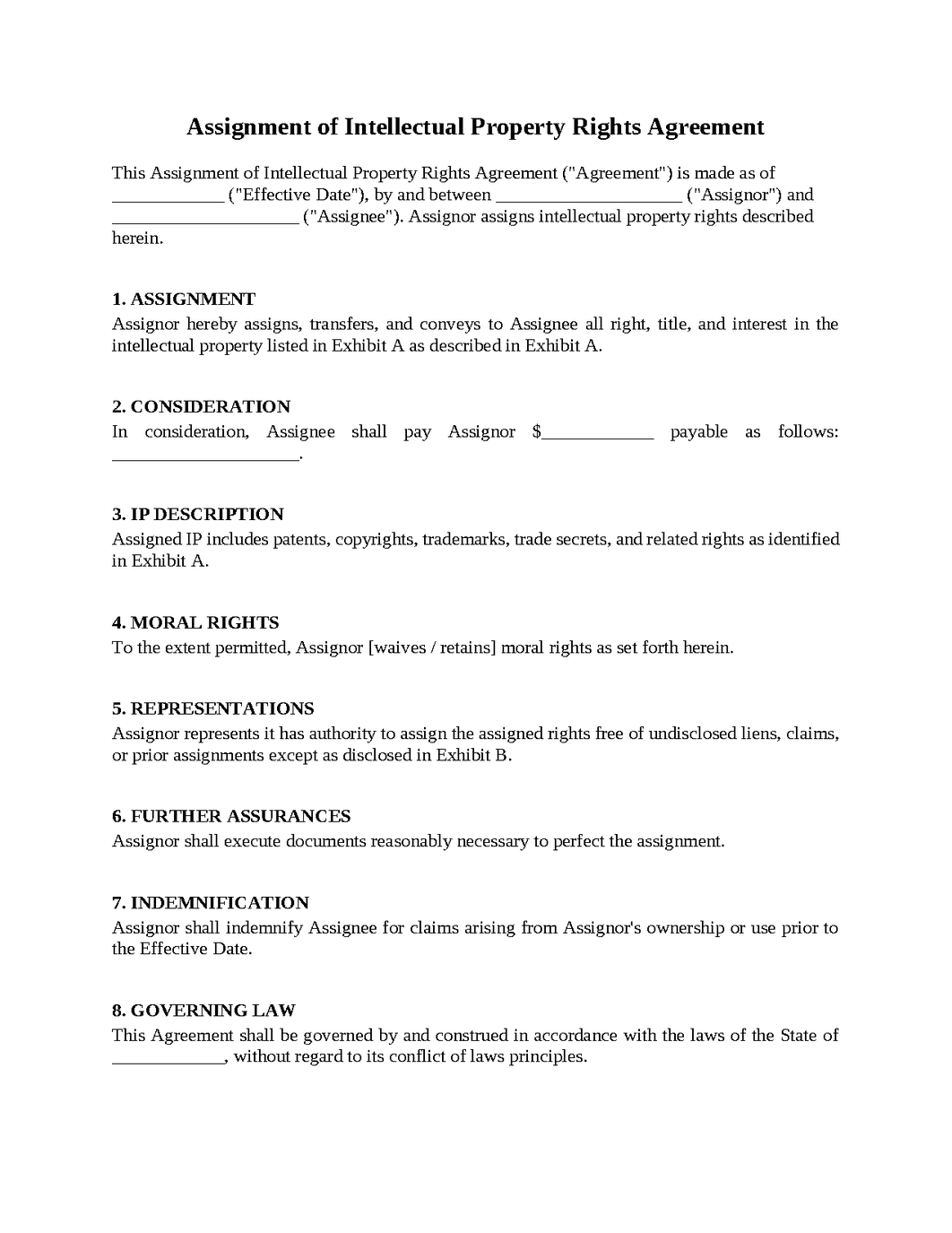
Assignment of Intellectual Property Rights Agreement
An Assignment of Intellectual Property Rights Agreement is a legal contract used when a person or business transfers ownership of intellectual property rights to another party. The party transferring the rights is known as the assignor, while the recipient is known as the assignee. Intellectual property rights can include patents, copyrights, trademarks, trade secrets, software code, inventions, designs, domain names, proprietary processes, customer-facing content, and other intangible assets. Businesses frequently use Assignment of Intellectual Property Rights Agreements during acquisitions, employment relationships, contractor engagements, startup financing transactions, technology transfers, joint ventures, and succession planning. Because intellectual property often represents a company's most valuable asset, ownership disputes can create significant legal and financial consequences. An Assignment of Intellectual Property Rights Agreement helps establish who owns the intellectual property, what rights are being transferred, and what obligations remain after the transfer is completed.
A Company Pays for Development Work but Never Receives Ownership
A software startup hires an independent developer to build a proprietary customer portal. The project takes nearly a year to complete and ultimately becomes a core component of the company's product offering.
The startup pays every invoice on time and assumes ownership of the software automatically belongs to the company.
Several years later, the startup enters acquisition discussions with a larger technology firm.
During due diligence, the buyer requests documentation proving ownership of all intellectual property associated with the platform. The startup provides invoices, contracts, and payment records showing that the developer was compensated fully.
The buyer's attorneys immediately identify a problem.
While the documents prove the developer was paid, they do not clearly transfer ownership of the intellectual property. Under applicable law, the developer may still own important portions of the code despite having been compensated for the work.
The acquisition stalls while the parties attempt to locate the developer and obtain corrective documentation.
What appeared to be a technical paperwork issue suddenly threatens a multimillion-dollar transaction.
To help avoid this problem, an Assignment of Intellectual Property Rights Agreement should clearly identify all intellectual property being transferred, state that ownership transfers upon creation or execution of the agreement, and require the assignor to cooperate with future filings or documentation requests. The agreement should also address derivative works, updates, enhancements, and future improvements so ownership remains clear as the intellectual property evolves.
Multiple Contributors Claim Ownership of the Same Asset
A medical technology company develops a new diagnostic platform over several years. Employees, consultants, engineers, researchers, and outside specialists all contribute to different aspects of the technology.
The project is highly successful.
As commercialization efforts begin, questions emerge regarding ownership of certain inventions, software components, and technical designs.
One consultant claims ownership of a key process developed during the project. Another contributor argues that portions of the technology were created independently before joining the effort.
Management is surprised.
The company assumed that because everyone worked toward a common goal, ownership would be straightforward. Instead, attorneys must determine who created what, when the work was performed, and whether ownership was ever assigned properly.
The uncertainty creates concerns among investors and potential licensing partners.
Intellectual property disputes involving multiple contributors are common because innovation rarely occurs through the efforts of a single individual. Without clear assignment documents, competing ownership claims can arise years after development is completed.
To reduce these risks, an Assignment of Intellectual Property Rights Agreement should specifically identify contributors, describe the intellectual property being assigned, include representations regarding ownership, and require the assignor to confirm that no third parties retain competing rights. The agreement should also address prior inventions and pre-existing intellectual property that are excluded from the transfer.
The Buyer Assumes Trade Secrets Are Included
A manufacturing company acquires a competitor's proprietary production technology through an intellectual property transaction.
The agreement references patents, technical drawings, engineering specifications, and software systems associated with the manufacturing process.
After closing, the buyer attempts to implement the technology.
Management quickly discovers that many of the most valuable aspects of the process are not contained in patents or written documents. Instead, critical information exists as trade secrets known only to certain employees.
Production efficiency suffers because important knowledge was never transferred.
The seller insists that only specifically identified intellectual property rights were included in the transaction. The buyer argues that the practical value of the technology depends on the unwritten know-how associated with it.
The disagreement becomes expensive and disruptive.
This issue occurs frequently because intellectual property often includes both formal rights and informal knowledge. Parties may focus heavily on patents, copyrights, and trademarks while overlooking confidential processes and institutional expertise.
To avoid these problems, an Assignment of Intellectual Property Rights Agreement should clearly define whether trade secrets, know-how, confidential information, documentation, training materials, and proprietary processes are included in the transfer. The agreement should also establish procedures for transferring knowledge necessary to use the intellectual property effectively.
The Assignor Continues Using the Intellectual Property After the Sale
A design agency develops a highly recognizable brand identity for its own business and later sells the intellectual property rights to a larger marketing organization as part of an acquisition.
The buyer expects to become the exclusive owner of the intellectual property.
Several months after closing, the former owners launch a new venture.
Although they do not use the exact same branding, they begin using designs, content, and marketing materials that are substantially similar to the assets that were sold.
The buyer becomes concerned.
Customers begin confusing the two businesses. Online materials appear related. The value of the intellectual property purchased in the transaction starts to erode.
The former owners argue that they are merely using concepts and ideas they helped create. The buyer believes the conduct violates the spirit and purpose of the sale.
Disputes like this are common when intellectual property transfers are not accompanied by clear restrictions regarding future use.
To reduce these risks, an Assignment of Intellectual Property Rights Agreement should specify whether the assignor retains any rights to use the intellectual property after closing. The agreement should address future use restrictions, license-back arrangements, derivative works, and obligations to avoid confusingly similar uses that could undermine the value of the transferred rights.
An Acquisition Reveals Missing Ownership Records
A private equity firm acquires a software company whose value depends heavily on its intellectual property portfolio.
The company owns software applications, trademarks, copyrights, customer-facing content, proprietary databases, and patented technologies.
During due diligence, attorneys begin reviewing ownership records.
Most documentation appears complete, but several important gaps emerge. Certain contractor agreements cannot be located. Some intellectual property was developed through acquired companies years earlier. Several assignments were never recorded properly.
The private equity firm becomes concerned.
Without a clear chain of ownership, enforcing intellectual property rights may become more difficult. Future acquisitions, financing transactions, licensing deals, and litigation efforts could all be affected.
The closing timeline begins slipping as lawyers attempt to reconstruct years of ownership history.
What seemed like a mature intellectual property portfolio suddenly contains significant uncertainty.
To avoid these issues, an Assignment of Intellectual Property Rights Agreement should create a detailed ownership record, identify the specific intellectual property being transferred, require delivery of supporting documentation, and obligate the assignor to assist with future filings, registrations, and ownership confirmations. Maintaining a clear chain of title is often just as important as the intellectual property itself.
Intellectual property rights frequently represent the most valuable assets a business owns. Whether those rights involve software, inventions, trademarks, copyrights, trade secrets, proprietary processes, or other intangible assets, ownership must be documented carefully. An Assignment of Intellectual Property Rights Agreement provides a structured framework for transferring those rights and clarifying the expectations of everyone involved. When drafted properly, it can help reduce ownership disputes, support future business transactions, protect valuable innovations, and provide confidence regarding who owns and controls the intellectual property going forward.
:::

Get started with Upsign today!
Easily send, sign and track your documents