

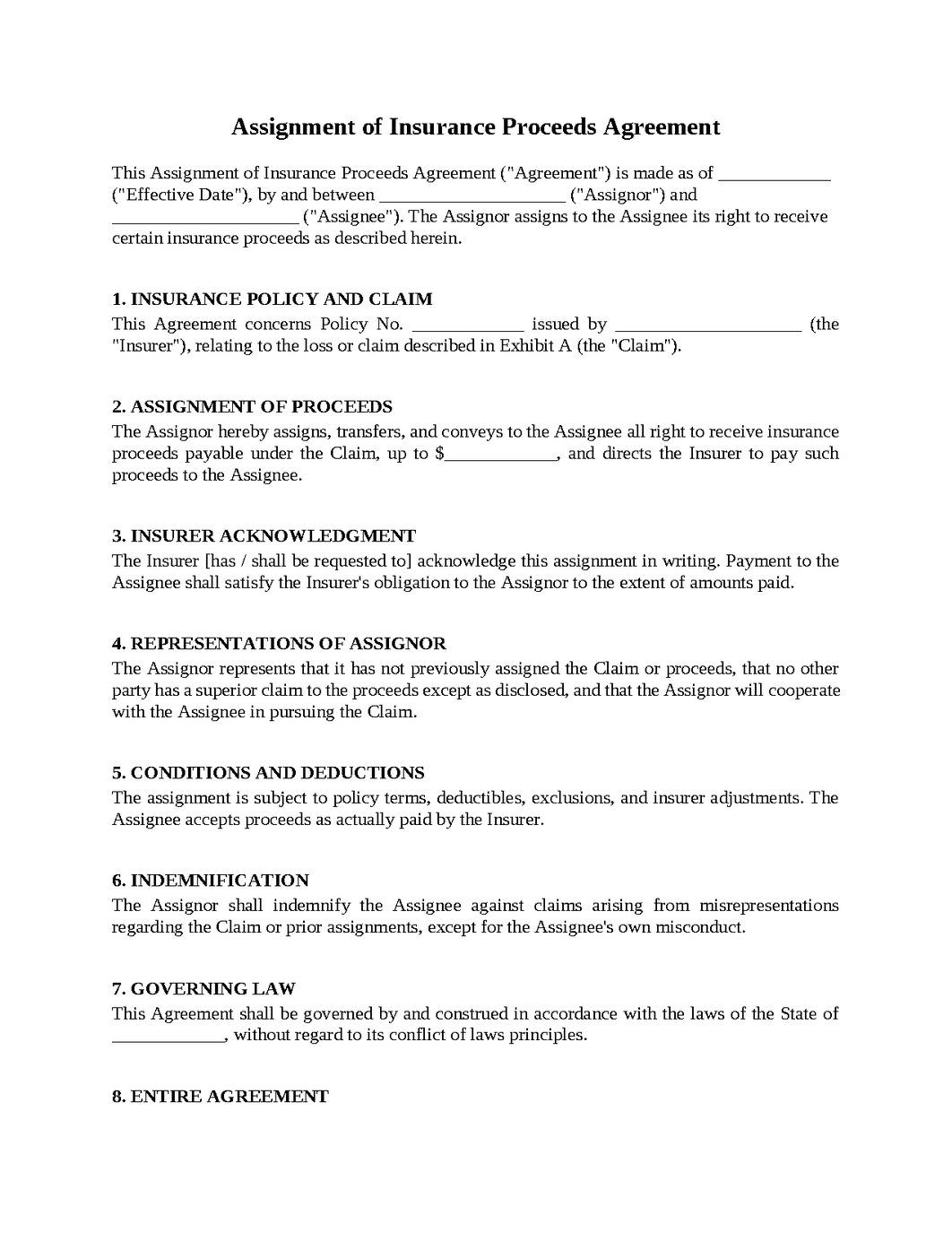
Assignment of Insurance Proceeds Agreement
An Assignment of Insurance Proceeds Agreement is a legal contract used to transfer the right to receive insurance claim payments from one party to another. The party transferring the right is known as the assignor, while the party receiving the right to payment is known as the assignee. These agreements are commonly used in construction projects, property restoration claims, lender transactions, business financing arrangements, healthcare claims, and commercial insurance matters. Insurance proceeds can represent significant sums of money, particularly after property damage, business interruptions, natural disasters, or major liability claims. Because multiple parties often have financial interests in the insurance recovery, disputes can arise regarding who is entitled to receive the proceeds. An Assignment of Insurance Proceeds Agreement helps clarify ownership of those payment rights and establishes the terms under which the assignment occurs.
A Property Owner Hires a Contractor but the Insurance Check Goes Elsewhere
A homeowner suffers significant damage after a pipe bursts during the winter. Floors are ruined, walls must be repaired, and large portions of the home require reconstruction.
The homeowner hires a restoration contractor who agrees to begin work immediately, even before the insurance claim is fully processed.
To give the contractor confidence that payment will be available, the homeowner assigns the right to receive certain insurance proceeds related to the repair work.
Months later, the insurance company approves the claim and issues payment.
Unfortunately, the insurance adjuster sends the check directly to the homeowner rather than the contractor. The homeowner deposits the funds and uses a portion of the money for unrelated expenses.
The contractor eventually completes the repairs but discovers there is not enough money remaining to pay the invoice in full.
What began as a routine insurance restoration project quickly turns into a payment dispute.
To reduce the likelihood of this problem, an Assignment of Insurance Proceeds Agreement should clearly identify the claim, specify which proceeds are being assigned, require notice to the insurance carrier, and establish procedures for handling payments that are mistakenly sent to the assignor after the assignment becomes effective.
A Mortgage Lender and Contractor Both Claim the Same Insurance Money
A commercial building suffers extensive fire damage. The property owner files a claim under the building's insurance policy and begins planning repairs.
A restoration contractor agrees to perform the reconstruction work and receives an assignment of insurance proceeds as security for payment.
Several months later, the insurance company approves a substantial claim payment.
Before the funds are distributed, however, the property's mortgage lender asserts its own rights to the insurance proceeds under the loan documents. According to the lender, any insurance recovery must first be used to protect the lender's collateral interest in the property.
The contractor disagrees.
The contractor argues that it performed the work that restored the property and therefore should be paid from the insurance proceeds.
The property owner is caught in the middle. Both parties claim entitlement to the same funds, and the insurance company becomes reluctant to release payment until ownership issues are resolved.
Disputes like this occur because insurance proceeds often attract competing claims. Property owners, lenders, contractors, landlords, tenants, and other stakeholders may all have legitimate interests in the recovery.
To help avoid these conflicts, an Assignment of Insurance Proceeds Agreement should disclose existing lender interests, address priority issues, and clarify whether lender approval or consent is required before the assignment becomes effective.
The Insurance Company Challenges the Assignment
A manufacturing company suffers a major equipment failure that interrupts operations for several months. The company files a business interruption claim under its commercial insurance policy.
While waiting for the claim to be resolved, the company obtains emergency financing from a private lender.
As part of the financing arrangement, the company assigns a portion of the anticipated insurance proceeds to the lender.
The lender expects repayment directly from the future claim payment.
When the insurance carrier learns about the assignment, questions immediately arise.
The insurer points to policy provisions restricting assignments or requiring notice before certain rights may be transferred. The lender insists that the assignment is valid and enforceable.
The dispute delays the claim process and creates uncertainty regarding who should ultimately receive payment.
Insurance policies often contain assignment-related provisions that many parties overlook. Some distinguish between assigning policy rights before a loss and assigning claim proceeds after a loss. Others impose notice requirements or other procedural conditions.
To minimize these risks, an Assignment of Insurance Proceeds Agreement should address policy restrictions directly, require cooperation from the assignor, and ensure that all necessary notices and approvals are obtained before the parties rely on the assignment.
A Business Sale Includes an Ongoing Insurance Claim
A regional distribution company agrees to sell its operations to a larger competitor. During due diligence, the buyer discovers that the seller has a pending insurance claim arising from storm damage that occurred months earlier.
The claim has not yet been resolved, but everyone expects a substantial payment.
The parties quickly realize that an important question must be answered: Who gets the insurance money after the sale closes?
The seller argues that the damage occurred before the transaction and therefore the insurance proceeds should belong to the seller.
The buyer disagrees. Once the acquisition is completed, the buyer will own the affected facilities and may bear future repair obligations.
Negotiations become complicated because the insurance claim represents a significant asset.
Without a clear agreement, both parties risk future disputes after the transaction closes.
Situations like this are common in mergers, acquisitions, and asset sales where unresolved insurance claims exist at the time ownership changes hands.
To avoid confusion, an Assignment of Insurance Proceeds Agreement should identify the specific claim being transferred, define which proceeds belong to which party, and establish responsibilities for pursuing and administering the claim after closing.
The Claim Produces Less Money Than Expected
A healthcare provider assigns anticipated insurance proceeds to a lender in exchange for immediate financing. Historical claim data suggests that the insurance recovery will be more than sufficient to satisfy the obligation.
Both parties enter the transaction with confidence.
Months later, however, the insurer denies portions of the claim and approves a payment that is significantly smaller than expected.
The lender is disappointed because the assigned proceeds are no longer sufficient to cover the amount advanced. The healthcare provider argues that the assignment transferred the proceeds that were ultimately recovered, not a guaranteed payment amount.
The disagreement centers on expectations.
The lender believed the claim would produce a certain level of recovery. The healthcare provider viewed the insurance claim as inherently uncertain.
This type of problem occurs frequently because insurance claims involve variables that neither party fully controls. Coverage disputes, policy exclusions, deductibles, depreciation calculations, and claim adjustments can all affect the final amount paid.
To reduce misunderstandings, an Assignment of Insurance Proceeds Agreement should clearly state whether any recovery amount is guaranteed, allocate the risk of claim reductions, and address what happens if the insurance proceeds are less than anticipated.
Insurance proceeds often represent valuable financial rights that can be assigned for a variety of business and personal reasons. However, ownership of those proceeds can become complicated when lenders, contractors, insurers, property owners, and other parties have competing interests in the same claim. An Assignment of Insurance Proceeds Agreement provides a structured framework for documenting the transfer of payment rights and establishing expectations for everyone involved. When drafted carefully, it can help reduce disputes, clarify priorities, and provide confidence regarding who is entitled to receive insurance proceeds when a claim is ultimately paid.
:::

Get started with Upsign today!
Easily send, sign and track your documents