

Assignment of Domain Name Agreement
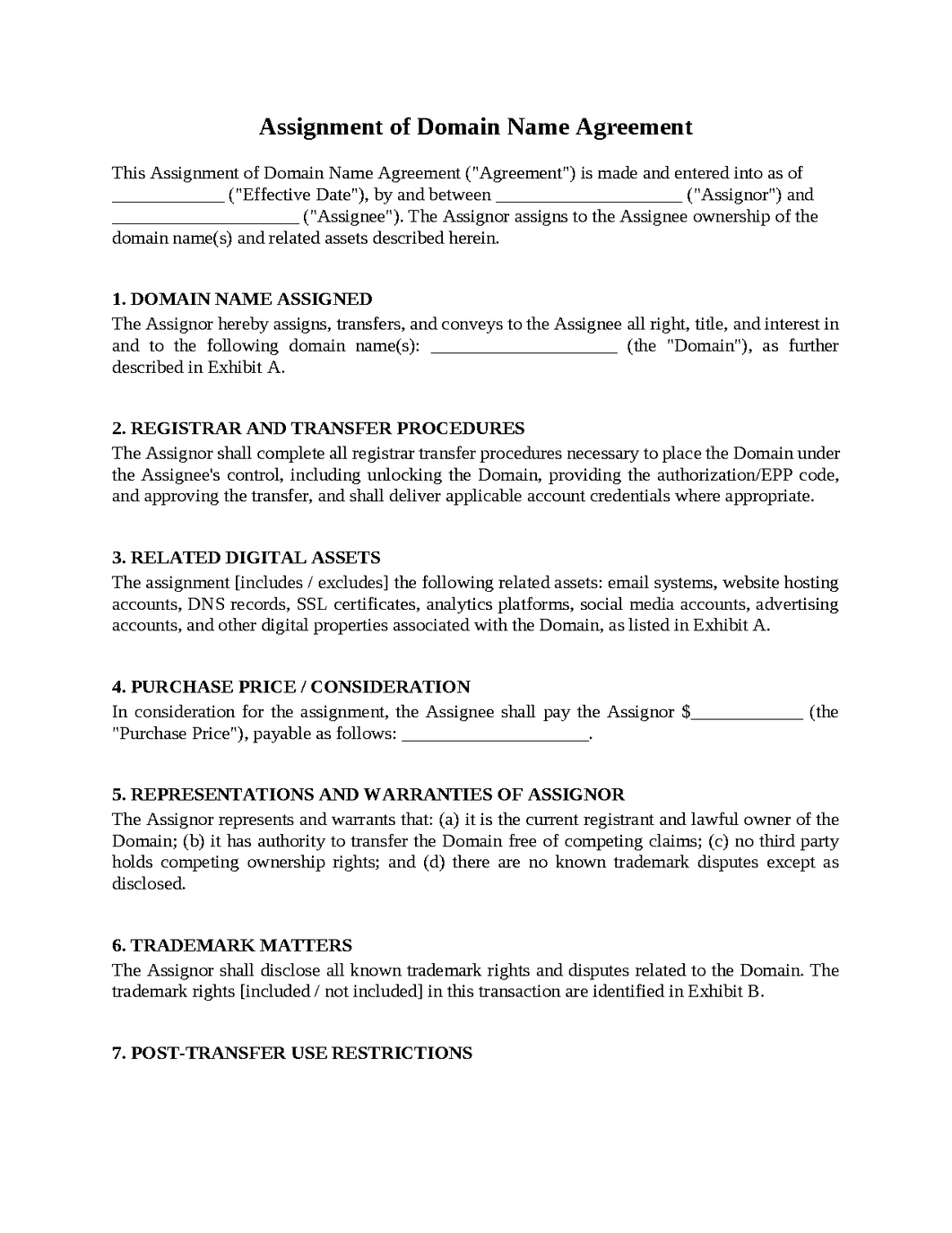
An Assignment of Domain Name Agreement is a legal contract used when ownership of an internet domain name is transferred from one party to another. The party transferring the domain name is known as the assignor, while the recipient is known as the assignee. Domain name assignments commonly occur during business acquisitions, asset sales, brand transfers, intellectual property transactions, startup acquisitions, succession planning, and corporate restructurings. While a domain name may appear to be a simple digital asset, it often serves as the foundation of a company's online presence, marketing efforts, customer communications, and brand identity. Because domain names can be extremely valuable, disputes frequently arise regarding ownership, transfer procedures, associated accounts, trademark rights, and post-transfer usage. An Assignment of Domain Name Agreement helps establish who owns the domain name and what rights are transferred as part of the transaction.
The Business Buys the Brand but Never Receives Control of the Domain
A regional e-commerce company acquires a smaller competitor whose website generates thousands of customer visits each month. One of the most valuable assets involved in the acquisition is the competitor's domain name.
The parties negotiate a purchase agreement and close the transaction successfully.
Management assumes ownership of the domain transferred automatically with the sale.
Several weeks later, the buyer attempts to update website settings and discovers a problem.
The domain remains registered under the former owner's personal account with the domain registrar. Login credentials were never transferred, and the former owner is no longer responding consistently to requests.
The buyer technically purchased the business but cannot fully control the website associated with it.
Marketing campaigns are delayed. Customer communications become difficult. The value of the acquisition begins to suffer.
What appeared to be a simple administrative oversight becomes a significant operational problem.
To help avoid this issue, an Assignment of Domain Name Agreement should identify the specific domain names being transferred, require completion of registrar transfer procedures, provide for the transfer of account credentials where appropriate, and obligate the assignor to cooperate until full control has been transferred successfully.
Multiple Parties Claim Ownership of the Domain Name
A technology startup launches a software platform using a domain name that becomes closely associated with its brand.
Several years later, investors begin preparing the company for acquisition.
During due diligence, attorneys discover conflicting ownership records.
The company's founder originally registered the domain personally before the business was formed. Over time, employees managed the website, contractors maintained hosting services, and the company paid renewal fees.
Everyone assumed the company owned the domain.
When acquisition discussions begin, the founder argues that the domain remains a personal asset because it was never formally transferred. Other stakeholders disagree and point to years of company use and expense payments.
The disagreement creates uncertainty regarding one of the startup's most valuable assets.
Potential buyers become concerned because ownership of the brand's primary online identity is unclear.
Transactions involving domain names frequently uncover informal ownership arrangements that were never documented properly.
To reduce these risks, an Assignment of Domain Name Agreement should contain clear ownership representations, identify the current registrant, confirm authority to transfer the domain, and establish that no third parties possess competing ownership rights or claims.
The Buyer Assumes Related Digital Assets Are Included
A marketing company purchases a valuable domain name associated with a successful online business.
The buyer assumes the transaction includes everything necessary to operate the website.
After closing, however, several unexpected issues arise.
The seller transferred the domain name itself but retained control of related email accounts, website hosting environments, DNS settings, analytics accounts, advertising platforms, social media profiles, and customer databases.
The buyer becomes frustrated.
From management's perspective, ownership of the domain should have included the supporting infrastructure that makes the website function.
The seller disagrees and points to the assignment documents, which reference only the domain name.
The disagreement delays operations and creates unnecessary transition costs.
This issue is common because domain names often function as part of a much larger digital ecosystem.
To avoid these disputes, an Assignment of Domain Name Agreement should clearly identify any related assets being transferred, including email systems, hosting accounts, DNS records, SSL certificates, analytics platforms, social media accounts, advertising accounts, and other digital properties associated with the domain.
The Seller Launches a Competing Website Using a Similar Domain
A business sells ownership of a highly recognizable domain name as part of a broader brand acquisition.
The buyer expects to become the exclusive owner of the online identity associated with the brand.
Several months later, the seller launches a new website using a domain name that differs by only a few characters.
Customers begin visiting the wrong website.
Emails are sent to incorrect addresses. Search engine traffic becomes fragmented. Some customers mistakenly assume the two businesses remain affiliated.
The buyer believes the seller is intentionally benefiting from the goodwill associated with the transferred domain.
The seller argues that the new domain is legally distinct and does not violate the assignment.
The dispute quickly escalates.
Domain name transfers often create conflicts when future usage restrictions are not addressed clearly.
To reduce these risks, an Assignment of Domain Name Agreement should address post-transfer use restrictions, prohibit confusingly similar domain registrations where appropriate, and establish obligations designed to protect the goodwill associated with the transferred domain name.
A Trademark Dispute Emerges After the Transfer
A company acquires a valuable domain name because it aligns perfectly with its branding strategy.
The domain has generated substantial traffic for years and appears highly valuable.
After closing, a third party sends a cease-and-desist letter alleging trademark infringement.
The buyer is surprised.
Although ownership of the domain transferred successfully, questions now arise regarding the relationship between the domain name and existing trademark rights.
The buyer argues that the seller should have disclosed the dispute. The seller insists no formal litigation existed at the time of the assignment.
The disagreement becomes increasingly important because the domain's value depends heavily on the ability to continue using it.
Domain names and trademark rights are often closely connected, but ownership of one does not necessarily guarantee ownership of the other.
To avoid these issues, an Assignment of Domain Name Agreement should require disclosure of known trademark disputes, identify related trademark rights included in the transaction, and contain representations regarding the assignor's authority to transfer the domain free of known claims that could materially affect its value.
Domain names often serve as the digital foundation of modern businesses and can represent significant economic value. Whether transferred through acquisitions, asset sales, branding transactions, or corporate restructurings, ownership and control must be documented carefully. An Assignment of Domain Name Agreement provides a structured framework for transferring those rights and clarifying expectations regarding ownership, digital assets, branding, registrar control, and future use. When drafted properly, it can help reduce disputes, preserve brand value, and provide confidence regarding ownership and control of valuable online assets.

Get started with Upsign today!
Easily send, sign and track your documents