

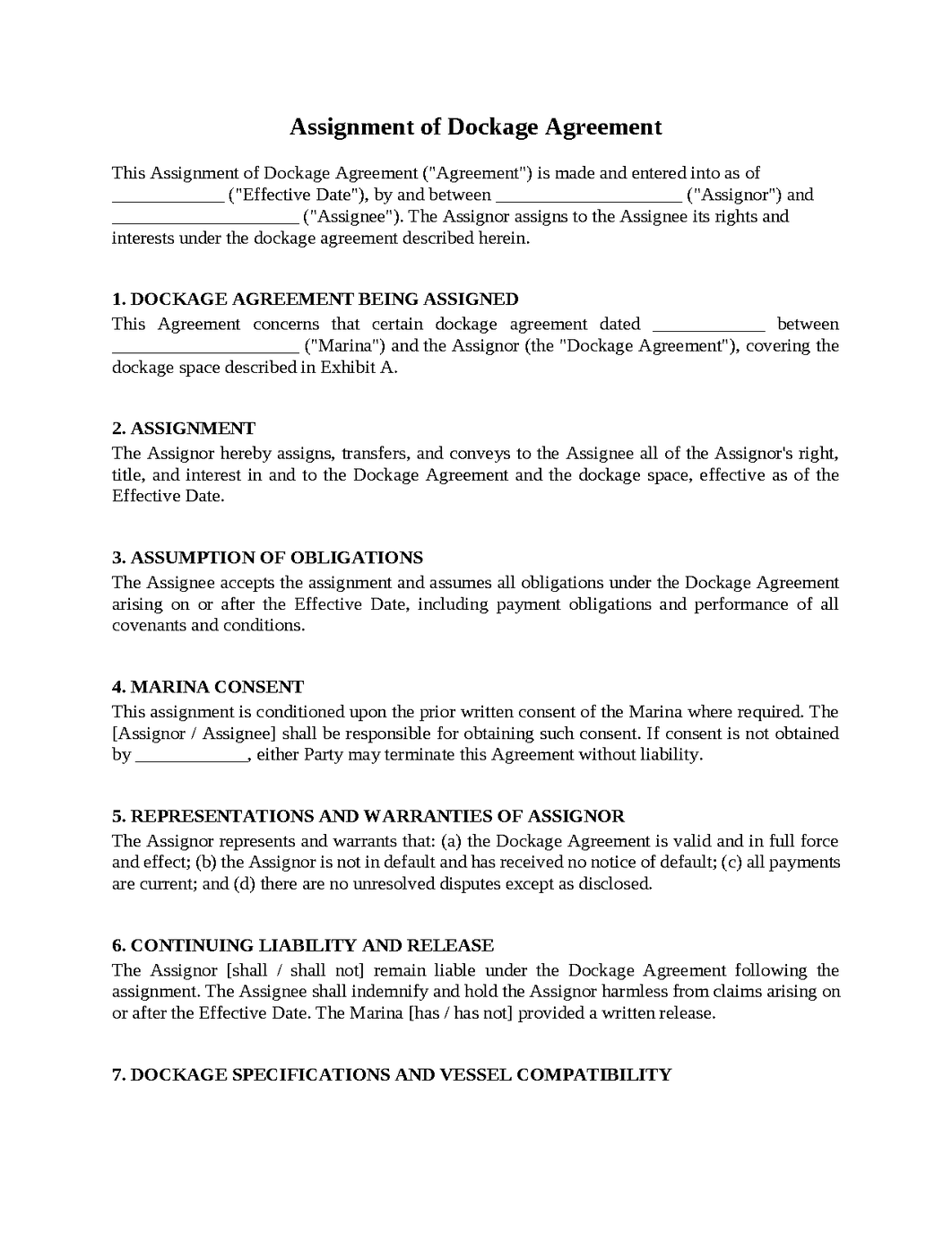
Assignment of Dockage Agreement
An Assignment of Dockage Agreement is a legal contract used when a party transfers its rights and obligations under a dockage agreement to another person or business. The party transferring the dockage rights is known as the assignor, while the party receiving those rights is known as the assignee. Dockage agreements are commonly used by marinas, yacht clubs, waterfront developments, commercial ports, fishing operations, and recreational boat owners. Because desirable dockage locations are often limited in availability and may provide access to utilities, security services, fueling facilities, and protected waterways, dockage rights can have significant value. Disputes frequently arise regarding marina approval requirements, vessel restrictions, payment obligations, maintenance responsibilities, and rights associated with the dockage space. An Assignment of Dockage Agreement helps establish who assumes responsibility for the dockage arrangement and what obligations transfer to the assignee.
The Dockage Rights Are Transferred Without Required Approval
A boat owner leases dockage space at a popular waterfront marina located near a busy coastal destination. The dockage location provides convenient access to fuel services, maintenance facilities, and protected mooring conditions.
After purchasing a larger vessel and relocating to another marina, the owner decides to transfer the dockage agreement to another boater who has been searching for space in the harbor.
The parties negotiate directly and complete the transfer informally. The new boater moves into the dockage space and begins using the marina's facilities. For several months, everything appears to proceed without incident.
Eventually, marina management notices that a different vessel occupies the assigned space. A review of marina records reveals that the dockage agreement prohibits assignments without prior written approval.
No approval was ever requested.
The marina immediately notifies both parties that the transfer violates marina policy. Management raises concerns regarding insurance coverage, vessel specifications, and compliance with marina regulations.
The assignee suddenly faces the possibility of losing access to the dockage space. The assignor faces potential penalties and remains exposed to liability under the original agreement.
To help avoid this problem, an Assignment of Dockage Agreement should identify all consent requirements and make marina approval a condition of the assignment. The agreement should also specify which party is responsible for obtaining consent and what occurs if approval is denied.
The Assignee Discovers Hidden Restrictions on Vessel Use
A recreational boater acquires rights under a dockage agreement because the location appears ideal for a recently purchased vessel.
The dockage space is located near the marina entrance, provides convenient access to amenities, and appears large enough to accommodate the boat comfortably.
Before completing the assignment, however, the assignee does not carefully review the marina rules incorporated into the dockage agreement.
After moving into the space, problems emerge. The marina restricts overnight occupancy, limits liveaboard activities, imposes guest-use restrictions, and prohibits certain types of commercial operations from the dock.
The assignee is surprised because many of these activities were central to plans for using the vessel.
Additional restrictions affect parking access, storage rights, utility usage, and guest privileges. The value of the dockage arrangement is significantly lower than expected.
The assignee argues that these limitations should have been disclosed before the assignment occurred. The assignor responds that the rules were available for review and are standard marina policies.
To reduce these risks, an Assignment of Dockage Agreement should require disclosure of material marina rules, occupancy limitations, commercial-use restrictions, utility policies, and operational requirements that could affect the assignee's intended use of the dockage space.
The Original Dockage Holder Remains Responsible for Future Charges
A fishing charter operator assigns a dockage agreement after relocating operations to a different harbor.
The assignee takes possession of the dockage space and begins operating from the marina. Monthly dockage fees are paid regularly, and the arrangement appears successful.
Several years later, the assignee encounters financial difficulties and stops paying marina charges.
Outstanding dockage fees accumulate rapidly. Utility charges, maintenance assessments, and marina service fees remain unpaid.
The marina contacts the original dockage holder and demands payment.
The assignor is shocked.
Having left the marina years earlier, the assignor assumed all obligations ended when the dockage rights were transferred. The marina points to provisions in the dockage agreement stating that the original holder remains liable unless formally released.
The assignor now faces unexpected financial exposure for obligations created by another party.
The situation becomes even more frustrating because the assignor has no practical control over the dockage space or the assignee's conduct.
To avoid these problems, an Assignment of Dockage Agreement should address continuing liability directly. The agreement should specify whether the assignor remains responsible after the transfer and require the assignee to indemnify the assignor against future marina-related claims. Whenever possible, the assignor should also obtain a written release from the marina.
The Assignee Learns the Dockage Space Cannot Accommodate the Vessel
A yacht owner assumes a dockage agreement for a waterfront slip that appears suitable based on photographs and general marina descriptions.
The vessel's dimensions are discussed briefly during negotiations, but no detailed measurements are reviewed.
After taking possession, the assignee discovers that the vessel's beam exceeds marina guidelines for the assigned space. Dock access becomes difficult, neighboring vessels have limited maneuvering room, and marina management expresses concern about safety.
Additional issues emerge when electrical service, water connections, and mooring equipment prove inadequate for the vessel's requirements.
The assignee is frustrated because relocation options within the marina are limited and alternative dockage space is scarce.
The marina insists that compliance with vessel restrictions remains the responsibility of the dockage holder.
What initially appeared to be a valuable assignment now creates operational headaches and unexpected expenses.
To help prevent these disputes, an Assignment of Dockage Agreement should identify slip dimensions, vessel restrictions, utility capacities, and marina requirements. The agreement should also confirm that the assignee has independently verified compatibility between the vessel and the assigned dockage space.
A Storm Damage Claim Creates a Complex Dispute
A boat owner assumes rights under a dockage agreement at a marina located in a region frequently affected by seasonal storms.
Several months after the assignment, severe weather strikes the harbor. High winds and rough conditions cause substantial damage to multiple vessels and portions of the marina infrastructure.
During the aftermath, questions arise regarding the condition of dock structures, mooring equipment, and safety systems.
The assignee argues that certain deficiencies existed before the assignment occurred and contributed to the damage. The assignor insists that the dockage space was transferred in acceptable condition.
Marina management becomes involved because neighboring vessel owners file claims for damage. Insurance companies launch investigations, and attorneys begin reviewing maintenance records and assignment documents.
The financial consequences quickly become significant.
What began as a simple transfer of dockage rights evolves into a multi-party dispute involving property damage, insurance coverage, and contractual liability.
To reduce these risks, an Assignment of Dockage Agreement should allocate responsibility for dockage conditions, maintenance obligations, insurance requirements, and losses occurring after the transfer date. The agreement should also document the condition of the dockage facilities before the assignment becomes effective.
Dockage rights can be valuable assets, particularly in locations where marina space is limited and demand is high. However, transferring those rights can create significant challenges involving marina approvals, vessel restrictions, continuing liability, operational limitations, and damage-related claims. An Assignment of Dockage Agreement provides a structured framework for documenting these transfers and clarifying expectations regarding future rights and responsibilities. When drafted carefully, it can help reduce disputes, preserve valuable waterfront access, and provide confidence regarding the successful transfer of dockage rights and obligations.

Get started with Upsign today!
Easily send, sign and track your documents