

Assignment of Boat Slip Agreement
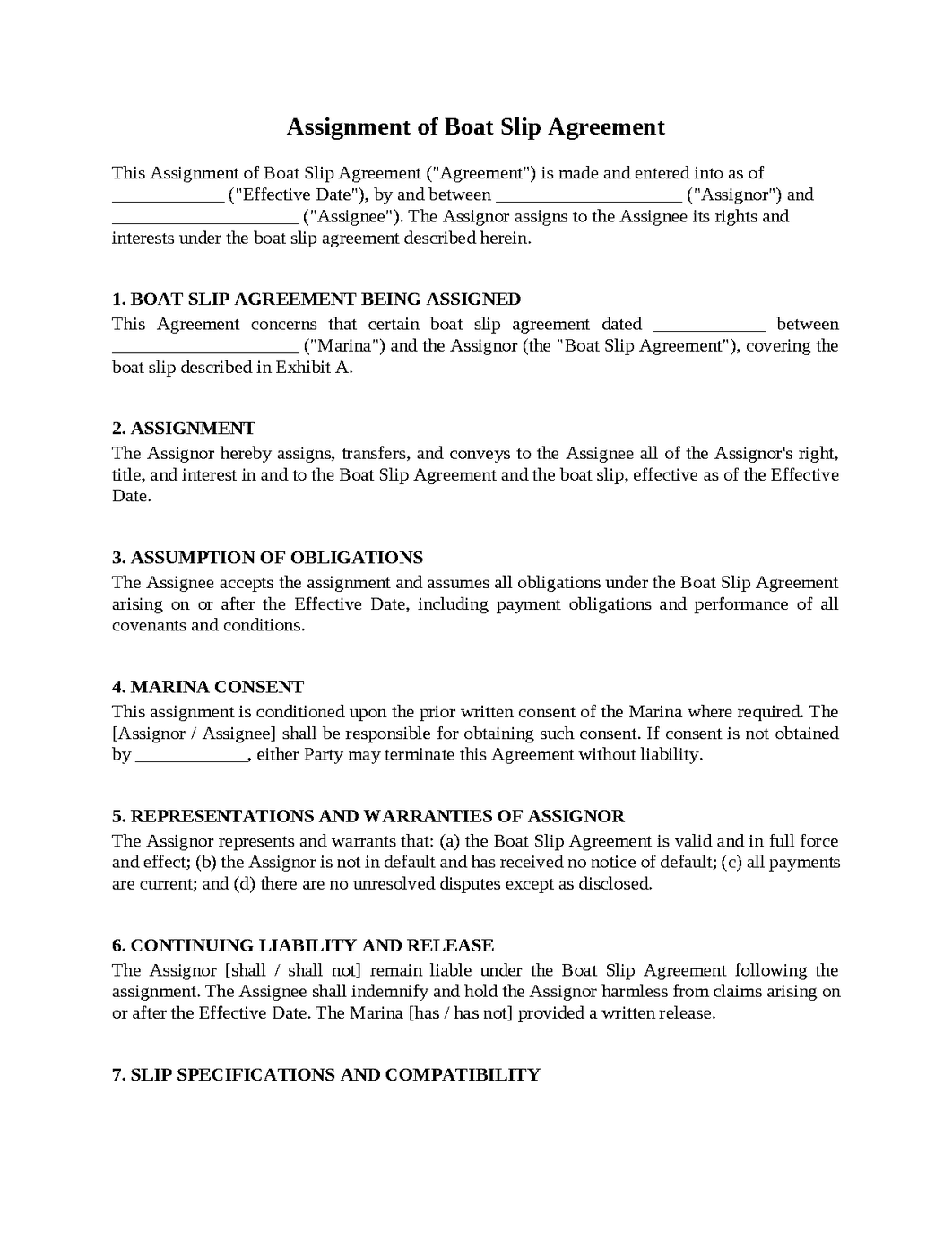
An Assignment of Boat Slip Agreement is a legal contract used when a party transfers its rights and obligations under a boat slip agreement to another person or entity. The party transferring the slip rights is known as the assignor, while the party receiving those rights is known as the assignee. Boat slip assignments commonly occur when boat owners sell vessels, relocate to different waterways, upgrade to larger boats, retire from boating, or transfer ownership of marine-related businesses. Because boat slips are often located in desirable marinas with long waiting lists and limited availability, slip rights can have substantial value. Disputes frequently arise regarding marina approvals, vessel restrictions, fee obligations, maintenance responsibilities, and liability for damage occurring at the slip. An Assignment of Boat Slip Agreement helps establish who assumes responsibility for the slip and what rights and obligations transfer as part of the assignment.
The Boat Owner Sells the Vessel and Assumes the Slip Transfers Automatically
A boat owner leases a highly desirable slip at a marina located on a popular lake. The marina maintains a lengthy waiting list, and many boaters have waited years for an opportunity to secure a slip in the facility.
When the owner decides to sell the boat, a buyer quickly emerges. The buyer is particularly interested because the boat is already located in a premium marina. During negotiations, both parties assume that ownership of the slip will transfer naturally as part of the boat sale.
The transaction closes, the buyer takes possession of the vessel, and the boat remains in the same slip. For several weeks, everything appears to proceed smoothly.
The situation changes when marina management reviews updated registration information and discovers that ownership of the vessel has changed. Marina personnel explain that the slip agreement prohibits assignments without prior written approval and that slip occupancy rights are not automatically transferable.
The buyer is shocked. Access to the marina was a major factor in the purchase decision, and alternative slips in the area are extremely difficult to obtain.
What began as a straightforward boat sale suddenly becomes a dispute involving the marina, the seller, and the buyer. The buyer risks losing access to the slip entirely, while the seller faces accusations that the transfer was misrepresented.
To help avoid this problem, an Assignment of Boat Slip Agreement should clearly identify any marina approval requirements and make approval a condition of the assignment. The agreement should also specify what happens if the marina refuses to approve the transfer and whether either party has termination rights if approval cannot be obtained.
The Assignee Discovers the Slip Cannot Accommodate the New Boat
A boat owner assigns a slip agreement to another boater who recently purchased a larger vessel.
The assignee believes the slip will work perfectly because it accommodated the assignor's boat for years. The marina location is attractive, the pricing is favorable, and the parties are eager to complete the transaction before boating season begins.
Neither party conducts a detailed review of the vessel specifications or the slip dimensions.
After moving the boat into the slip, problems emerge almost immediately. The vessel extends beyond marina guidelines, maneuvering space is limited, and neighboring boat owners begin complaining about access difficulties.
Further review reveals that the vessel's beam exceeds recommended limits for the slip. Electrical service is insufficient for the boat's equipment, and dock infrastructure may not safely support the vessel's requirements.
The assignee now faces significant costs associated with relocating the boat or upgrading marina infrastructure. The value of the assignment is far lower than anticipated.
To reduce these risks, an Assignment of Boat Slip Agreement should require disclosure of slip dimensions, vessel restrictions, utility capacities, and marina rules. The agreement should also confirm that the assignee has independently verified compatibility between the slip and the intended vessel before the assignment becomes effective.
The Original Slip Holder Remains Responsible for Marina Charges
A recreational boater assigns a slip agreement after moving to another state.
The assignee begins using the slip immediately and pays marina fees without issue. The assignor assumes that all obligations ended when the assignment was completed.
Several years later, however, the assignee stops paying marina charges. Dock fees, utility expenses, maintenance assessments, and other costs accumulate rapidly.
The marina begins collection efforts and contacts the original slip holder.
The assignor is surprised to learn that the marina still considers the original tenant responsible under the agreement. Although the slip has not been used personally for years, no formal release of liability was ever obtained.
The assignor now faces collection demands and potential legal expenses arising from obligations created by someone else.
The situation becomes particularly frustrating because the assignor has no practical control over the slip or the assignee's conduct.
This issue occurs frequently because many people assume that assigning a slip automatically eliminates future responsibility.
To avoid these problems, an Assignment of Boat Slip Agreement should clearly address continuing liability. The agreement should require the assignee to indemnify the assignor against future obligations and should identify whether the marina has released the assignor from responsibility. Whenever possible, a written release should be secured before the transfer becomes final.
Hidden Marina Rules Create Operational Problems
A boat owner acquires rights under a slip agreement at a prestigious marina known for its amenities and convenient location.
The assignee plans to use the boat extensively during the summer months and occasionally host overnight guests aboard the vessel.
After taking possession of the slip, the assignee learns that the marina imposes numerous restrictions that were never discussed during negotiations.
Liveaboard use is prohibited. Overnight occupancy is restricted. Guest access rules are strict. Certain maintenance activities may not be performed within the marina. Seasonal usage limitations also affect when the vessel may remain in the slip.
The assignee becomes frustrated because these restrictions interfere with planned use of the boat.
Several family trips must be modified, and additional expenses are incurred to secure alternative accommodations and services.
The dispute centers on whether these limitations should have been disclosed before the assignment occurred.
To help prevent these issues, an Assignment of Boat Slip Agreement should require disclosure of all material marina rules, occupancy restrictions, operational limitations, utility policies, and other requirements that may affect how the assignee intends to use the slip.
A Dock Failure Leads to a Major Liability Dispute
A boat owner assumes a slip agreement at a marina located in an area known for seasonal storms and fluctuating water levels.
For several months, everything operates normally. The boat remains secure, marina fees are paid, and the assignment appears successful.
Following a severe weather event, a portion of the dock system fails. The vessel breaks loose, collides with neighboring boats, and damages marina infrastructure.
Insurance companies, marina operators, and boat owners immediately begin investigating.
During the investigation, questions arise regarding the condition of the dock before the assignment occurred. Maintenance records reveal prior concerns about structural issues, but it is unclear whether those concerns were addressed properly.
The assignee argues that the dock was defective when the assignment occurred. The assignor insists the slip was transferred in acceptable condition and that responsibility shifted to the new tenant.
The resulting claims involve substantial repair costs, insurance disputes, and legal expenses.
What began as a routine assignment becomes a complex liability dispute involving multiple parties.
To reduce these risks, an Assignment of Boat Slip Agreement should document the condition of the slip and dock facilities before the transfer becomes effective. The agreement should allocate responsibility for maintenance issues, establish insurance requirements, and clearly define liability for losses arising before and after the assignment date.
Boat slips often represent valuable and difficult-to-obtain assets, particularly in desirable marinas where demand exceeds supply. However, assigning a boat slip can create significant challenges involving marina approvals, vessel compatibility, ongoing liability, operational restrictions, and damage-related claims. An Assignment of Boat Slip Agreement provides a structured framework for documenting these transfers and clarifying expectations regarding future rights and obligations. When drafted carefully, it can help reduce disputes, preserve valuable marina access, and provide confidence regarding the successful transfer of boat slip rights and responsibilities.

Get started with Upsign today!
Easily send, sign and track your documents