

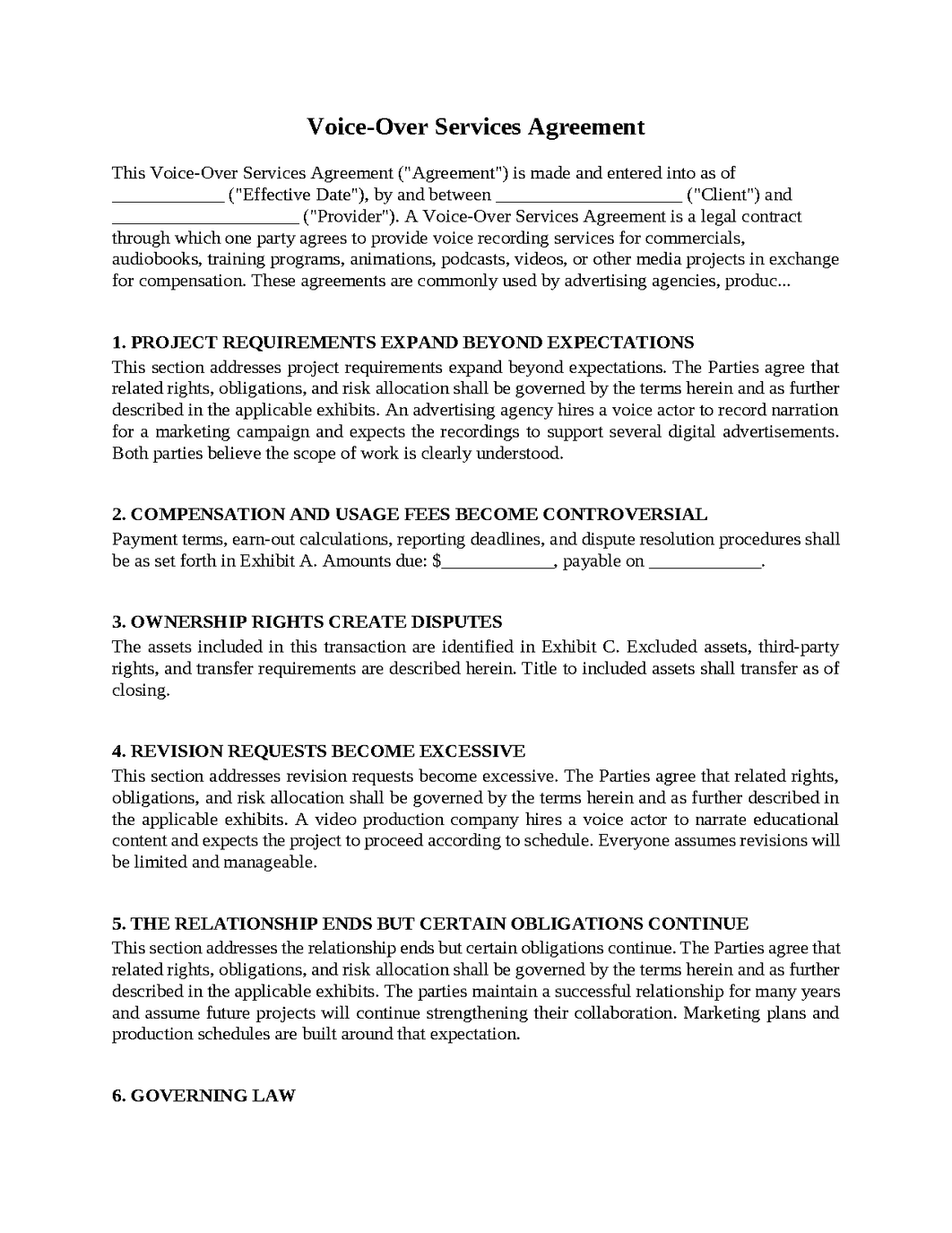
Voice-Over Services Agreement
A Voice-Over Services Agreement is a legal contract through which one party agrees to provide voice recording services for commercials, audiobooks, training programs, animations, podcasts, videos, or other media projects in exchange for compensation. These agreements are commonly used by advertising agencies, production companies, software businesses, publishers, entertainment companies, and content creators seeking professional narration and audio production services. A Voice-Over Services Agreement typically addresses the scope of services, usage rights, compensation arrangements, revision procedures, intellectual property rights, and procedures governing disputes and termination. Because voice recordings often become part of valuable commercial projects, disputes can arise when expectations regarding rights and responsibilities are not documented clearly. A carefully drafted Voice-Over Services Agreement helps establish certainty and protect the interests of both clients and voice talent.
Project Requirements Expand Beyond Expectations
An advertising agency hires a voice actor to record narration for a marketing campaign and expects the recordings to support several digital advertisements. Both parties believe the scope of work is clearly understood.
Initially, recording sessions proceed smoothly and the client expresses satisfaction with the results. Over time, however, additional requests arise involving new scripts, alternate versions, and extended projects that were never originally discussed.
The agency believes flexibility is necessary because marketing campaigns often evolve and additional recordings contribute to the success of the project. The voice actor believes the new requests exceed the original agreement and argues that additional work should result in additional compensation. As demands increase, tensions emerge regarding the scope of services.
To help avoid this problem, a Voice-Over Services Agreement should clearly establish the services being provided and define how revisions and additional work will be handled.
Compensation and Usage Fees Become Controversial
A software company engages a professional narrator to record training materials and expects the pricing arrangement to remain straightforward. Everyone assumes the compensation structure accurately reflects the intended use of the recordings.
As the company expands its training programs internationally, questions arise regarding whether the original fees cover additional languages, platforms, and audiences. Different interpretations create uncertainty regarding compensation.
The narrator believes broader use increases the value of the recordings and argues that expanded distribution justifies additional fees. The company believes the original payment should provide sufficient rights to support growth and future needs. As the project expands, disagreements emerge regarding compensation and licensing rights.
To help prevent these issues, a Voice-Over Services Agreement should clearly establish payment terms and define the uses covered by the agreed compensation.
Ownership Rights Create Disputes
A publisher hires a voice actor to record an audiobook and expects the completed work to become part of its catalog. Both parties assume ownership rights are understood.
As the recording gains popularity, questions arise regarding the ownership of the voice recordings and whether the narrator retains rights to future uses. Different expectations create uncertainty regarding intellectual property.
The publisher believes ownership should belong to the company because it financed the project and intends to distribute the work commercially. The voice actor believes certain rights should remain protected because the performance represents personal talent and creative effort. As the value of the recordings increases, tensions develop regarding ownership rights.
To help avoid these problems, a Voice-Over Services Agreement should clearly establish intellectual property rights and define ownership of recordings and related materials.
Revision Requests Become Excessive
A video production company hires a voice actor to narrate educational content and expects the project to proceed according to schedule. Everyone assumes revisions will be limited and manageable.
After recording is completed, repeated script changes and requests for alternate performances begin affecting timelines and costs. Questions arise regarding how many revisions are included within the original agreement.
The production company believes revisions are necessary because quality and audience engagement depend upon achieving the desired result. The voice actor believes repeated changes create additional work and argues that new recordings should be compensated separately. As revisions increase, disagreements emerge regarding performance obligations.
To help prevent these issues, a Voice-Over Services Agreement should clearly establish revision procedures and define the circumstances under which additional fees apply.
The Relationship Ends but Certain Obligations Continue
The parties maintain a successful relationship for many years and assume future projects will continue strengthening their collaboration. Marketing plans and production schedules are built around that expectation.
Eventually, changing priorities lead one side to terminate the relationship. Questions arise regarding existing recordings, future use rights, unpaid fees, and obligations associated with completed projects.
The client believes continued access to previously recorded materials is necessary because marketing campaigns and products depend upon them. The voice actor believes future obligations should be limited according to the agreement and expects finality. As the relationship concludes, disagreements emerge regarding the rights and responsibilities that survive termination.
To help avoid this problem, a Voice-Over Services Agreement should clearly establish termination procedures and identify the obligations and protections that continue after the relationship ends.
Voice-Over Services Agreements are valuable tools that allow businesses and creators to obtain professional narration while protecting intellectual property and defining expectations. However, issues involving project scope, compensation disputes, ownership rights, revision requests, and post-termination obligations can become significant sources of conflict when expectations are not documented clearly. A carefully drafted Voice-Over Services Agreement provides a structured framework for allocating responsibilities and protecting the interests of both clients and voice talent. When prepared thoughtfully, it can reduce uncertainty, strengthen professional relationships, encourage creativity, and provide the foundation necessary for successful media productions.

Get started with Upsign today!
Easily send, sign and track your documents