

Separation Agreement
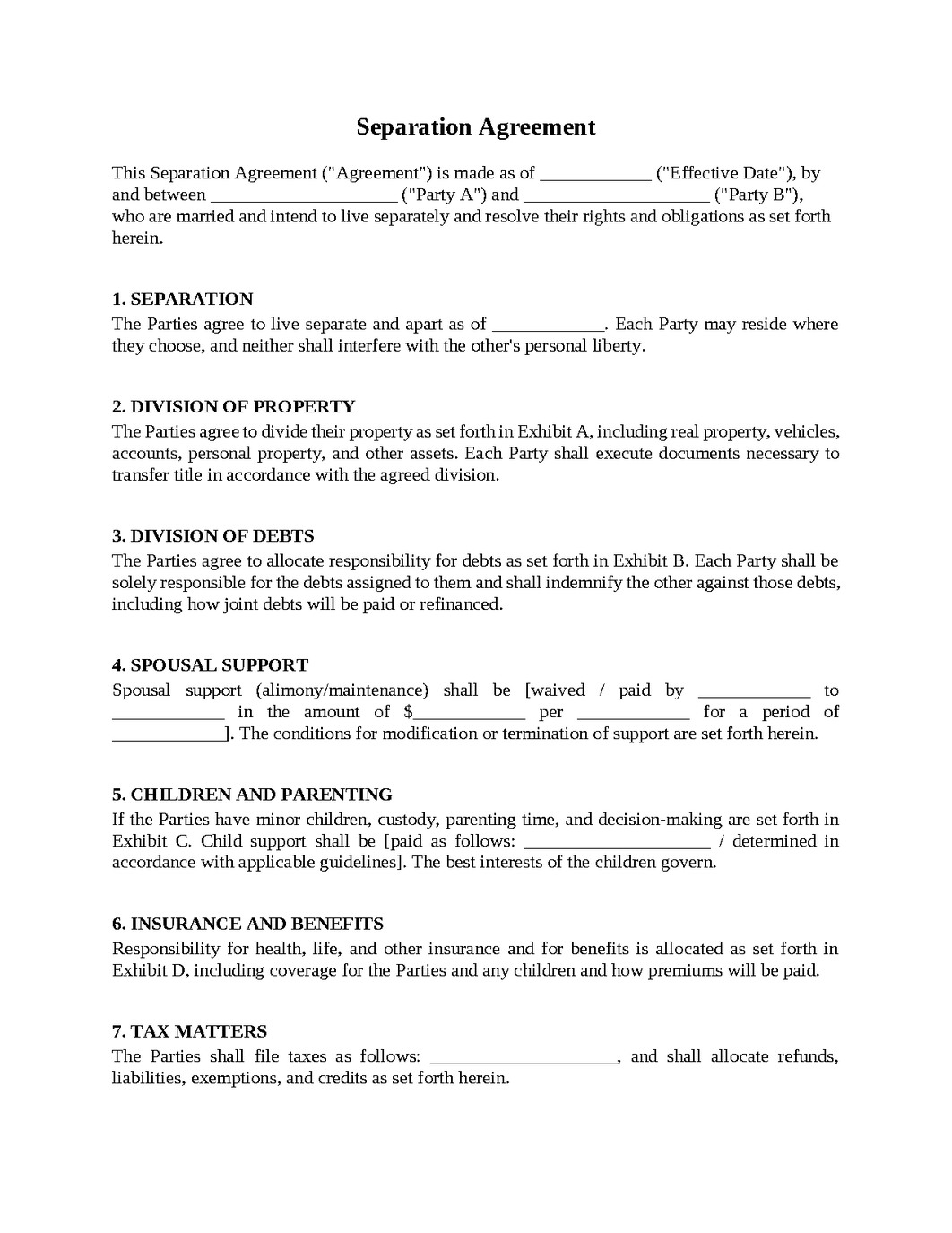
A Separation Agreement is a legal contract entered into by spouses who have decided to live separately but have not yet finalized a divorce or who wish to resolve important issues outside of court. Separation Agreements commonly address property division, debt allocation, child custody, parenting schedules, child support, spousal support, insurance coverage, tax matters, and other financial and personal responsibilities. These agreements are often used to provide stability during a period of transition and to reduce uncertainty regarding each party's rights and obligations. Because separation often occurs during emotionally challenging circumstances, disputes can arise when expectations are not documented clearly. A well-drafted Separation Agreement helps establish structure, reduce conflict, and provide a roadmap for the future.
The Parties Have Different Expectations About Property Division
A married couple decides to separate after many years together.
During the marriage, they accumulated a home, retirement accounts, investment assets, vehicles, and personal property. Both spouses generally agree that assets should be divided fairly, but they have different views regarding what fairness means.
One spouse believes certain assets should remain separate because they were acquired before the marriage or inherited from family members. The other spouse believes those assets became part of the marital estate through years of shared use and contribution.
As discussions continue, disagreements emerge regarding ownership, valuation, and future rights.
Neither spouse necessarily intends to be unreasonable, but emotions and financial interests complicate the process.
To help avoid this problem, a Separation Agreement should clearly identify marital and separate property, establish valuation methods, define ownership rights, and document how assets will be divided.
Parenting Responsibilities Become a Source of Conflict
A separating couple shares responsibility for minor children and wants to maintain stability during the transition.
Both parents care deeply about the children's well-being but have different opinions regarding schedules, decision-making authority, school involvement, and holiday arrangements.
One parent prefers a highly structured parenting schedule. The other believes flexibility is necessary to accommodate changing circumstances.
As time passes, misunderstandings occur regarding exchanges, vacations, extracurricular activities, and communication expectations.
The disagreements create stress not only for the parents but also for the children.
To reduce these risks, a Separation Agreement should clearly define parenting schedules, decision-making responsibilities, communication procedures, holiday arrangements, and methods for resolving future parenting disputes.
One Spouse Assumes Debt Will Be Shared Differently
During the marriage, the couple accumulated mortgages, credit card balances, vehicle loans, and other financial obligations.
As separation discussions begin, each spouse focuses primarily on assets and pays less attention to debt allocation. Later, questions arise regarding responsibility for various obligations.
One spouse believes debts should follow the assets they relate to. The other believes liabilities should be divided equally regardless of purpose.
Creditors continue expecting payment regardless of the spouses' internal agreement, creating additional complexity.
The disagreement becomes more significant as financial pressures increase.
To help prevent these issues, a Separation Agreement should clearly identify all known debts, allocate repayment responsibility, address refinancing expectations when appropriate, and explain how future liability issues will be handled.
Financial Circumstances Change After the Agreement Is Signed
A couple successfully negotiates a Separation Agreement and begins living separately.
At the time the agreement is signed, both spouses have stable employment and predictable financial circumstances. Several months later, however, one spouse loses employment, experiences a medical issue, or encounters other significant financial changes.
The affected spouse seeks modifications to support obligations or other financial provisions. The other spouse believes the agreement should remain enforceable as originally written.
Neither party anticipated the change in circumstances, yet both are affected by the consequences.
What initially seemed like a balanced agreement becomes more difficult to administer.
To help avoid these problems, a Separation Agreement should address modification procedures, identify circumstances that may justify future changes, and establish mechanisms for reviewing support obligations when significant events occur.
The Parties Reconcile Temporarily and Create Confusion
A separated couple enters into a formal agreement and begins living independently.
Months later, the spouses attempt reconciliation and resume portions of their relationship. They spend time together, share certain expenses, and discuss the possibility of remaining married.
Eventually, the reconciliation efforts end and the separation resumes. Questions then arise regarding whether portions of the Separation Agreement remained in effect during the reconciliation period.
Each spouse remembers events differently and interprets the legal effect of the reconciliation in a different way.
The uncertainty creates confusion regarding financial obligations and future rights.
To reduce these risks, a Separation Agreement should address reconciliation scenarios, establish procedures for suspending or modifying obligations, and clarify how temporary reunification affects the agreement's enforceability.
Separation Agreements serve as important tools for helping spouses navigate the complex transition from marriage to separate lives. However, issues involving property division, parenting responsibilities, debt allocation, changing financial circumstances, and reconciliation efforts can become significant sources of conflict when expectations are not documented clearly. A carefully drafted Separation Agreement provides a structured framework for addressing these concerns and protecting both parties involved. When prepared thoughtfully, it can help reduce uncertainty, preserve stability, minimize disputes, and support a smoother transition during a difficult period of change.

Get started with Upsign today!
Easily send, sign and track your documents