

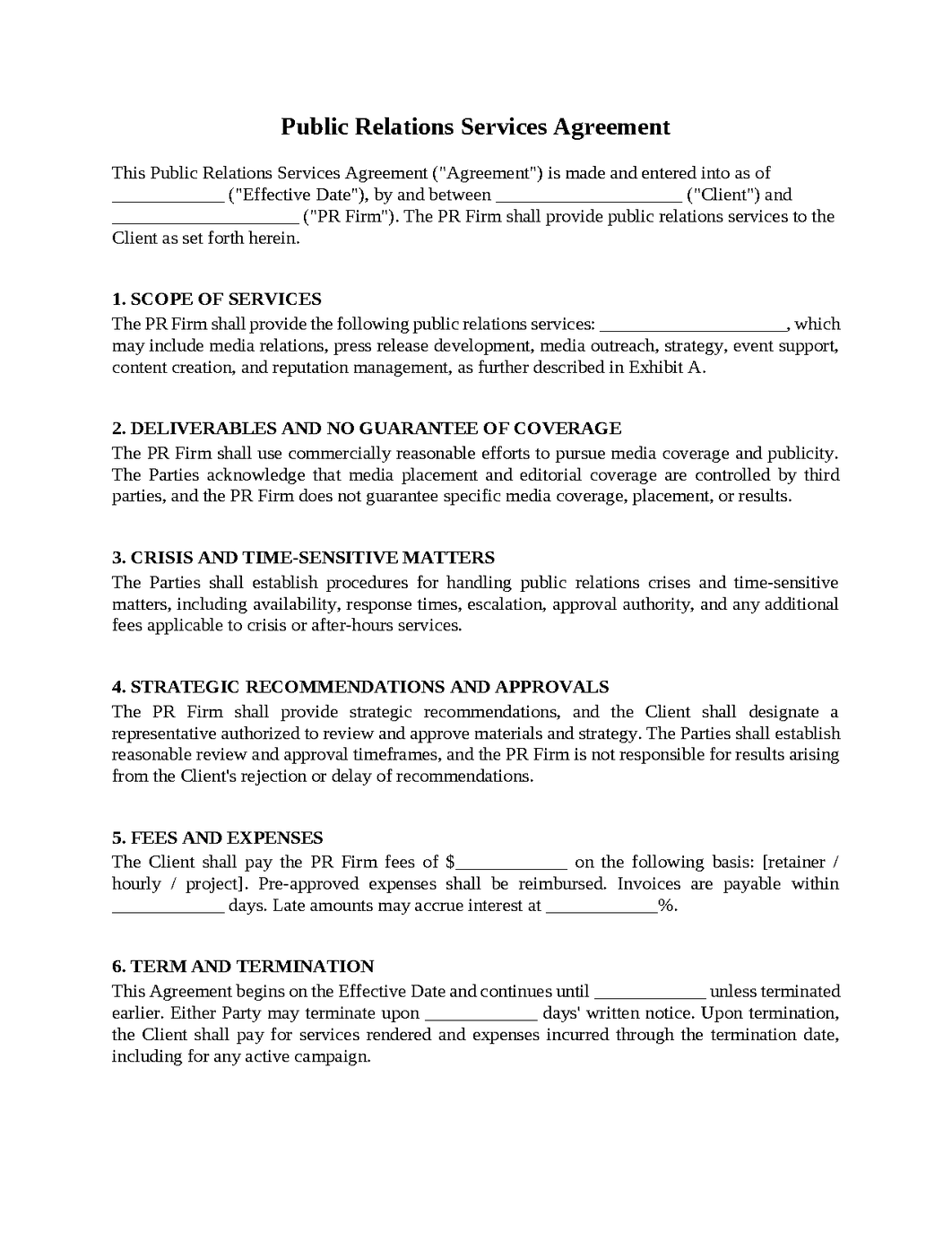
Public Relations Services Agreement
A Public Relations Services Agreement is a legal contract that establishes the terms under which a public relations firm, communications consultant, marketing agency, or independent professional provides public relations and communications services for a client. These agreements are commonly used by businesses, nonprofit organizations, public figures, startups, professional firms, healthcare organizations, and government entities seeking assistance with media relations, reputation management, press outreach, crisis communications, content development, and brand positioning. Because public relations efforts directly affect a client's reputation and public image, disputes can arise when expectations, performance standards, and responsibilities are not clearly documented. A well-drafted Public Relations Services Agreement helps align expectations and reduce misunderstandings throughout the engagement.
The Client Expects Media Coverage That Never Materializes
A growing company hires a public relations firm to increase brand awareness and generate media attention for a new product launch.
During initial discussions, both parties are enthusiastic about the opportunity. The client believes that hiring a professional public relations firm will result in substantial media coverage, industry recognition, and increased visibility.
The public relations firm develops messaging strategies, prepares press materials, conducts media outreach, and schedules interviews. Despite these efforts, media interest proves more limited than expected.
The client becomes frustrated because anticipated publicity does not occur. The firm argues that media coverage cannot be guaranteed and that journalists ultimately decide which stories receive attention.
The disagreement develops because the parties had different expectations regarding outcomes versus services.
To help avoid this problem, a Public Relations Services Agreement should clearly define the scope of services, distinguish efforts from guaranteed results, and establish realistic performance expectations for both parties.
A Public Relations Crisis Requires Immediate Action
A company experiences an unexpected public relations crisis involving negative media attention, customer complaints, or social media criticism.
The client contacts the public relations firm expecting immediate assistance and around-the-clock support. The firm responds quickly but explains that the engagement was structured primarily for routine communications rather than emergency crisis management.
As public scrutiny increases, tensions emerge regarding response times, staffing availability, and strategic recommendations. The client believes crisis support should be included automatically. The firm believes the situation falls outside the original scope of services.
What began as a standard public relations engagement becomes a dispute regarding responsibilities during an emergency.
To reduce these risks, a Public Relations Services Agreement should address crisis communications services, identify emergency response procedures, establish availability expectations, and clarify whether additional fees apply to urgent matters.
The Client Rejects Strategic Recommendations
A public relations firm is hired to improve a company's public image and strengthen relationships with customers and industry stakeholders.
After conducting research and developing a communications strategy, the firm recommends several changes to messaging, media positioning, and public outreach efforts.
Company leadership disagrees with portions of the strategy and insists on pursuing a different approach. The firm warns that the alternative plan may be less effective but ultimately follows the client's instructions.
Months later, results fail to meet expectations. The client blames the firm for poor performance, while the firm points out that key recommendations were never implemented.
The disagreement centers on responsibility for outcomes when professional advice is rejected.
To help prevent these issues, a Public Relations Services Agreement should clearly define decision-making authority, establish approval procedures, and document the respective responsibilities of the client and service provider throughout the engagement.
Confidential Information Is Disclosed Improperly
A client shares sensitive business information with a public relations firm so that effective communications strategies can be developed.
The information includes future product plans, internal financial information, customer data, and strategic initiatives that have not yet been announced publicly.
During the engagement, concerns arise that confidential information may have been disclosed improperly through communications, media interactions, or discussions with third parties.
The client becomes worried about competitive harm and reputational consequences. The public relations firm believes reasonable precautions were taken and that any disclosure was unintentional.
Trust quickly deteriorates because confidential information is central to the relationship.
To help avoid these problems, a Public Relations Services Agreement should clearly define confidential information, establish disclosure restrictions, require appropriate safeguards, and identify remedies for confidentiality breaches.
The Relationship Ends During an Active Campaign
A company hires a public relations firm to support a major product launch and long-term branding initiative.
Several months into the campaign, differences emerge regarding strategy, budget, and performance expectations. The client decides to terminate the relationship and engage another firm.
The timing creates operational challenges because media outreach efforts are underway, journalists have been contacted, press materials are being distributed, and future communications have already been planned.
Questions arise regarding ownership of work product, transfer of media contacts, unfinished projects, and responsibility for ongoing communications.
What should have been a routine business transition becomes complicated because neither party planned for the possibility of ending the relationship mid-campaign.
To reduce these risks, a Public Relations Services Agreement should establish termination procedures, define ownership rights, address transition responsibilities, and require cooperation regarding active projects and media relationships.
Public relations services can play a vital role in shaping public perception, managing reputation, and supporting organizational growth. However, issues involving performance expectations, crisis communications, strategic disagreements, confidentiality, and contract termination can become significant sources of conflict when responsibilities are not documented clearly. A carefully drafted Public Relations Services Agreement provides a structured framework for managing these relationships and protecting both parties involved. When prepared thoughtfully, it can help reduce misunderstandings, preserve professional relationships, support effective communications, and promote successful public relations outcomes.

Get started with Upsign today!
Easily send, sign and track your documents