

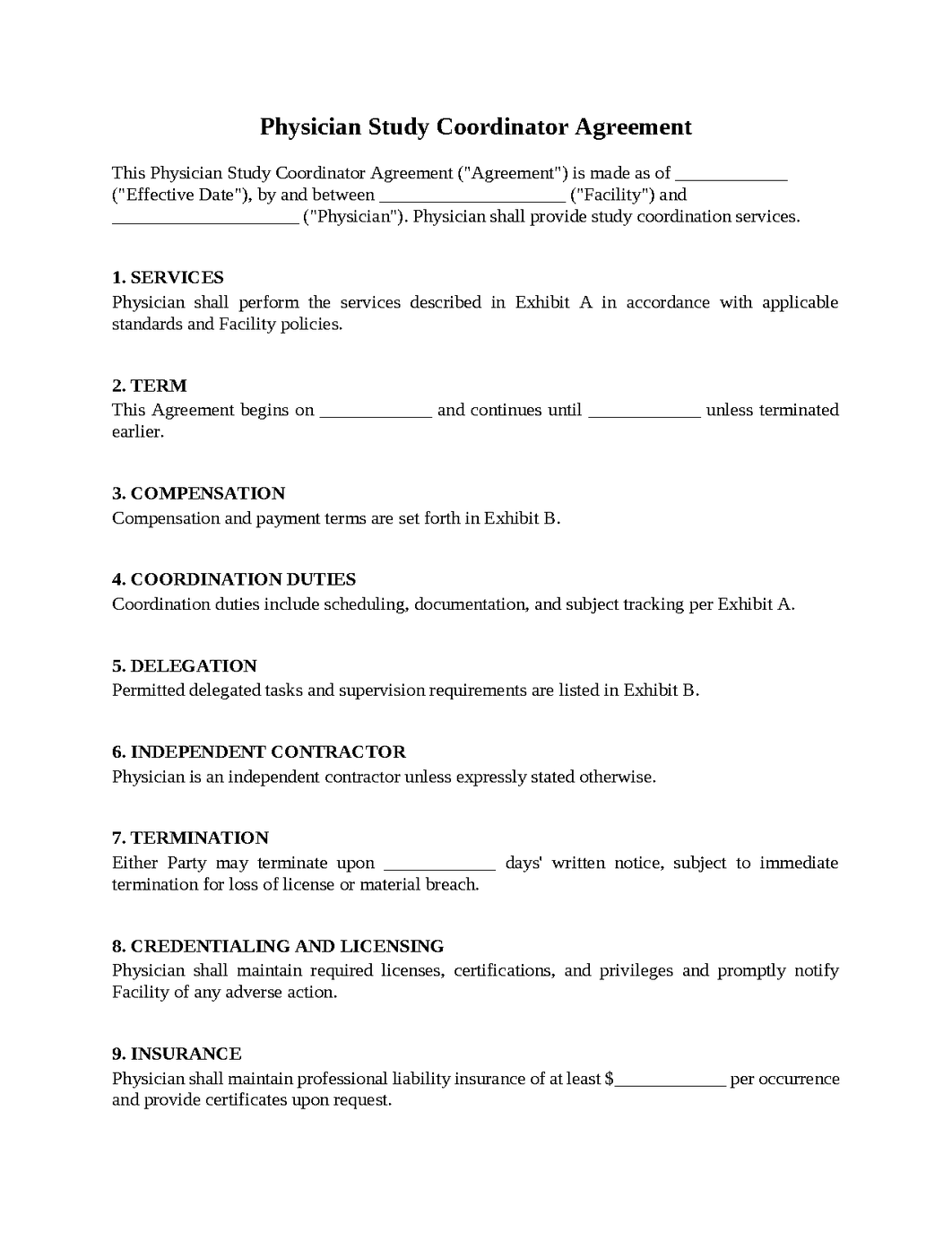
Physician Study Coordinator Agreement
A Physician Study Coordinator Agreement is a legal contract that establishes the terms under which a physician supervises, collaborates with, or works alongside a study coordinator in the administration of clinical research projects. These agreements are commonly used in clinical trials, observational studies, registries, post-market surveillance programs, and academic research initiatives. The agreement typically addresses responsibilities for patient enrollment, informed consent, data collection, regulatory compliance, study documentation, adverse event reporting, and communication with sponsors. Because successful research depends on close coordination between investigators and study staff, disputes can arise when roles and expectations are not clearly documented. A well-drafted Physician Study Coordinator Agreement helps ensure research integrity while protecting study participants and supporting regulatory compliance.
Responsibilities Become Blurred Between the Physician and Coordinator
A physician serves as principal investigator for a multi-site clinical trial and hires an experienced study coordinator to manage many of the study's operational activities.
Initially, both parties work together effectively. The coordinator schedules patient visits, organizes study documentation, and communicates with sponsors, while the physician focuses on clinical oversight and participant safety. As the study expands, however, responsibilities begin overlapping.
The coordinator starts making decisions that the physician believes require investigator review. At the same time, the physician assumes certain administrative tasks are being handled by the coordinator when they are not. Important deadlines are missed because each person believes the other is responsible.
Neither party intended to neglect responsibilities, but unclear boundaries create confusion and operational problems. What began as a collaborative relationship becomes increasingly frustrating because duties were never defined with sufficient detail.
To help avoid this problem, a Physician Study Coordinator Agreement should clearly identify each party's responsibilities, establish approval requirements, define delegated activities, and create procedures for resolving uncertainty regarding task ownership. Clear role definitions help prevent misunderstandings throughout the study.
Participant Enrollment Procedures Are Not Followed Consistently
A research study requires strict adherence to eligibility criteria before participants can be enrolled.
The study coordinator is responsible for screening potential participants and gathering required documentation before enrollment decisions are made. Because enrollment targets are difficult to achieve, pressure begins mounting to recruit additional participants quickly.
Several enrollment files later reveal inconsistencies in screening documentation. The physician believes all final enrollment decisions required investigator approval, while the coordinator believes the physician reviewed and accepted the supporting materials before participants entered the study.
The sponsor becomes concerned that enrollment procedures may not have been followed consistently. Both the physician and coordinator are surprised because each believed the process was functioning appropriately.
The issue creates unnecessary scrutiny and delays as enrollment records are reviewed and corrected.
To reduce these risks, a Physician Study Coordinator Agreement should establish enrollment procedures, define screening responsibilities, require documentation review protocols, and identify approval requirements before participants are enrolled.
Regulatory Audits Expose Documentation Deficiencies
A physician and study coordinator successfully manage a research study for more than a year. Patient visits occur on schedule, data collection remains current, and sponsor communications proceed smoothly.
During a routine audit, however, inspectors identify missing signatures, incomplete delegation logs, inconsistent visit documentation, and gaps in regulatory files. Although the underlying research activities occurred appropriately, the supporting records do not always reflect the work performed.
The physician believes the coordinator was responsible for maintaining regulatory documentation. The coordinator believes the physician was required to review and approve certain records regularly.
As the audit expands, both parties spend substantial time responding to findings and reconstructing documentation. The study's credibility becomes affected even though participant care was not compromised.
To help avoid these problems, a Physician Study Coordinator Agreement should clearly allocate documentation responsibilities, establish recordkeeping standards, define review procedures, and require periodic compliance checks. Strong documentation provisions help support successful audits and inspections.
Adverse Event Reporting Creates Conflict
A participant in a clinical trial experiences a serious medical complication during the study period.
The study coordinator learns of the event and begins gathering information. The physician evaluates the participant and determines that treatment is necessary. Questions quickly arise regarding reporting obligations and regulatory deadlines.
The coordinator believes the event should be reported immediately based on sponsor requirements. The physician wants additional information before determining whether the complication qualifies as a reportable event under the protocol.
Because reporting deadlines are short, tension develops regarding who is responsible for initiating notifications and ensuring compliance. Both parties are focused on participant safety but disagree about how the reporting process should proceed.
The situation becomes more stressful because regulatory consequences may result if deadlines are missed.
To help prevent these issues, a Physician Study Coordinator Agreement should clearly establish adverse event reporting procedures, define responsibilities for gathering information, identify notification timelines, and allocate responsibility for sponsor and regulatory communications.
The Coordinator Leaves During an Active Study
A study coordinator who has managed a complex clinical trial for several years accepts a position with another organization.
The departure creates immediate challenges because the coordinator possesses extensive knowledge regarding participant schedules, sponsor communications, regulatory files, and operational procedures. Several active participants remain enrolled, and numerous study obligations are ongoing.
The physician assumes a replacement coordinator can be trained quickly. The departing coordinator warns that substantial transition planning is necessary to avoid disruptions.
As the departure date approaches, questions arise regarding transfer of records, training of replacement staff, sponsor notifications, and responsibility for unfinished tasks. Without a structured transition plan, important details risk being overlooked.
What should be a routine staffing change becomes a significant operational concern.
To help avoid these problems, a Physician Study Coordinator Agreement should establish transition procedures, define knowledge-transfer responsibilities, require cooperation during staffing changes, and address continuity planning for active studies. Careful transition provisions help maintain study integrity and participant safety.
Physicians and study coordinators must work closely together to ensure that clinical research is conducted safely, ethically, and in compliance with regulatory requirements. However, issues involving delegated responsibilities, participant enrollment, documentation, adverse event reporting, and staffing transitions can quickly create challenges when expectations are not documented clearly. A carefully drafted Physician Study Coordinator Agreement provides a structured framework for managing these responsibilities and supporting successful research operations. When prepared thoughtfully, it can help strengthen compliance, improve communication, protect participants, and promote high-quality clinical research.

Get started with Upsign today!
Easily send, sign and track your documents