

Physician Staffing Agreement
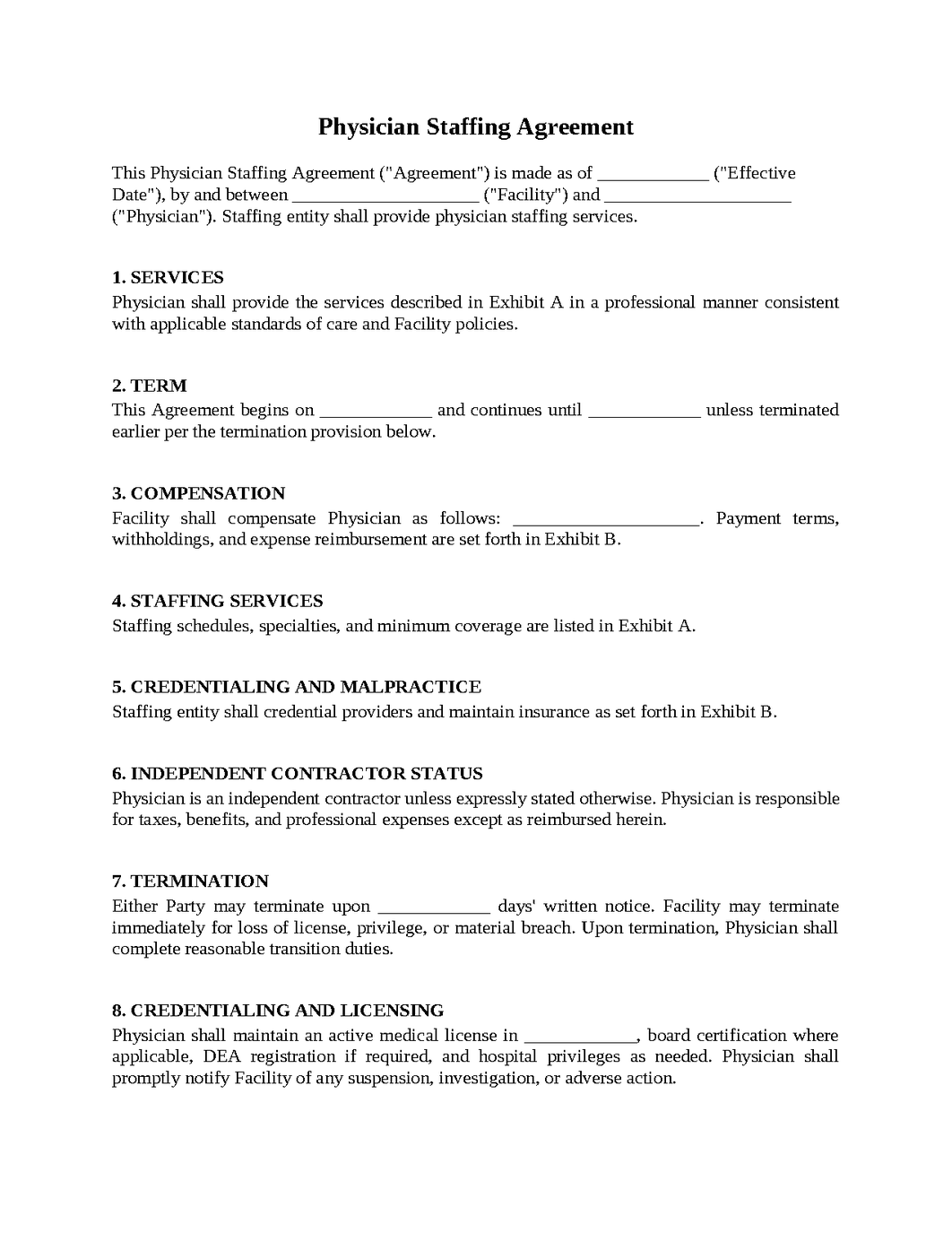
A Physician Staffing Agreement is a legal contract that establishes the terms under which a physician staffing company, physician group, healthcare system, hospital, clinic, or other organization provides physicians to deliver medical services. These agreements are commonly used to address staffing shortages, seasonal demand fluctuations, physician absences, specialty coverage needs, emergency department staffing, hospitalist programs, and recruitment challenges. A Physician Staffing Agreement typically addresses staffing requirements, physician qualifications, scheduling obligations, compensation, credentialing, malpractice coverage, compliance responsibilities, and termination rights. Because multiple parties are involved in delivering patient care, disputes can arise when expectations regarding staffing services are not clearly documented. A well-drafted Physician Staffing Agreement helps ensure continuity of care while protecting both the healthcare organization and the staffing provider.
The Supplied Physicians Do Not Meet Expectations
A regional hospital enters into a staffing agreement with a physician staffing company to address a shortage of emergency medicine physicians. During negotiations, the staffing company assures the hospital that it can provide highly qualified physicians with relevant experience and strong clinical backgrounds.
Initially, both parties are optimistic about the arrangement. As physicians begin arriving, however, concerns start emerging. Some providers are unfamiliar with certain hospital systems, others require more orientation than anticipated, and a few physicians lack experience handling the specific patient volume seen at the facility.
Hospital leadership becomes frustrated because it expected physicians who could transition into the role immediately with minimal support. The staffing company argues that all physicians meet the qualifications outlined in the agreement and that some adjustment period is normal.
The disagreement grows because neither side clearly defined what qualifications, experience levels, or performance expectations would apply to staffing assignments. What started as a staffing solution becomes a debate about whether contractual obligations have actually been met.
To help avoid this problem, a Physician Staffing Agreement should clearly define physician qualifications, specialty requirements, certifications, experience standards, and performance expectations. Detailed staffing criteria help ensure both parties understand what type of providers will be supplied.
Scheduling Changes Create Operational Chaos
A healthcare organization contracts with a staffing company to provide hospitalist coverage for several facilities. The arrangement relies on carefully coordinated schedules to ensure continuous patient care.
For several months, the program operates smoothly. Over time, however, last-minute schedule changes become increasingly common. Physicians occasionally cancel shifts due to illness, travel complications, or conflicting obligations. Replacement providers are not always available on short notice.
Hospital administrators become concerned because staffing gaps create patient care challenges and increase workload for existing physicians. The staffing company argues that unexpected events are unavoidable and that reasonable efforts are being made to find replacements.
As disruptions continue, frustration grows on both sides. The healthcare organization wants greater reliability, while the staffing company believes it is managing difficult circumstances appropriately.
To reduce these risks, a Physician Staffing Agreement should establish scheduling requirements, cancellation procedures, replacement obligations, notice periods, and contingency plans for staffing shortages. Clear operational standards help reduce disruptions and misunderstandings.
Credentialing Responsibilities Become Unclear
A physician staffing company agrees to provide specialty physicians for a healthcare system experiencing recruitment difficulties.
Both parties assume credentialing will be handled efficiently because similar arrangements have been used previously. As physicians are assigned, however, confusion develops regarding who is responsible for gathering records, obtaining verifications, coordinating approvals, and tracking application progress.
The healthcare organization expects the staffing company to manage most of the process. The staffing company believes the healthcare organization controls credentialing requirements and timelines.
Several physicians experience delayed start dates because documentation remains incomplete. Staffing shortages continue, and patient care schedules must be adjusted repeatedly.
Neither party intentionally causes the delays, but the lack of clearly defined responsibilities creates operational problems and frustration.
To help avoid these issues, a Physician Staffing Agreement should clearly allocate credentialing responsibilities, establish documentation requirements, define approval timelines, and identify procedures for addressing delays. Well-defined credentialing obligations help prevent costly interruptions.
Malpractice Claims Lead to Finger-Pointing
A physician supplied under a staffing agreement provides care at a hospital for several months. Years later, a patient files a malpractice claim relating to treatment received during that assignment.
The physician assumes the staffing company's insurance will provide protection. The staffing company believes the hospital's coverage applies because the services were performed at the hospital. The healthcare organization points to contractual language suggesting responsibility rests elsewhere.
As insurance carriers become involved, questions arise regarding coverage limits, defense obligations, reporting requirements, and indemnification responsibilities.
The claim itself may ultimately be resolved successfully, but uncertainty regarding insurance responsibilities creates immediate legal and financial concerns for everyone involved.
The dispute highlights the danger of assuming insurance issues have been addressed without clearly documenting responsibilities.
To help prevent these problems, a Physician Staffing Agreement should clearly identify malpractice coverage requirements, establish minimum policy limits, allocate indemnification responsibilities, and address reporting obligations. Detailed insurance provisions help eliminate uncertainty when claims arise.
The Staffing Relationship Ends During a Provider Shortage
A healthcare organization relies on a physician staffing company for several years to maintain coverage across multiple service lines.
Eventually, the organization decides to bring staffing functions in-house and terminate the agreement. While the decision makes strategic sense, neither party has developed a detailed transition plan.
Many physicians remain actively scheduled, patient care programs depend on existing staffing arrangements, and recruitment efforts for replacement providers are still underway. The healthcare organization wants sufficient time to replace coverage, while the staffing company wants flexibility to reassign physicians to other opportunities.
As the termination date approaches, concerns arise regarding patient care continuity, physician scheduling, unfinished assignments, and transition responsibilities.
What should be a manageable business decision becomes significantly more complicated because the agreement never contemplated how the relationship would unwind.
To reduce these risks, a Physician Staffing Agreement should establish notice requirements, transition obligations, cooperation duties, and procedures for maintaining coverage during the transition period. Careful planning can help prevent disruptions when the relationship ends.
Physician staffing arrangements play a critical role in helping healthcare organizations maintain access to qualified medical professionals during periods of growth, transition, or workforce shortages. However, issues involving physician qualifications, scheduling, credentialing, malpractice coverage, and contract termination can quickly become sources of conflict when expectations are not documented clearly. A carefully drafted Physician Staffing Agreement provides a structured framework for managing these relationships and protecting all parties involved. When prepared thoughtfully, it can help improve operational stability, support continuity of care, reduce misunderstandings, and promote successful long-term staffing partnerships.

Get started with Upsign today!
Easily send, sign and track your documents