

Physician Services Agreement
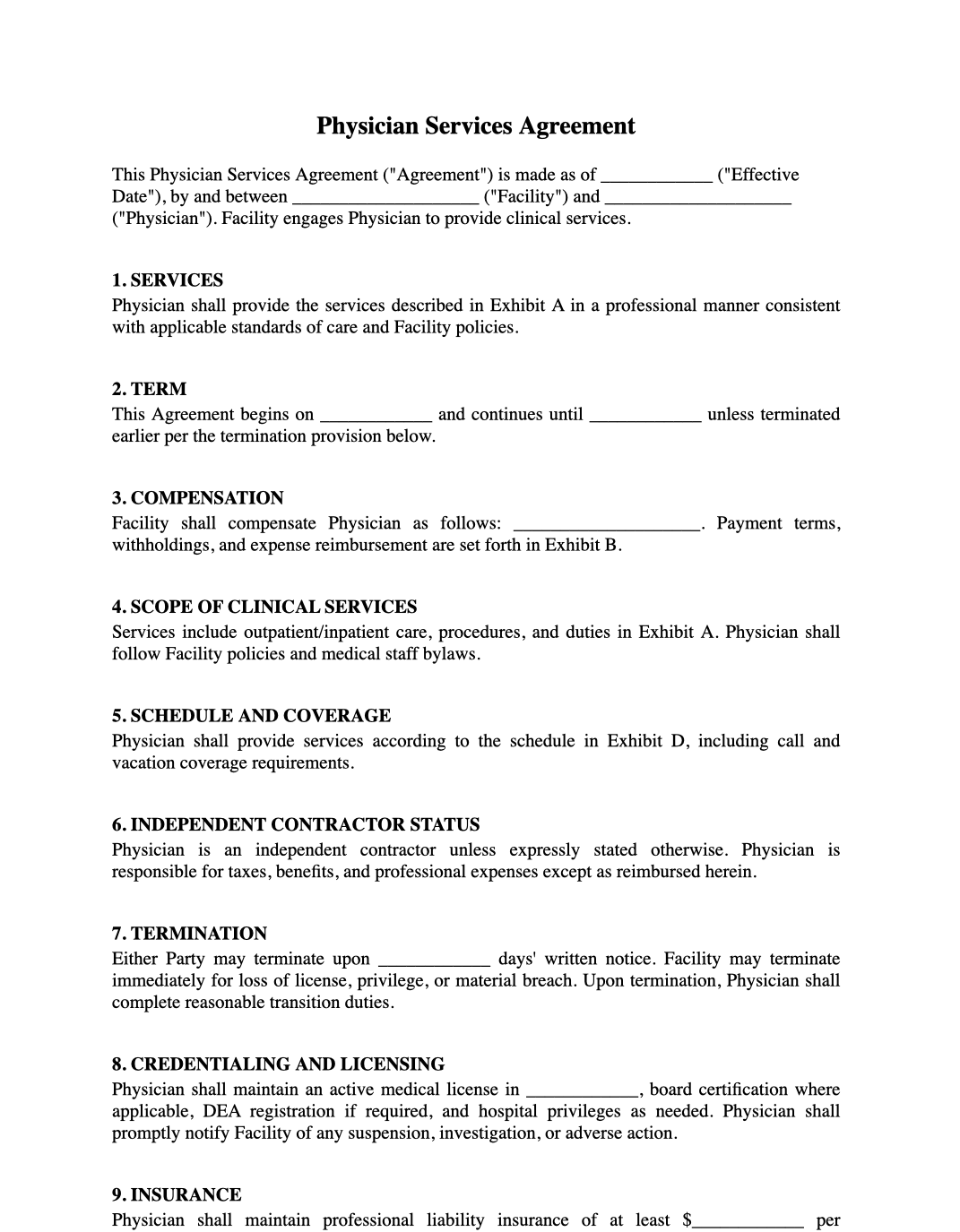
A Physician Services Agreement is a legal contract that establishes the terms under which a physician provides professional medical services to a hospital, clinic, healthcare system, medical group, employer, or other organization. Unlike a traditional employment agreement, a Physician Services Agreement is often used for specialized service arrangements, medical directorships, coverage agreements, consulting services, telemedicine programs, specialty call coverage, and other professional healthcare relationships. These agreements typically address scope of services, compensation, scheduling requirements, regulatory compliance, malpractice coverage, documentation standards, and termination rights. Because patient care, regulatory obligations, and professional liability are involved, disputes can become both financially and professionally significant when expectations are not documented clearly. A well-drafted Physician Services Agreement helps define responsibilities and reduce uncertainty for all parties involved.
The Scope of Services Expands Beyond Expectations
A healthcare system contracts with a physician to provide specialty consultation services at a regional hospital. During negotiations, both parties focus primarily on compensation, scheduling flexibility, and anticipated patient volume.
Initially, the physician provides the services exactly as expected. As demand for specialty care increases, however, hospital administrators begin requesting additional responsibilities. The physician is asked to attend more committee meetings, assist with staff training, provide administrative support, and participate in quality improvement initiatives.
The physician becomes concerned that these additional duties require significant time but are not reflected in the compensation arrangement. Hospital leadership believes the activities are a natural extension of the physician's role and essential to supporting patient care.
As the requests continue increasing, frustration develops on both sides. The physician feels that the original agreement is being expanded unfairly, while the hospital believes the physician is refusing to support important operational needs.
To help avoid this problem, a Physician Services Agreement should clearly define the scope of services, identify required duties, establish expectations for administrative activities, and address compensation for responsibilities that extend beyond direct patient care. Detailed service descriptions help prevent disagreements regarding what work is included in the arrangement.
Coverage Requirements Become a Source of Conflict
A medical group enters into a Physician Services Agreement with a cardiologist to provide weekend and holiday coverage for several healthcare facilities.
At the beginning of the relationship, patient volumes remain manageable and scheduling works smoothly. Over time, however, demand increases significantly. Additional facilities begin requesting coverage, and emergency consultations become more frequent.
The physician finds that coverage obligations are consuming far more time than originally anticipated. Weekends that were expected to involve occasional consultations now require substantial clinical involvement and frequent travel between locations.
The medical group argues that coverage needs have evolved and that flexibility is necessary to meet patient demands. The physician responds that the arrangement no longer reflects the workload originally contemplated by the agreement.
What began as a mutually beneficial relationship gradually becomes strained because neither party anticipated how dramatically service demands would change.
To reduce these risks, a Physician Services Agreement should establish clear coverage requirements, define service locations, identify scheduling expectations, and provide mechanisms for adjusting compensation if coverage responsibilities increase materially over time.
Documentation Standards Lead to Payment Disputes
A physician agrees to provide specialized services for a healthcare organization under a compensation structure tied to completed patient encounters and documented services.
For several months, invoices are processed without issue. As billing volume increases, however, questions arise regarding documentation requirements and eligibility for payment.
The organization begins rejecting certain claims, arguing that supporting records are incomplete or fail to satisfy internal standards. The physician believes the services were provided appropriately and that the documentation is sufficient under accepted medical practices.
Because the agreement provides only general references to documentation obligations, each disputed invoice requires lengthy review and discussion. Payment delays begin affecting the physician's cash flow, while the organization becomes frustrated with recurring disagreements.
The conflict grows even though both parties are attempting to comply with their obligations.
To help prevent these issues, a Physician Services Agreement should clearly define documentation requirements, billing standards, record retention obligations, and procedures for resolving disputed claims. Establishing objective standards upfront can significantly reduce payment-related disputes.
Regulatory Investigations Create Uncertainty
A physician contracts with a healthcare company to provide telemedicine services across several states.
The arrangement grows rapidly, and patient demand exceeds expectations. As operations expand, regulators begin reviewing licensing, billing practices, documentation standards, and compliance procedures associated with the services being provided.
Questions arise regarding who is responsible for maintaining licenses, monitoring regulatory changes, and responding to government inquiries. The physician assumes the company manages compliance infrastructure. The company assumes the physician bears responsibility for professional licensing and regulatory compliance.
When an investigation begins, both parties become concerned about potential liability.
The uncertainty creates tension because responsibilities were never allocated clearly in the agreement. What should have been a cooperative response becomes a debate regarding who is responsible for addressing the issue.
To reduce these risks, a Physician Services Agreement should clearly allocate compliance responsibilities, identify licensing obligations, establish cooperation procedures for audits and investigations, and define how regulatory matters will be handled if they arise.
The Relationship Ends During Ongoing Patient Care
A physician provides specialty services to a healthcare organization for several years and develops strong relationships with patients, staff members, and referring providers.
Eventually, the organization decides to restructure its service model and terminate the agreement. Although both parties agree the relationship will end, significant questions arise regarding patients who remain under active treatment.
The physician wants to ensure continuity of care and proper communication with affected patients. The organization is concerned about maintaining operations and avoiding disruptions to services.
Disagreements emerge regarding medical record access, patient notifications, unfinished treatment plans, and post-termination responsibilities. Both parties recognize the importance of protecting patients but have different views regarding how the transition should occur.
Without clear contractual guidance, a routine business decision becomes significantly more complicated.
To help avoid these problems, a Physician Services Agreement should establish detailed termination procedures, address continuity-of-care obligations, identify responsibilities for patient notifications, and clarify access to medical records during and after the transition. These provisions help protect patients while reducing conflict between the parties.
Physician Services Agreements play an important role in modern healthcare by allowing organizations to access specialized medical expertise through flexible professional arrangements. However, issues involving service expectations, coverage requirements, compensation, regulatory compliance, and patient transitions can create significant disputes when responsibilities are not documented clearly. A carefully drafted Physician Services Agreement provides a structured framework for defining obligations and protecting both parties. When prepared thoughtfully, it can help reduce misunderstandings, support high-quality patient care, maintain regulatory compliance, and promote successful long-term professional relationships.

Get started with Upsign today!
Easily send, sign and track your documents