

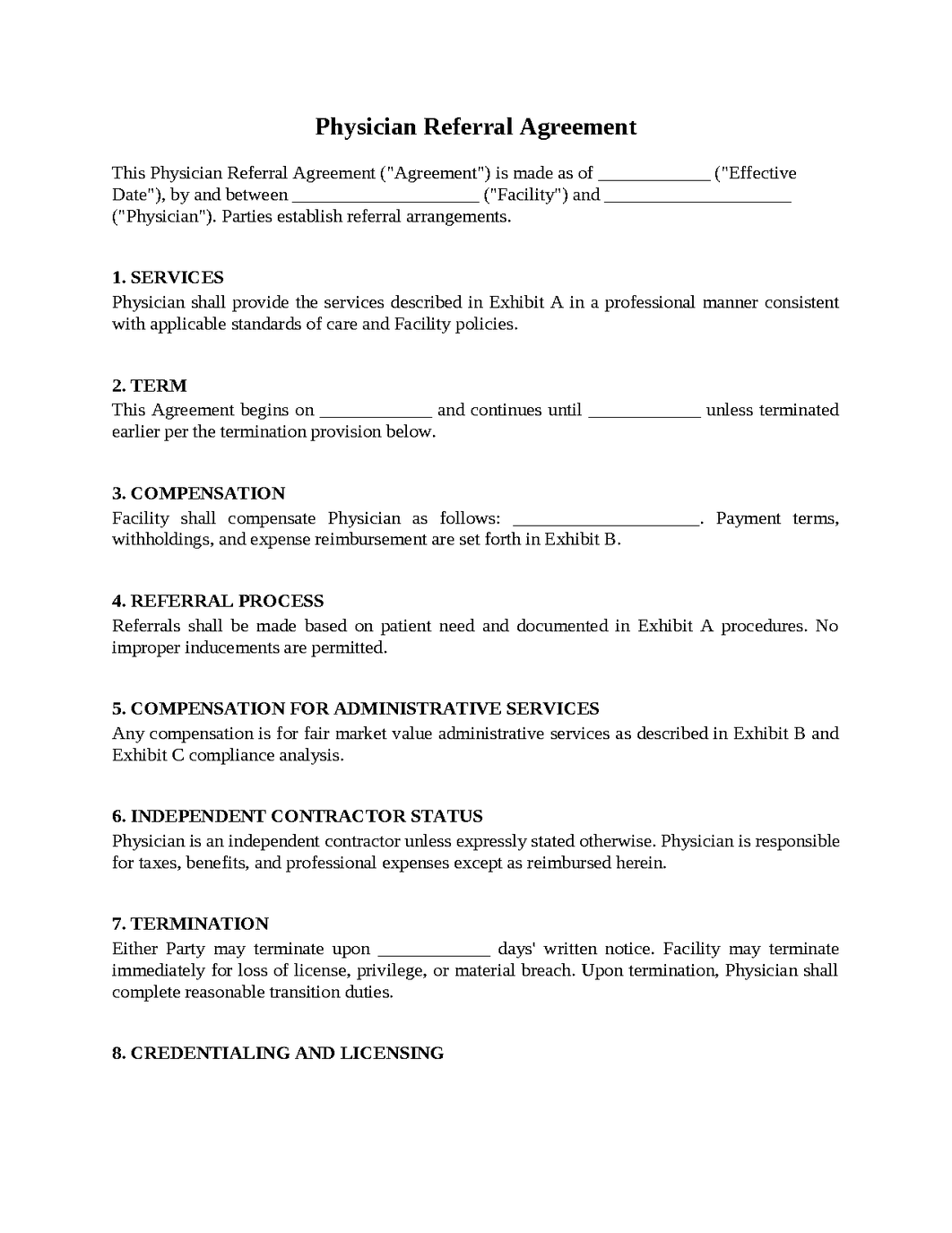
Physician Referral Agreement
A Physician Referral Agreement is a legal contract that establishes the terms under which physicians, physician groups, healthcare providers, or medical organizations coordinate patient referrals for specialized medical services. These agreements are commonly used between primary care physicians and specialists, healthcare networks, hospitals, diagnostic facilities, rehabilitation providers, and other organizations involved in patient care. Because patient referrals can affect treatment outcomes, continuity of care, reimbursement, regulatory compliance, and professional relationships, disputes often arise when referral expectations are not clearly documented. A well-drafted Physician Referral Agreement helps establish clear procedures while supporting patient care and compliance with applicable healthcare laws.
Referral Expectations Are Never Clearly Defined
A primary care practice enters into a referral arrangement with a specialty cardiology group. Both organizations serve the same community and believe the relationship will improve patient access to specialized care.
Initially, referrals occur informally. Primary care physicians send patients to the cardiology group whenever specialized evaluation is needed, and the specialists provide consultation reports after patient visits. Because the arrangement appears to function smoothly, neither side spends much time discussing referral procedures in detail.
As patient volume increases, however, expectations begin diverging. The primary care practice expects rapid appointment availability for urgent patients, while the cardiology group schedules referrals based on existing capacity and clinical priorities. Primary care physicians become frustrated when patients wait longer than expected for specialist evaluations.
The cardiology group, meanwhile, believes it is handling referrals appropriately and cannot always accommodate the timelines requested. What began as a cooperative relationship gradually becomes strained because neither party clearly defined referral expectations at the outset.
To help avoid this problem, a Physician Referral Agreement should establish referral procedures, scheduling expectations, communication timelines, and priority protocols for urgent cases. Clear operational standards help ensure that both organizations understand their responsibilities.
Patient Information Does Not Flow Efficiently
A physician group regularly refers patients to a specialty practice for advanced treatment and diagnostic services. Both organizations believe they are providing high-quality care and maintaining effective communication.
Over time, however, problems begin emerging. Referral documentation occasionally arrives incomplete, consultation reports are delayed, and important test results are not always communicated promptly to the referring physicians.
Patients become frustrated because they must repeatedly provide the same information to multiple providers. Referring physicians become concerned that incomplete communication could affect treatment decisions and continuity of care.
The specialists argue that they are overwhelmed by administrative demands and cannot always provide immediate updates. The referring physicians insist that timely information is critical to managing patient care appropriately.
The disagreement highlights how even successful referral relationships can create operational challenges when communication standards are not clearly established.
To help prevent these issues, a Physician Referral Agreement should define documentation requirements, information-sharing procedures, reporting timelines, and responsibilities for communicating treatment recommendations and test results. These provisions help support continuity of care and reduce administrative confusion.
Regulatory Compliance Questions Arise
A healthcare organization develops a referral relationship involving several physician groups and specialty providers. The arrangement is designed to improve patient access to coordinated care and enhance treatment outcomes.
As the relationship grows, financial and operational interactions between the parties become more complex. Marketing initiatives are coordinated, shared resources are discussed, and questions arise regarding compensation for certain administrative services connected to the referral process.
During a compliance review, regulators request information regarding the structure of the arrangement. The parties are required to demonstrate that referrals are based on legitimate patient care considerations rather than improper financial incentives.
Although no one intended to create a compliance problem, inadequate documentation makes it difficult to explain certain aspects of the relationship.
The resulting review consumes significant time and resources while creating uncertainty for everyone involved.
To reduce these risks, a Physician Referral Agreement should clearly address regulatory compliance requirements, prohibit improper referral incentives, document legitimate business purposes, and require cooperation in responding to audits or investigations. Proper drafting can help protect all parties from unnecessary compliance concerns.
Patients Feel Pressured Into Specific Referrals
A primary care physician routinely refers patients to a particular specialty group under an established referral arrangement.
Most patients appreciate the convenience of receiving recommendations from a trusted provider. Over time, however, some patients begin expressing concerns that alternative specialists are not being discussed adequately.
Several patients believe they were directed toward a specific provider without being informed of other available options. Although the physician believes the recommended specialist offers excellent care, questions arise regarding patient choice and informed decision-making.
The specialty group becomes concerned that patient dissatisfaction may affect its reputation. The referring physician feels unfairly criticized for making recommendations based on professional judgment.
The situation creates tension because all parties want what is best for patients but have different views regarding how referral discussions should occur.
To help avoid these disputes, a Physician Referral Agreement should address patient choice, disclosure obligations, referral communications, and procedures for ensuring patients understand available options. Clear guidelines can help preserve trust while supporting appropriate referrals.
The Referral Relationship Ends Abruptly
A physician group and a specialty practice maintain a successful referral relationship for many years. Patients become accustomed to the arrangement, staff members develop efficient workflows, and communication processes operate smoothly.
Eventually, one of the organizations decides to pursue a different strategic direction and terminate the referral relationship. The decision itself is not controversial, but neither side has considered how ongoing patient matters will be handled.
Dozens of patients are in the middle of treatment plans, diagnostic evaluations, and follow-up care. Questions immediately arise regarding future referrals, pending appointments, access to records, and continuity of care.
Both organizations want to avoid disrupting patient treatment, yet there is no established process for transitioning responsibilities. Staff members struggle to answer patient questions, and confusion begins affecting operations.
To help prevent these problems, a Physician Referral Agreement should establish termination procedures, transition responsibilities, patient notification requirements, and protocols for handling active cases when the referral relationship ends. Thoughtful transition planning helps protect patients and reduce operational disruption.
Physician referral relationships play an important role in coordinating healthcare services and ensuring patients receive specialized care when needed. However, issues involving referral procedures, communication standards, regulatory compliance, patient choice, and relationship termination can create significant challenges when expectations are not documented clearly. A carefully drafted Physician Referral Agreement provides a structured framework for managing these relationships and protecting all parties involved. When prepared thoughtfully, it can help support continuity of care, strengthen professional collaboration, reduce misunderstandings, and promote positive patient outcomes.

Get started with Upsign today!
Easily send, sign and track your documents