

Physician Recruitment Agreement
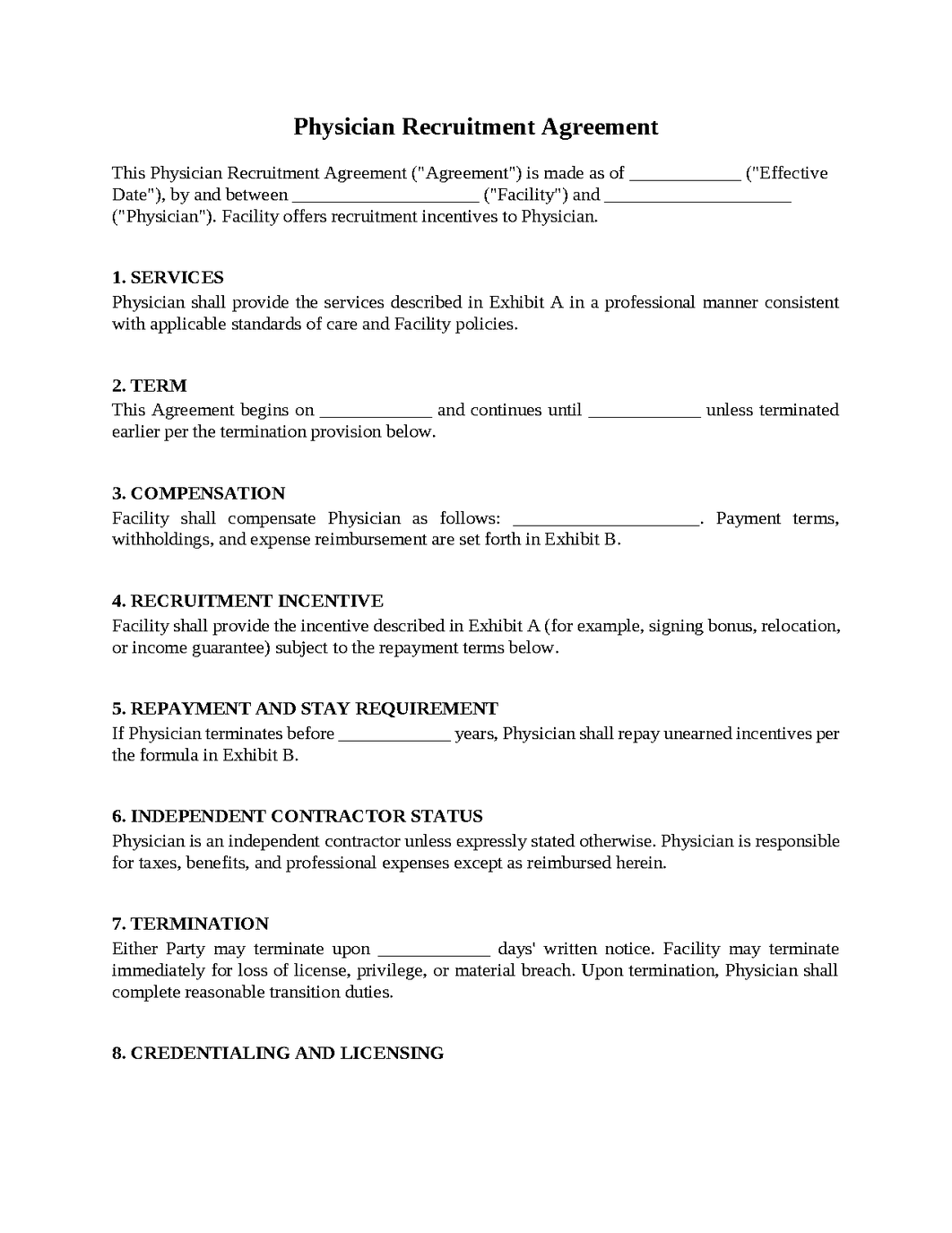
A Physician Recruitment Agreement is a legal contract that establishes the terms under which a hospital, healthcare system, medical practice, or recruiting organization provides compensation, incentives, relocation assistance, income guarantees, loan repayment assistance, signing bonuses, or other benefits to attract a physician to a particular community or practice. These agreements are commonly used when healthcare providers face physician shortages, seek to expand service lines, or recruit specialists to underserved areas. Because physician recruitment often involves substantial financial commitments and long-term expectations, disputes can arise when the physician's obligations, compensation terms, or service requirements are not clearly documented. A well-drafted Physician Recruitment Agreement helps align expectations and reduce misunderstandings before the physician begins practice.
The Physician Leaves Before Fulfilling the Service Commitment
A regional hospital recruits a specialist to serve a community that has struggled for years to attract physicians with that expertise. To make the opportunity more attractive, the hospital offers a substantial recruitment package that includes relocation assistance, a signing bonus, and an income guarantee during the physician's first year of practice.
The physician accepts the offer and relocates with family to the community. Initially, the arrangement appears successful. However, after eighteen months, the physician receives another opportunity in a larger metropolitan area that offers higher compensation and more professional growth opportunities.
The physician decides to leave.
Hospital leadership is frustrated because significant resources were invested in recruiting the physician. Community leaders are disappointed because patients will once again face limited access to specialty care. The physician argues that career opportunities change and that no one should be forced to remain in a position indefinitely.
The dispute centers on whether the physician must repay recruitment incentives and, if so, how much. Because the agreement contains unclear repayment provisions, both parties interpret their obligations differently.
To help avoid this problem, a Physician Recruitment Agreement should clearly define minimum service commitments, repayment obligations, forgiveness schedules, and the circumstances that trigger reimbursement. Detailed provisions can significantly reduce disputes when a physician departs earlier than expected.
Relocation Expenses Exceed Expectations
A healthcare system recruits a physician from another state and agrees to reimburse relocation expenses associated with the move.
During negotiations, both parties assume the relocation package will adequately cover moving costs. The agreement references reimbursement for "reasonable relocation expenses" but provides little additional detail.
As the move progresses, expenses increase rapidly. Temporary housing becomes necessary, storage costs accumulate, and transportation expenses exceed original estimates. The physician submits reimbursement requests for all costs associated with relocating the family.
The healthcare system approves some requests but denies others, arguing that certain expenses fall outside the intended scope of the relocation package.
The physician believes the expenses were necessary and expected to be covered. The healthcare system believes it is being asked to reimburse costs that were never contemplated during negotiations.
What should have been a straightforward relocation benefit becomes a source of frustration before the physician even begins practice.
To reduce these risks, a Physician Recruitment Agreement should clearly define eligible relocation expenses, reimbursement limits, documentation requirements, approval procedures, and any excluded costs. Specific drafting helps prevent disagreements regarding what expenses qualify for reimbursement.
Income Guarantee Terms Become Controversial
A physician is recruited to establish a new specialty practice in a growing community. Because patient volume may take time to develop, the recruiting hospital provides an income guarantee to help support the physician during the startup period.
The physician expects the guarantee to provide financial stability while building a patient base. The hospital views the arrangement as temporary support that may eventually require repayment depending on the physician's production and long-term service.
As the practice develops, questions arise regarding how income generated by the physician affects the guarantee calculations. The physician believes certain revenues should not reduce guaranteed payments. The hospital believes all collections must be considered.
The disagreement grows because the financial impact is substantial. Both parties review the agreement and discover that several key calculation methods were not defined with sufficient detail.
The resulting uncertainty damages what had otherwise been a productive relationship.
To help prevent these disputes, a Physician Recruitment Agreement should clearly explain how income guarantees are calculated, how collections affect payments, whether advances must be repaid, and the circumstances under which repayment obligations may be forgiven. Examples and detailed formulas can be particularly helpful.
Regulatory Compliance Issues Threaten the Arrangement
A hospital recruits a physician to expand access to specialty care within its service area. The recruitment package includes financial incentives designed to encourage the physician to establish a local practice.
The parties focus heavily on compensation and community needs. Relatively little attention is given to the regulatory framework governing physician recruitment arrangements.
Several years later, auditors review the transaction and raise questions regarding compliance with healthcare regulations. The review focuses on how incentives were structured, whether fair market value requirements were satisfied, and whether the arrangement complied with applicable laws governing financial relationships in healthcare.
The physician and hospital both become concerned.
Although neither party intended to violate any regulations, the costs of responding to audits, investigations, and legal reviews can be significant. What originally appeared to be a routine recruitment package now carries unexpected compliance risk.
To reduce these risks, a Physician Recruitment Agreement should clearly address regulatory compliance requirements, fair market value standards, documentation obligations, and cooperation responsibilities if audits or investigations occur. Proper drafting can help protect both parties from avoidable regulatory concerns.
Expectations About Practice Support Are Never Aligned
A physician agrees to relocate to a new community after receiving assurances that adequate support will be available to build a successful practice.
During recruitment discussions, references are made to marketing assistance, referral development efforts, staffing support, and administrative resources. Both parties leave negotiations feeling optimistic.
After the physician arrives, however, expectations begin diverging. The physician believes additional support should be provided to accelerate practice growth. The healthcare organization believes it has already fulfilled its obligations.
Patient volumes develop more slowly than expected. Staffing shortages create operational challenges. Referral patterns take longer to establish than either side anticipated.
The physician becomes frustrated and questions whether the promises made during recruitment are being honored. The healthcare organization argues that many of the discussions were informal expectations rather than contractual commitments.
The disagreement creates tension during a critical period when both parties should be focused on building a successful practice.
To help avoid these problems, a Physician Recruitment Agreement should clearly define any support services being provided, including staffing assistance, marketing efforts, referral development programs, office resources, and administrative support. Documenting these expectations helps ensure both parties understand their responsibilities from the beginning.
Physician recruitment often requires significant investments of time, money, and resources from both healthcare organizations and physicians. Early departures, relocation disputes, compensation disagreements, compliance concerns, and unmet expectations can quickly undermine what should be a mutually beneficial relationship. A carefully drafted Physician Recruitment Agreement provides a structured framework for addressing these issues before problems arise. When prepared thoughtfully, it can help attract qualified physicians, protect financial investments, support regulatory compliance, and promote long-term success for both the physician and the recruiting organization.

Get started with Upsign today!
Easily send, sign and track your documents