

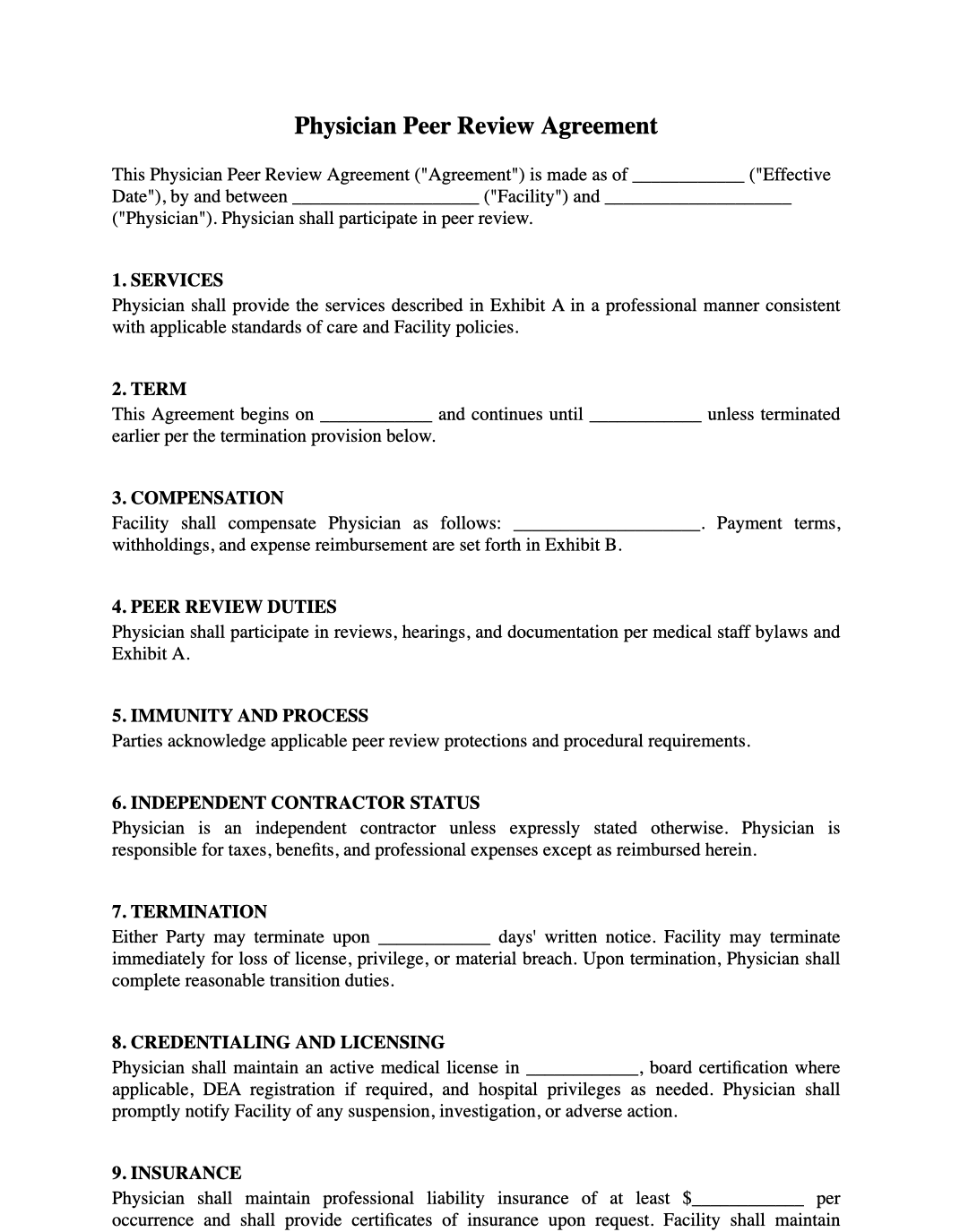
Physician Peer Review Agreement
A Physician Peer Review Agreement is a legal contract that establishes the terms under which physicians participate in the evaluation of the clinical performance, professional conduct, decision-making, and quality of care provided by other physicians. These agreements are commonly used by hospitals, medical staffs, healthcare systems, physician groups, specialty practices, and credentialing organizations. Peer review programs play a critical role in maintaining quality standards, identifying opportunities for improvement, supporting patient safety, and satisfying accreditation and regulatory requirements. Because peer review activities often involve professional reputations, clinical judgment, disciplinary recommendations, and sensitive patient information, disputes can arise when expectations are not documented clearly. A well-drafted Physician Peer Review Agreement helps establish a fair, objective, and confidential review process while protecting both reviewers and reviewed physicians.
The Reviewing Physician Is Accused of Bias
A hospital initiates a peer review after concerns arise regarding a surgeon's patient outcomes. A respected physician from the same specialty is appointed to conduct the review because of extensive clinical experience and familiarity with the procedures involved.
At first, everyone agrees that the reviewer possesses the qualifications necessary to evaluate the case objectively. As the review progresses, however, the surgeon learns that the reviewing physician has competed for referrals in the same market for many years and has previously disagreed with certain treatment approaches.
The surgeon begins questioning whether the review can truly be impartial. Although no evidence suggests the reviewer is acting unfairly, concerns about potential bias quickly overshadow the clinical issues being evaluated.
Hospital leadership finds itself defending the integrity of the process rather than focusing on the underlying quality concerns. The reviewer becomes frustrated because professional expertise is being questioned despite a sincere effort to conduct an objective evaluation.
To help avoid this problem, a Physician Peer Review Agreement should establish conflict-of-interest standards, require disclosure of potential biases, identify procedures for selecting reviewers, and provide mechanisms for replacing reviewers when impartiality could reasonably be questioned. Clear safeguards help preserve confidence in the review process.
Confidential Information Is Shared Improperly
A physician participates in a peer review committee responsible for evaluating patient care concerns and professional performance issues.
The committee reviews sensitive patient records, physician evaluations, internal investigations, and quality improvement recommendations. Members understand that confidentiality is essential to maintaining the integrity of the process.
After a particularly controversial review, information begins circulating within the medical community regarding the committee's discussions and preliminary conclusions. Although no one can identify the source of the disclosure immediately, trust in the peer review process is damaged.
The physician under review becomes concerned that professional reputation has been harmed before any final conclusions have been reached. Committee members become reluctant to participate openly in future discussions because they are unsure whether confidential information will remain protected.
The organization must now address not only the original review matter but also concerns regarding the confidentiality of the process itself.
To reduce these risks, a Physician Peer Review Agreement should clearly define confidential information, prohibit unauthorized disclosures, establish security requirements for records, and identify consequences for violating confidentiality obligations. Strong confidentiality provisions help protect both patients and physicians.
The Scope of the Review Expands Unexpectedly
A peer review committee is asked to evaluate a specific patient care incident involving a physician's clinical decision-making.
The reviewing physicians begin their work expecting to focus on a limited set of facts related to a single case. During the review, however, additional concerns emerge regarding unrelated patient encounters, documentation practices, and administrative issues.
Committee members begin expanding the review into areas that were never part of the original assignment. The physician being reviewed becomes frustrated because the process appears to be evolving into a broad investigation rather than the focused evaluation originally described.
Hospital administrators believe the additional issues should be examined because they may reveal larger patterns. The physician argues that expanding the review without clear notice undermines fairness and due process.
The disagreement shifts attention away from the substantive issues and toward procedural concerns.
To help avoid these problems, a Physician Peer Review Agreement should clearly define the scope of reviews, establish procedures for expanding investigations, require notice when additional issues are considered, and ensure physicians understand the matters being evaluated. Clear procedures help maintain fairness and transparency.
Recommendations Lead to Disciplinary Disputes
A peer review committee completes an extensive evaluation and concludes that corrective action should be recommended.
Some committee members support educational interventions and additional training. Others believe more significant restrictions should be imposed. The physician under review disputes the findings entirely and argues that the conclusions are unsupported by the facts.
As the matter moves through the organization's disciplinary process, disagreements arise regarding how recommendations should be evaluated and who has authority to make final decisions.
The reviewing physicians believe their professional judgment should receive substantial weight. Hospital leadership wants flexibility to consider broader organizational concerns. The physician being reviewed wants a meaningful opportunity to respond and challenge the findings.
What began as a quality review now evolves into a dispute regarding fairness, authority, and professional consequences.
To help prevent these issues, a Physician Peer Review Agreement should establish review procedures, identify decision-making authority, define appeal rights, and explain how recommendations will be considered and implemented. Clear governance provisions help reduce procedural disputes.
A Physician Challenges the Outcome Years Later
A hospital completes a peer review involving a physician and implements certain corrective measures. The matter appears resolved, and everyone involved moves forward.
Several years later, a licensing inquiry, credentialing application, or malpractice proceeding raises questions regarding the original review. Documents must be located, records examined, and participants asked to recall events that occurred long ago.
Unfortunately, documentation practices were inconsistent. Some records are incomplete, retention policies were unclear, and important communications are difficult to locate.
The physician argues that the review process was flawed. The organization struggles to reconstruct what occurred and demonstrate that proper procedures were followed.
A matter that seemed resolved years earlier now creates significant administrative and legal challenges because the underlying records are inadequate.
To help avoid these problems, a Physician Peer Review Agreement should establish documentation standards, record retention requirements, reporting procedures, and responsibilities for maintaining review materials. Proper recordkeeping helps protect the integrity of the process long after the review concludes.
Physician peer review programs are essential to maintaining quality healthcare, supporting professional accountability, and promoting patient safety. However, issues involving reviewer impartiality, confidentiality, scope of review, disciplinary recommendations, and record retention can become significant sources of conflict when expectations are not documented clearly. A carefully drafted Physician Peer Review Agreement provides a structured framework for conducting fair and effective reviews while protecting all parties involved. When prepared thoughtfully, it can help strengthen quality improvement efforts, support regulatory compliance, preserve professional trust, and promote excellence in patient care.

Get started with Upsign today!
Easily send, sign and track your documents