

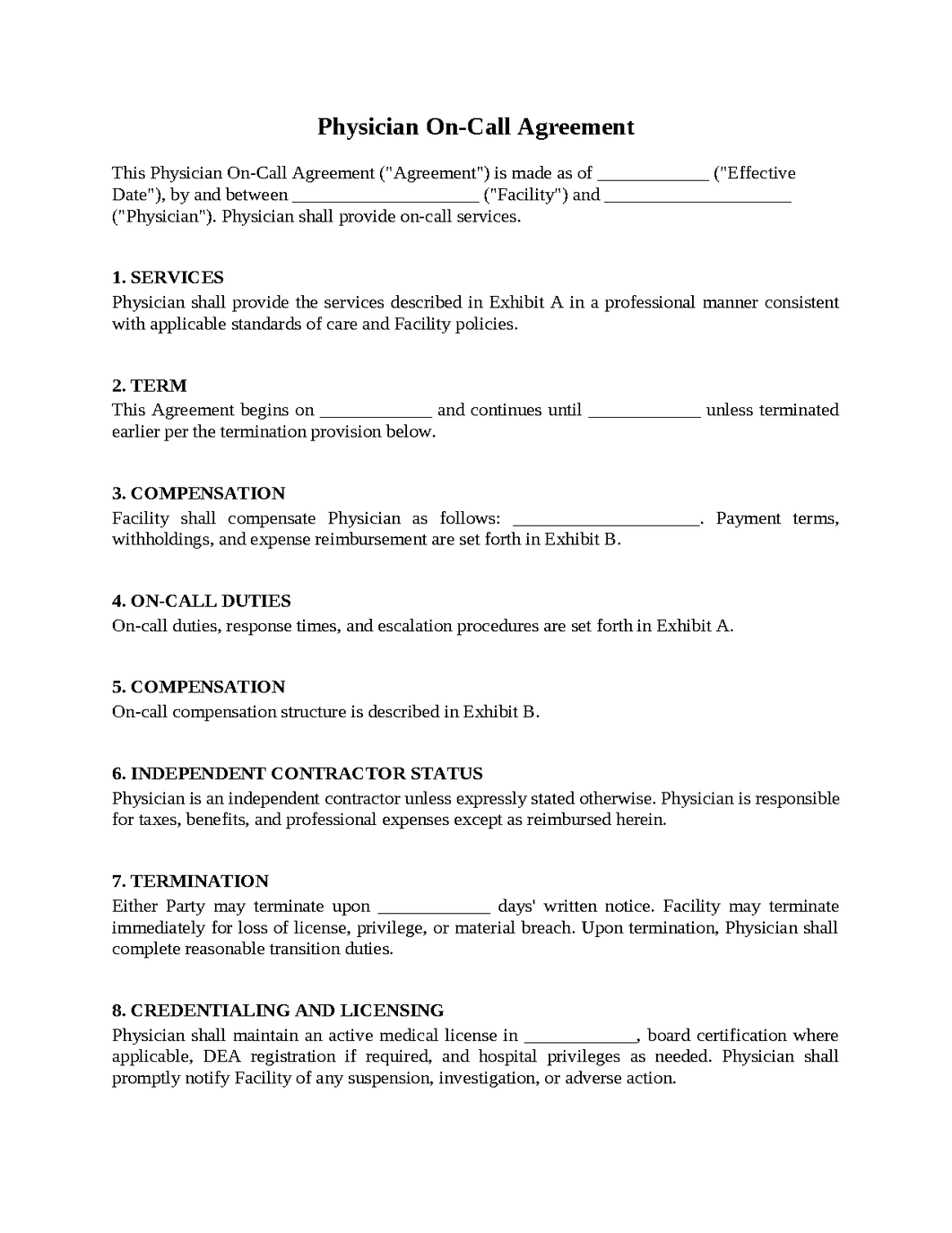
Physician On-Call Agreement
A Physician On-Call Agreement is a legal contract that establishes the terms under which a physician agrees to be available to provide medical consultations, treatment decisions, emergency responses, or other professional services outside normal working hours. These agreements are commonly used by hospitals, specialty groups, emergency departments, trauma centers, surgical practices, and healthcare systems that require continuous access to physician expertise. A Physician On-Call Agreement typically addresses availability requirements, response times, compensation, patient care responsibilities, communication procedures, malpractice coverage, and scheduling obligations. Because on-call physicians often make critical decisions under time-sensitive circumstances, misunderstandings regarding responsibilities can create significant operational, legal, and patient care risks. A well-drafted Physician On-Call Agreement helps establish clear expectations and promote continuity of care.
The Physician and Hospital Have Different Expectations About Availability
A regional hospital contracts with an orthopedic surgeon to provide weekend and evening on-call coverage. During negotiations, both parties focus on scheduling logistics, compensation, and the anticipated need for emergency consultations.
The surgeon assumes that being on call primarily means remaining available by telephone and reporting to the hospital only when circumstances require in-person evaluation. Hospital administrators, however, expect the physician to remain close enough to arrive quickly whenever emergency cases arise.
The difference in expectations becomes apparent when a trauma patient arrives requiring urgent orthopedic consultation. Hospital staff expect immediate in-person attendance, while the physician believes a telephone consultation is appropriate until additional information becomes available.
Although the patient ultimately receives treatment, the incident creates frustration among hospital staff and raises concerns regarding future emergency responses. Both parties realize they have very different interpretations of what on-call availability actually requires.
To help avoid these problems, a Physician On-Call Agreement should clearly define availability requirements, geographic restrictions, response expectations, and circumstances that require in-person attendance. Specific standards help eliminate uncertainty when urgent situations arise.
Response Time Requirements Become a Source of Conflict
A neurology group enters into an agreement to provide overnight call coverage for a healthcare system. Everyone agrees that timely responses are important, but the agreement contains only general language requiring the physician to respond within a "reasonable" period of time.
For several months, the arrangement functions without issue. As patient volumes increase, however, emergency department staff begin documenting delays in returned calls and consultation requests.
The physicians believe they are responding appropriately given the complexity of cases and competing professional responsibilities. Hospital leadership views the delays differently and becomes concerned that patient care and operational efficiency may be affected.
Because the agreement never established objective response standards, both sides rely on subjective interpretations of what constitutes a reasonable response.
The resulting disagreement strains an otherwise productive relationship and creates unnecessary operational tension.
To reduce these risks, a Physician On-Call Agreement should establish specific response time requirements, communication protocols, escalation procedures, and documentation standards. Objective expectations make it easier to evaluate performance fairly.
Compensation No Longer Matches the Workload
A hospital recruits a specialist to provide on-call coverage for a service line that historically generated a relatively modest number of consultations.
The parties agree to a fixed daily stipend based on prior call volume data. Initially, the arrangement appears fair because patient demand remains consistent with expectations.
Over time, however, the hospital expands several related clinical programs. Patient volumes increase significantly, consultation requests become more frequent, and the physician begins spending far more time handling on-call responsibilities than originally anticipated.
The physician believes the compensation structure no longer reflects the actual workload. The hospital argues that the stipend compensates the physician for availability rather than the number of patients treated.
As frustration grows, both sides begin reevaluating the arrangement. What started as a mutually beneficial agreement now feels unbalanced.
To help avoid these disputes, a Physician On-Call Agreement should address compensation review procedures, workload adjustments, additional payments for unusually high service demands, and mechanisms for renegotiating terms if patient volume changes substantially.
Malpractice Exposure Is Not Fully Addressed
A specialist agrees to provide on-call services for multiple hospitals within a healthcare network. Because the physician already maintains professional liability coverage through a separate practice, both parties assume insurance concerns have been addressed adequately.
Several years later, a patient files a malpractice claim relating to treatment decisions made during an on-call consultation. The physician believes the hospital's coverage should provide protection because the services were performed on the hospital's behalf.
The hospital takes a different position and argues that the physician's individual malpractice policy should respond first. Insurance carriers become involved, and questions arise regarding policy limits, reporting obligations, defense costs, and indemnification responsibilities.
The dispute becomes expensive long before the underlying claim is resolved. Both parties discover that assumptions made during contract negotiations created significant uncertainty.
To help prevent these problems, a Physician On-Call Agreement should clearly identify insurance requirements, minimum coverage limits, indemnification obligations, reporting procedures, and responsibility for tail coverage if applicable. Detailed insurance provisions can eliminate costly ambiguity later.
Patient Care Responsibilities Are Unclear After the Call Ends
A physician provides overnight call coverage for a large internal medicine practice. During one shift, several patients require urgent treatment decisions, medication changes, and follow-up testing.
The physician handles the immediate concerns appropriately and documents the encounters before the shift concludes. The following morning, however, questions arise regarding responsibility for ongoing care.
Some patients assume the on-call physician will continue monitoring their conditions. The primary physicians believe responsibility transferred back automatically when regular office hours resumed. Test results remain pending, follow-up appointments need scheduling, and communication regarding treatment plans is incomplete.
Although everyone involved is attempting to act responsibly, the lack of a formal handoff process creates confusion and increases the risk of important issues being overlooked.
The situation highlights how continuity-of-care concerns can arise even when clinical decisions during the call period were handled properly.
To reduce these risks, a Physician On-Call Agreement should establish handoff procedures, define follow-up responsibilities, require communication regarding unresolved patient matters, and specify documentation standards for transitions between physicians.
Physician on-call arrangements are essential to ensuring that patients receive timely medical attention outside normal business hours. However, issues involving availability expectations, response times, compensation, malpractice coverage, and continuity of care can quickly become sources of conflict when responsibilities are not documented clearly. A well-drafted Physician On-Call Agreement provides a structured framework for addressing these challenges before problems arise. When prepared thoughtfully, it can help support patient care, reduce misunderstandings, strengthen professional relationships, and ensure healthcare organizations maintain reliable access to physician expertise whenever it is needed.

Get started with Upsign today!
Easily send, sign and track your documents