

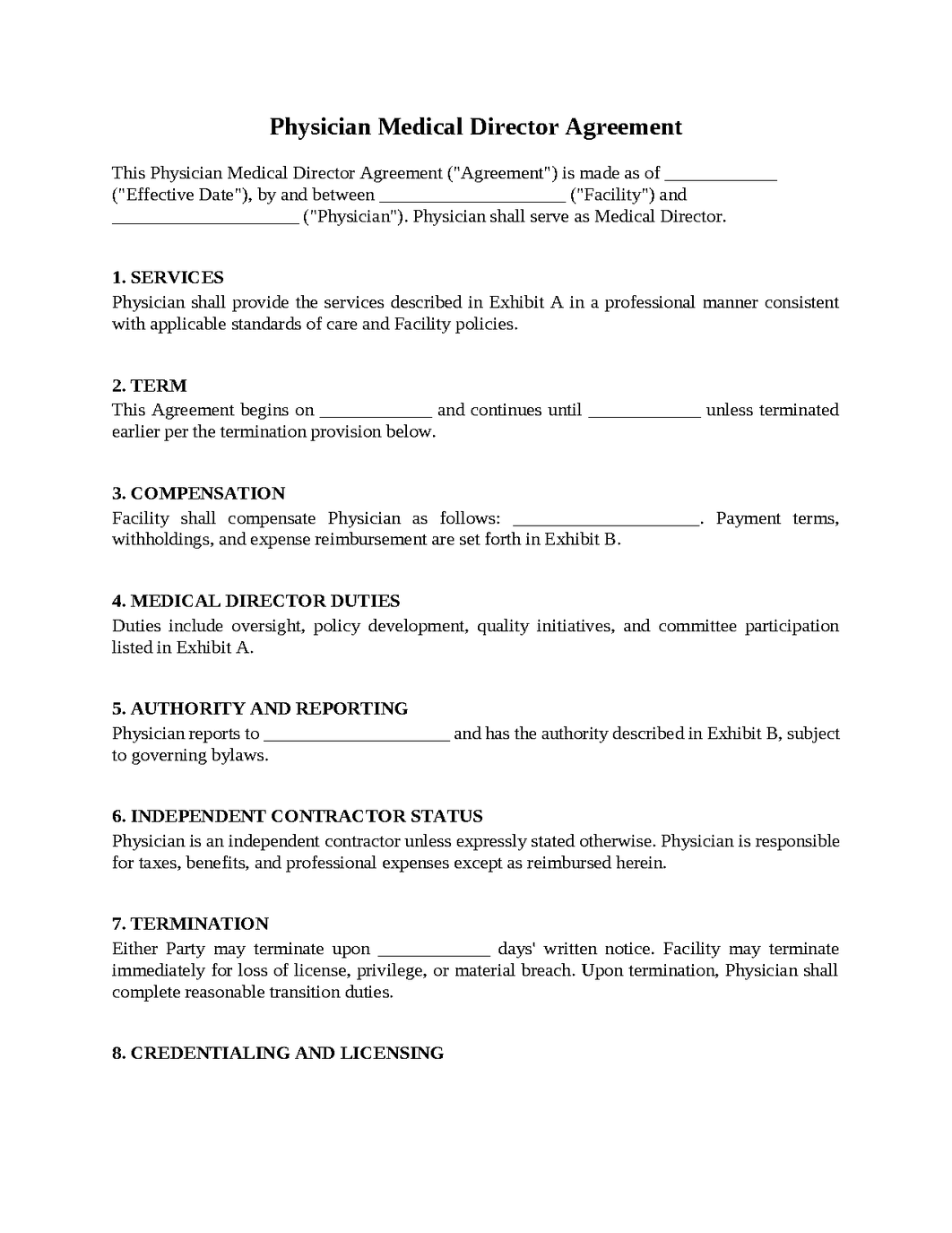
Physician Medical Director Agreement
A Physician Medical Director Agreement is a legal contract that establishes the terms under which a physician serves as a medical director for a healthcare organization, facility, program, or service line. Medical directors are commonly engaged by hospitals, surgery centers, urgent care clinics, imaging facilities, laboratories, long-term care facilities, telemedicine providers, hospice organizations, and other healthcare operations. Unlike physicians whose primary role is direct patient care, medical directors often provide clinical leadership, quality oversight, policy development, regulatory guidance, staff education, and operational support. Because medical director roles frequently involve both clinical and administrative responsibilities, disputes can arise when expectations are not clearly defined. A well-drafted Physician Medical Director Agreement helps clarify duties, compensation, authority, and compliance obligations while supporting the organization's operational goals.
Administrative Responsibilities Expand Beyond the Original Agreement
A growing outpatient surgery center recruits an experienced physician to serve as its medical director. During negotiations, both parties discuss quality oversight, occasional staff meetings, and assistance with clinical policies.
Initially, the role requires only a few hours each month. The physician reviews protocols, participates in periodic meetings, and provides guidance when clinical questions arise. As the facility expands, however, operational demands increase significantly.
The surgery center begins asking the medical director to attend additional committee meetings, review incident reports, assist with accreditation efforts, participate in recruitment activities, and provide ongoing staff training. What was originally presented as a limited oversight role gradually evolves into a substantial administrative commitment.
The physician becomes frustrated because the additional responsibilities consume far more time than anticipated. Facility leadership believes the requests are reasonable because the medical director is the organization's primary clinical leader.
The disagreement develops not because either party acted improperly, but because neither anticipated how much the role would expand over time.
To help avoid this problem, a Physician Medical Director Agreement should clearly define the scope of services, anticipated time commitments, meeting obligations, administrative duties, and procedures for approving additional responsibilities. The agreement should also address compensation adjustments if the workload increases materially.
Compensation Becomes Difficult to Justify
A healthcare organization hires a physician as medical director and agrees to pay a fixed monthly stipend for services.
For several years, the arrangement functions smoothly. During a routine compliance review, however, questions arise regarding whether the compensation remains consistent with the services actually being performed.
The organization believes the physician's experience and availability justify the compensation. Auditors, however, request documentation demonstrating the services provided, hours worked, and value received by the organization.
The physician has not consistently maintained records of meetings, policy reviews, consultations, and oversight activities because the parties never viewed detailed documentation as necessary.
What initially appeared to be a straightforward compensation arrangement now creates regulatory and compliance concerns. Both parties must devote significant time and resources to reconstructing activities performed over several years.
To reduce these risks, a Physician Medical Director Agreement should clearly describe services, establish documentation requirements, define expected time commitments, and ensure compensation reflects fair market value for the duties being performed. Detailed records can be invaluable if the arrangement is later reviewed.
Authority Is Never Clearly Defined
A physician accepts a medical director position with a multi-site healthcare organization.
The physician assumes the role includes authority to implement clinical protocols, enforce quality standards, and require corrective actions when patient care concerns are identified. Management views the position differently and believes the physician serves primarily in an advisory capacity.
The difference in expectations becomes apparent when the physician identifies operational issues requiring immediate attention. Recommendations are provided to leadership, but implementation is delayed or ignored.
The physician becomes concerned that patient care and regulatory compliance may be affected. Management becomes frustrated because it believes the medical director is attempting to exercise authority beyond what was intended.
The resulting conflict damages the working relationship and creates confusion among staff regarding who has decision-making authority.
To help avoid these disputes, a Physician Medical Director Agreement should clearly define the medical director's authority, reporting structure, advisory responsibilities, decision-making rights, and limitations on authority. Clarifying these expectations helps prevent future misunderstandings.
Regulatory Problems Trigger Questions About Responsibility
A physician serves as medical director for a healthcare facility subject to extensive licensing, accreditation, and regulatory requirements.
For years, operations proceed without significant issues. During a regulatory inspection, however, investigators identify deficiencies involving policies, documentation, staff training, and quality oversight.
The organization assumes the medical director bears primary responsibility because the issues relate to clinical oversight. The physician argues that management controlled staffing, resources, and operational decisions necessary to address the concerns.
As regulators continue their review, both parties become increasingly concerned about potential penalties, corrective action requirements, and reputational damage.
The disagreement centers on where responsibility begins and ends for the medical director role.
To help prevent these issues, a Physician Medical Director Agreement should clearly allocate compliance responsibilities, identify reporting obligations, establish escalation procedures for unresolved concerns, and define the medical director's role in regulatory matters. Clear allocation of responsibilities can significantly reduce uncertainty during investigations.
The Relationship Ends During a Critical Transition
A physician serves as medical director for a healthcare organization for nearly a decade.
During that time, the physician helps develop clinical protocols, accreditation programs, quality initiatives, and operational systems that become central to the organization's success. Eventually, the physician decides to step down and pursue other professional opportunities.
Although both parties agree the relationship should end amicably, questions immediately arise regarding the transition. Ongoing projects remain unfinished, accreditation reviews are pending, and staff members continue relying on the physician's guidance.
The organization wants continued support during the transition period. The physician believes responsibilities should conclude promptly after termination. Neither side anticipated the complexity involved in transferring leadership responsibilities.
As deadlines approach, uncertainty grows regarding knowledge transfer, record retention, pending projects, and communications with regulators and accrediting organizations.
To reduce these risks, a Physician Medical Director Agreement should establish detailed transition procedures, notice requirements, cooperation obligations, and responsibilities for pending matters. Thoughtful transition provisions can help ensure continuity and minimize operational disruption when the relationship concludes.
Medical directors play a critical role in modern healthcare organizations by providing clinical leadership, quality oversight, regulatory guidance, and professional expertise. However, disputes involving workload expectations, compensation, authority, compliance responsibilities, and transition planning can arise when these relationships are not documented carefully. A well-drafted Physician Medical Director Agreement provides a structured framework for defining responsibilities and protecting both the physician and the organization. When prepared thoughtfully, it can help promote regulatory compliance, support quality patient care, reduce misunderstandings, and foster a successful long-term professional relationship.

Get started with Upsign today!
Easily send, sign and track your documents