

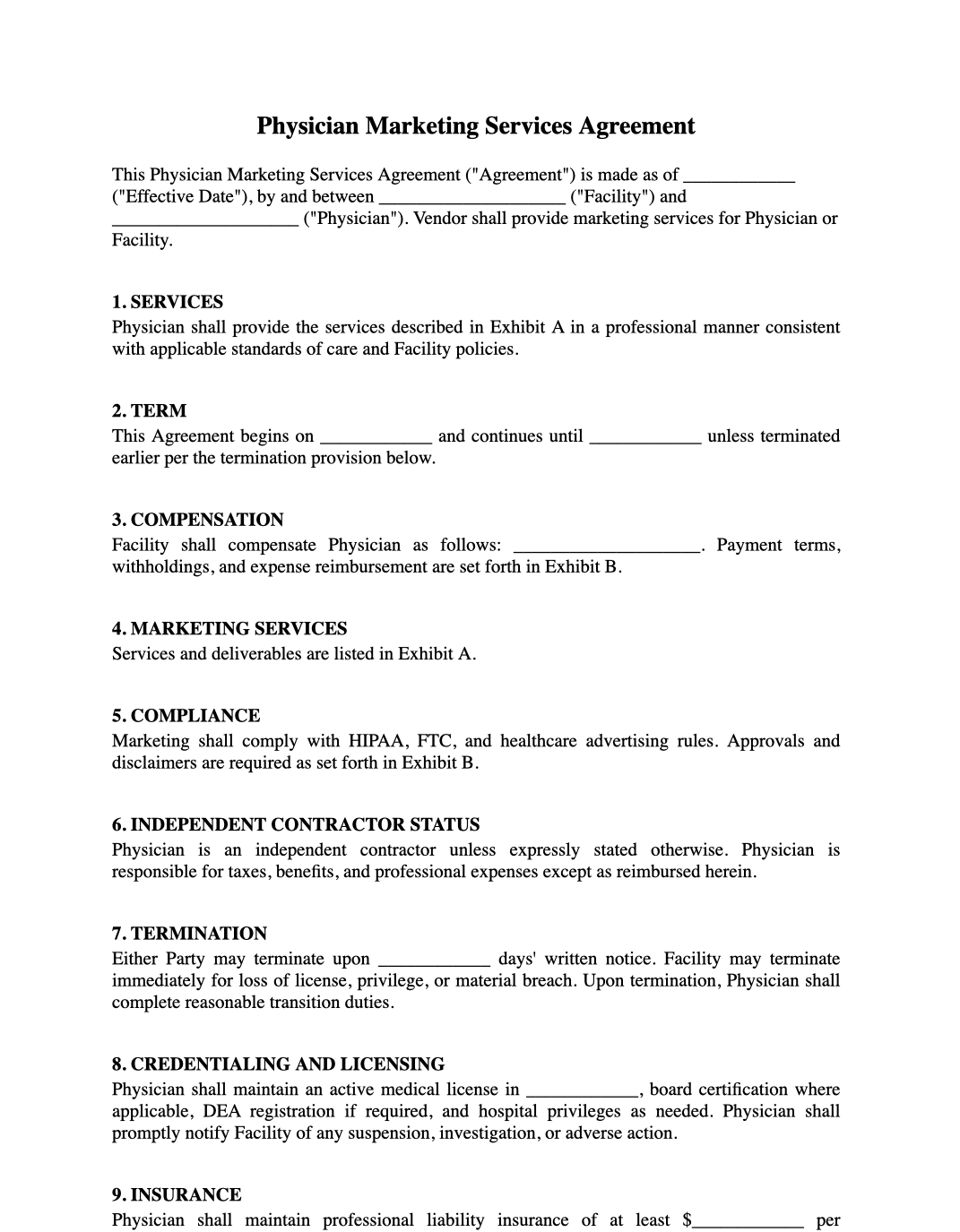
Physician Marketing Services Agreement
A Physician Marketing Services Agreement is a legal contract that establishes the terms under which a physician provides marketing, promotional, educational, brand awareness, content creation, public relations, or professional endorsement services for a healthcare organization, medical practice, pharmaceutical company, medical device manufacturer, healthcare technology company, or related business. These agreements are increasingly common as healthcare organizations seek credible clinical voices to support educational campaigns and market outreach efforts. Because physician marketing activities often involve professional reputation, regulatory compliance, patient trust, compensation arrangements, and intellectual property rights, disputes can arise when expectations are not clearly documented. A well-drafted Physician Marketing Services Agreement helps protect both the physician and the organization while supporting compliant and effective marketing efforts.
The Physician Is Asked to Endorse Claims That Feel Misleading
A healthcare technology company hires a physician to participate in a marketing campaign promoting a new patient engagement platform. The physician is attracted to the opportunity because the product appears useful and aligns with professional interests.
Initially, the physician reviews educational materials, participates in interviews, and helps explain how the platform may benefit healthcare providers. As the campaign develops, however, marketing personnel begin requesting stronger promotional statements regarding outcomes, efficiency gains, and patient satisfaction improvements.
The physician becomes uncomfortable because certain claims appear broader than what available data supports. The company argues that the statements are reasonable marketing language and necessary to remain competitive in the marketplace.
What began as an educational partnership gradually becomes a disagreement regarding professional credibility and marketing strategy. The physician worries about reputation and professional ethics, while the company focuses on maximizing the effectiveness of the campaign.
To help avoid this problem, a Physician Marketing Services Agreement should clearly define approval rights, content review procedures, permissible marketing claims, and the physician's ability to decline participation in materials that conflict with professional judgment. Clear content standards help protect both parties.
Marketing Materials Continue Being Used After the Relationship Ends
A physician agrees to participate in a series of videos, advertisements, webinars, and educational materials for a healthcare organization.
The campaign is successful, and the physician's content becomes widely distributed through websites, conferences, social media channels, and promotional materials. Several years later, the physician decides to end the relationship and pursue other opportunities.
After termination, however, the physician discovers that marketing materials featuring name, likeness, and professional credentials continue appearing in active campaigns. The organization believes it has the right to continue using materials created during the engagement.
The physician argues that ongoing use implies an endorsement that no longer exists. The organization responds that significant investments were made in creating and distributing the content.
The disagreement becomes increasingly important because both reputation and commercial value are involved.
To reduce these risks, a Physician Marketing Services Agreement should clearly define content ownership, licensing rights, post-termination usage rights, and procedures for removing or updating marketing materials after the relationship ends.
Compensation Draws Regulatory Scrutiny
A medical device company engages physicians to participate in educational and marketing initiatives designed to increase awareness of certain products and treatment options.
The physicians receive compensation for presentations, interviews, content development, and participation in marketing campaigns. Both parties believe the arrangement is legitimate and commercially reasonable.
During a compliance review, however, questions arise regarding how compensation was determined and whether payments accurately reflect the services being provided. Auditors request documentation regarding activities performed, time commitments, and the basis for compensation decisions.
Although the physicians performed valuable services, documentation supporting the arrangement is inconsistent. The company becomes concerned about demonstrating that compensation reflects legitimate marketing activities rather than improper incentives.
The physicians also worry about how the arrangement may be perceived by regulators, patients, and professional peers.
To help prevent these issues, a Physician Marketing Services Agreement should clearly define services, establish compensation based on fair market value, require activity documentation, and address applicable healthcare compliance obligations. Strong documentation can significantly reduce regulatory concerns.
Intellectual Property Ownership Becomes Unclear
A physician works closely with a healthcare company's marketing team to create articles, videos, educational guides, social media content, and training materials.
Over time, the physician contributes significant expertise and develops original content that becomes valuable to the company's marketing efforts. The materials generate substantial engagement and are incorporated into multiple campaigns.
As the relationship grows, questions emerge regarding who owns the content. The physician believes professional expertise and original contributions should remain personal intellectual property unless assigned explicitly. The company believes materials created as part of the engagement belong to the organization.
Neither side anticipated the issue when the relationship began because the focus remained on producing quality content.
What started as a collaborative project becomes a disagreement regarding ownership and future use rights.
To help avoid these disputes, a Physician Marketing Services Agreement should clearly address intellectual property ownership, licensing rights, derivative works, content modification rights, and future use permissions. Clear ownership provisions help eliminate uncertainty.
A Public Controversy Damages the Relationship
A physician serves as a public-facing representative for a healthcare brand and appears regularly in marketing campaigns.
Several years into the relationship, an unrelated public controversy emerges involving either the physician or the company. Media attention increases, public criticism grows, and stakeholders begin questioning whether the partnership should continue.
The organization worries that continued association may damage its reputation. The physician becomes concerned that marketing materials and public statements may create professional consequences beyond the original scope of the engagement.
Neither party anticipated the situation when the agreement was signed. Both want flexibility to protect their interests without creating unnecessary legal conflict.
The issue becomes especially sensitive because public perception can change rapidly and affect long-term professional opportunities.
To help reduce these risks, a Physician Marketing Services Agreement should include morality clauses, reputation protection provisions, termination rights, and procedures for addressing events that may negatively affect either party's public image.
Physician marketing relationships can create significant value by combining clinical expertise with effective communication and public education. However, issues involving promotional claims, content ownership, compensation, regulatory compliance, and reputation management can become major sources of conflict when expectations are not documented clearly. A carefully drafted Physician Marketing Services Agreement provides a structured framework for managing these relationships and protecting all parties involved. When prepared thoughtfully, it can help preserve professional credibility, support compliance efforts, reduce misunderstandings, and promote successful long-term marketing partnerships.

Get started with Upsign today!
Easily send, sign and track your documents