

Physician Investigator Agreement
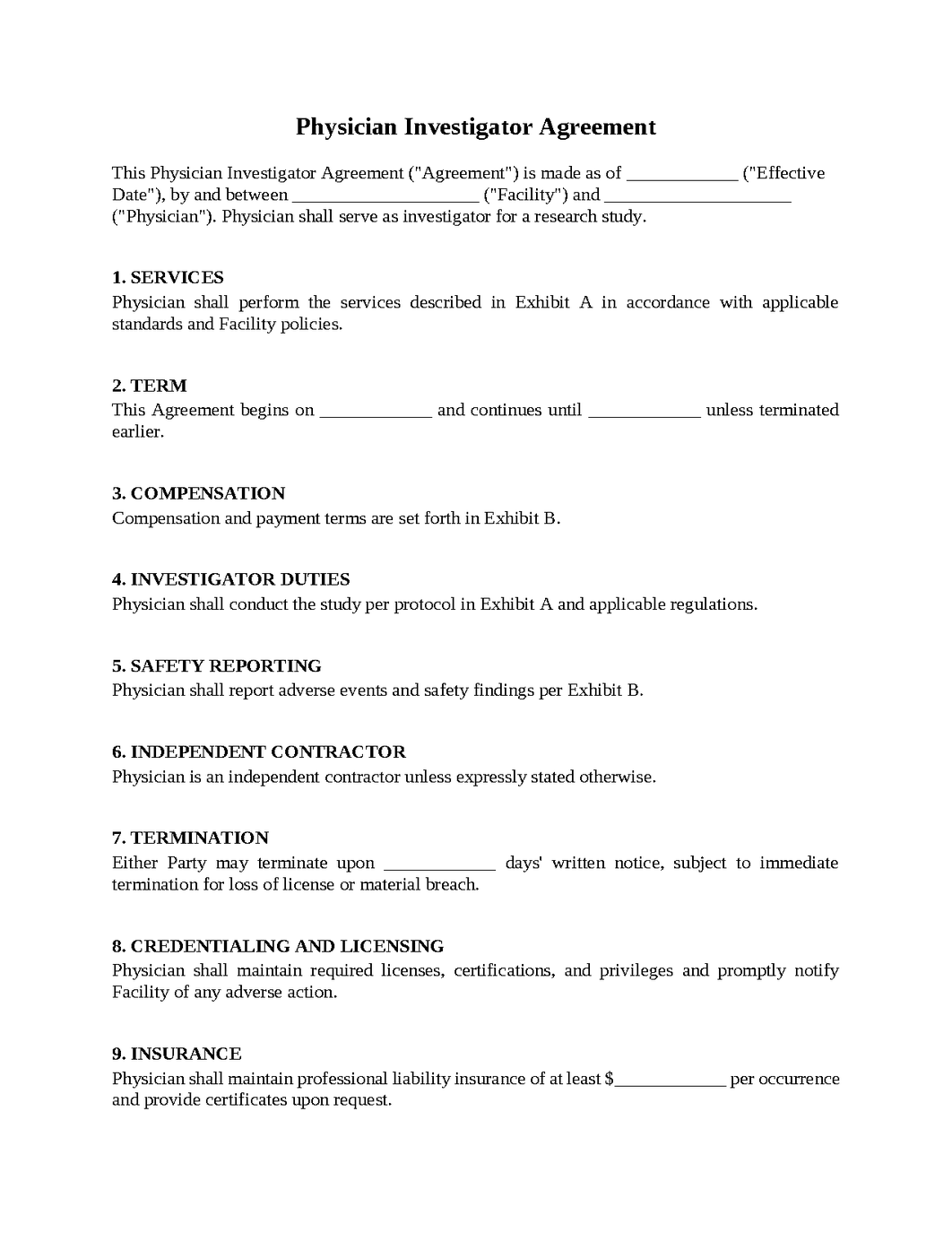
A Physician Investigator Agreement is a legal contract that establishes the terms under which a physician serves as an investigator in a clinical research study, medical trial, observational study, registry, or other research project. These agreements are commonly used by pharmaceutical companies, biotechnology firms, medical device manufacturers, contract research organizations, hospitals, universities, and healthcare systems. A Physician Investigator Agreement typically addresses study responsibilities, patient enrollment, protocol compliance, regulatory obligations, compensation, confidentiality, intellectual property, publication rights, and study termination procedures. Because physician investigators play a critical role in protecting participants and ensuring the integrity of research data, disputes can arise when expectations are not clearly documented. A well-drafted Physician Investigator Agreement helps support successful research while protecting all parties involved.
The Physician Delegates Too Much Responsibility to Staff
A physician agrees to serve as the principal investigator for a multi-site clinical study involving complex patient monitoring requirements and extensive regulatory documentation.
At the outset, the physician assembles an experienced research team and delegates many day-to-day administrative tasks to study coordinators and support staff. The arrangement appears efficient because the physician remains available for major clinical decisions while staff handle routine operational responsibilities.
As the study progresses, however, sponsor audits reveal inconsistencies in data collection, missed protocol deadlines, and incomplete regulatory documentation. The physician argues that staff members were responsible for those activities and that corrective action can be taken.
The sponsor takes a different view and emphasizes that the principal investigator remains ultimately responsible for study conduct regardless of delegation. What began as an operational issue evolves into a disagreement regarding accountability and oversight responsibilities.
To help avoid this problem, a Physician Investigator Agreement should clearly define supervisory obligations, identify responsibilities that may be delegated, establish oversight expectations, and clarify that ultimate responsibility for study compliance remains with the investigator. Detailed accountability provisions help prevent confusion when problems arise.
Patient Consent Procedures Become Controversial
A physician investigator participates in a clinical study involving patients with a chronic medical condition. Before enrollment, participants must complete a detailed informed consent process explaining the risks, benefits, and alternatives associated with the study.
Initially, the consent process appears to function smoothly. As enrollment accelerates, however, several participants later claim they did not fully understand certain study requirements and potential risks.
The physician believes the consent process complied with applicable standards and that participants received adequate information. The sponsor becomes concerned because participant complaints can create regulatory scrutiny and undermine confidence in the study.
Investigators, study coordinators, and sponsor representatives begin reviewing consent procedures to determine whether improvements are needed. The disagreement focuses less on intent and more on whether expectations regarding informed consent were sufficiently clear.
To reduce these risks, a Physician Investigator Agreement should establish detailed consent procedures, identify documentation requirements, define investigator responsibilities during participant discussions, and require compliance with all applicable ethical and regulatory standards.
Compensation Disputes Arise Over Study Milestones
A medical device company contracts with a physician investigator to participate in a long-term clinical study. Compensation is structured around patient enrollment, study visits, data collection milestones, and regulatory reporting activities.
At first, both parties believe the payment structure is straightforward. Over time, however, disagreements emerge regarding when certain milestones are considered complete. The physician believes substantial work has been performed and invoices accordingly.
The sponsor argues that some deliverables remain incomplete because documentation deficiencies and unresolved queries prevent final acceptance. As more patients are enrolled, the financial significance of the disagreement grows.
The physician becomes concerned about delayed payments, while the sponsor insists that compensation should only be paid after contractual requirements have been satisfied.
What should have been a routine payment process becomes an ongoing source of tension.
To help avoid these disputes, a Physician Investigator Agreement should clearly define payment milestones, acceptance criteria, invoicing procedures, and dispute-resolution mechanisms. Detailed compensation provisions help ensure both parties understand when payments are earned.
Confidential Research Information Is Shared Improperly
A physician investigator gains access to confidential study protocols, preliminary results, proprietary methodologies, and sponsor business strategies while participating in a research project.
The physician also remains active in academic medicine and regularly attends conferences, collaborates with peers, and participates in professional discussions. During one such discussion, information related to the study is referenced in a manner that the sponsor believes reveals confidential details.
The physician argues that no confidential documents were disclosed and that the comments reflected general scientific observations. The sponsor worries that sensitive information may have reached competitors or influenced public perceptions of the study.
The disagreement highlights the difficulty of balancing scientific collaboration with confidentiality obligations.
Neither party intended harm, but both have legitimate concerns regarding information sharing.
To help prevent these issues, a Physician Investigator Agreement should clearly define confidential information, establish disclosure restrictions, identify permissible scientific communications, and specify obligations that continue after the study concludes.
The Investigator Leaves Before the Study Is Complete
A physician serves as principal investigator for a multi-year research project involving hundreds of participants and extensive follow-up requirements.
Several years into the study, the physician accepts a leadership position at another institution and plans to relocate. The decision creates immediate concerns because numerous participants remain active in the study and substantial data collection activities are still underway.
The sponsor wants continuity and worries about disruptions to patient follow-up and regulatory compliance. The physician is committed to assisting with the transition but also needs to focus on new professional responsibilities.
Questions arise regarding transfer of records, participant communications, delegation of responsibilities, and approval of a replacement investigator. Without a clear transition process, uncertainty begins affecting study operations.
To reduce these risks, a Physician Investigator Agreement should establish transition procedures, define responsibilities during investigator changes, require cooperation in transferring study activities, and identify sponsor approval rights for replacement investigators. Careful planning helps maintain study integrity during leadership transitions.
Physician investigators play a vital role in advancing medical research, protecting study participants, and ensuring the integrity of scientific data. However, issues involving delegation, informed consent, compensation, confidentiality, and investigator transitions can become significant sources of conflict when expectations are not documented clearly. A carefully drafted Physician Investigator Agreement provides a structured framework for managing these responsibilities and supporting successful research efforts. When prepared thoughtfully, it can help strengthen regulatory compliance, protect participant welfare, reduce misunderstandings, and promote high-quality scientific research.

Get started with Upsign today!
Easily send, sign and track your documents