

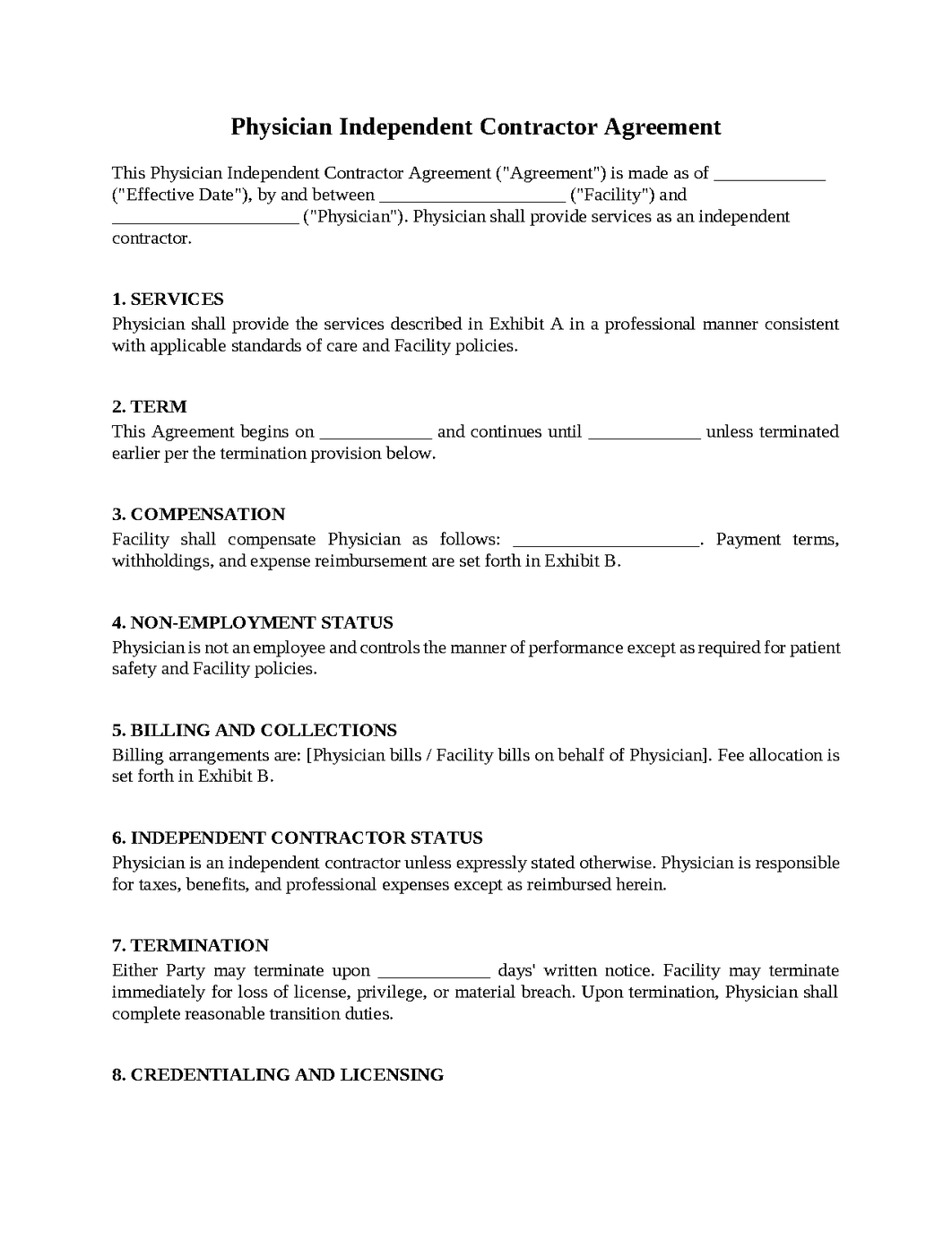
Physician Independent Contractor Agreement
A Physician Independent Contractor Agreement is a legal contract that establishes the terms under which a physician provides medical services as an independent contractor rather than as an employee. These agreements are commonly used for locum tenens arrangements, specialty coverage services, medical directorships, telemedicine services, emergency department staffing, consulting engagements, and part-time clinical assignments. Unlike employment agreements, independent contractor relationships typically involve different tax treatment, benefit structures, scheduling flexibility, and liability considerations. Because the distinction between an employee and an independent contractor carries significant legal, financial, and regulatory consequences, disputes frequently arise when expectations are not documented clearly. A well-drafted Physician Independent Contractor Agreement helps define the relationship and reduce uncertainty regarding each party's responsibilities.
The Physician Is Treated Like an Employee
A hospital contracts with a physician to provide specialty coverage on an independent contractor basis. The arrangement appears attractive because it offers scheduling flexibility and avoids many of the administrative requirements associated with employment.
Initially, both parties are satisfied. As time passes, however, the hospital begins exercising increasing control over the physician's daily activities. Work schedules are assigned unilaterally, attendance at staff meetings becomes mandatory, and the physician is required to follow workplace policies that closely resemble those imposed on employees.
The physician starts questioning whether the relationship is truly that of an independent contractor. At the same time, the hospital continues treating the physician as a contractor for tax and benefit purposes.
When the relationship eventually ends, disagreements arise regarding unpaid benefits, tax obligations, and worker classification. Regulatory agencies become involved, and both parties face the possibility of financial exposure associated with an improper classification.
To help avoid this problem, a Physician Independent Contractor Agreement should clearly define the independent nature of the relationship, specify the degree of control retained by each party, and ensure that operational practices remain consistent with contractor status. The agreement should also address tax responsibilities, benefits eligibility, and compliance with applicable worker-classification laws.
Compensation Terms Lead to Billing Disputes
A healthcare system hires a physician contractor to provide weekend coverage at several facilities. Compensation is based on a combination of hourly rates and additional payments for certain procedures performed during coverage periods.
For the first few months, payments appear accurate. As patient volume increases, however, disagreements begin emerging regarding how compensation should be calculated. The physician believes certain services qualify for additional payments, while the healthcare system interprets the agreement differently.
The problem worsens because billing records, procedure classifications, and payment calculations are not addressed in sufficient detail within the contract. Each monthly invoice generates new questions, and trust begins deteriorating.
Eventually, the physician claims substantial amounts remain unpaid. The healthcare system insists it has paid exactly what the agreement requires.
What began as a productive working relationship becomes a financial dispute that could have been avoided through clearer drafting.
To reduce these risks, a Physician Independent Contractor Agreement should clearly define compensation formulas, billing procedures, invoicing requirements, payment timelines, and any circumstances that trigger additional compensation. Detailed payment provisions help ensure both parties share the same expectations from the outset.
Malpractice Coverage Creates Uncertainty
A physician enters into an independent contractor arrangement with a medical group that needs temporary specialty coverage.
During contract negotiations, both parties focus primarily on scheduling and compensation. Because malpractice insurance already exists through several professional relationships, neither side spends much time discussing liability coverage.
Months later, a patient files a claim relating to services performed under the agreement. The physician assumes the medical group's insurance policy will provide protection. The medical group assumes the physician is responsible for maintaining independent coverage.
The disagreement becomes serious because defending the claim will be expensive regardless of the outcome. Both parties review the contract and discover that insurance responsibilities were addressed only vaguely.
As attorneys and insurance carriers become involved, uncertainty regarding coverage creates additional legal and financial complications.
To help avoid these disputes, a Physician Independent Contractor Agreement should clearly identify insurance requirements, minimum coverage limits, responsibility for premiums, and obligations relating to tail coverage. The agreement should leave no uncertainty regarding which party bears responsibility for professional liability protection.
Regulatory Compliance Problems Arise
A physician contracts with a healthcare organization to provide telemedicine services across multiple jurisdictions.
Initially, the arrangement operates smoothly. As the practice expands, however, questions arise regarding licensing requirements, documentation standards, billing practices, and regulatory compliance obligations in various states.
The healthcare organization assumes the physician is responsible for maintaining all required licenses and certifications. The physician assumes the organization has verified that services may be provided legally in each jurisdiction.
When a compliance issue is identified, both parties attempt to shift responsibility to the other.
The resulting investigation creates operational disruption and potential financial exposure. What started as a routine contractor relationship becomes a significant regulatory concern because responsibilities were never allocated clearly.
To reduce these risks, a Physician Independent Contractor Agreement should address licensing requirements, compliance obligations, credentialing responsibilities, documentation standards, and cooperation during regulatory investigations. Clearly assigning these responsibilities can significantly reduce future disputes.
The Relationship Ends Suddenly
A physician provides independent contractor services to a busy medical practice for several years. During that time, patients become familiar with the physician, scheduling systems are built around availability, and referral relationships develop.
Without warning, the practice decides to terminate the arrangement and replace the contractor with a full-time employee. The physician receives minimal notice and suddenly loses a substantial source of income.
At the same time, the practice struggles to maintain patient coverage during the transition. Questions arise regarding unfinished patient care responsibilities, access to medical records, outstanding invoices, and final compensation.
Both parties become frustrated because neither anticipated the abrupt ending of the relationship.
The transition proves disruptive not only for the physician and practice but also for patients who relied upon continuity of care.
To help prevent these issues, a Physician Independent Contractor Agreement should establish termination procedures, notice requirements, transition obligations, final payment timelines, and responsibilities relating to ongoing patient care. Clear exit provisions can reduce disruption and protect all parties when the relationship concludes.
Physician independent contractor relationships offer flexibility and specialized expertise, but they also create unique legal and operational challenges. Worker classification issues, compensation disputes, malpractice coverage concerns, regulatory obligations, and termination procedures can all become sources of conflict if expectations are not documented carefully. A well-drafted Physician Independent Contractor Agreement provides a structured framework for defining responsibilities and protecting both parties. When prepared thoughtfully, it can help reduce misunderstandings, support regulatory compliance, preserve professional relationships, and promote successful healthcare operations.

Get started with Upsign today!
Easily send, sign and track your documents