

Physician Credentialing Agreement
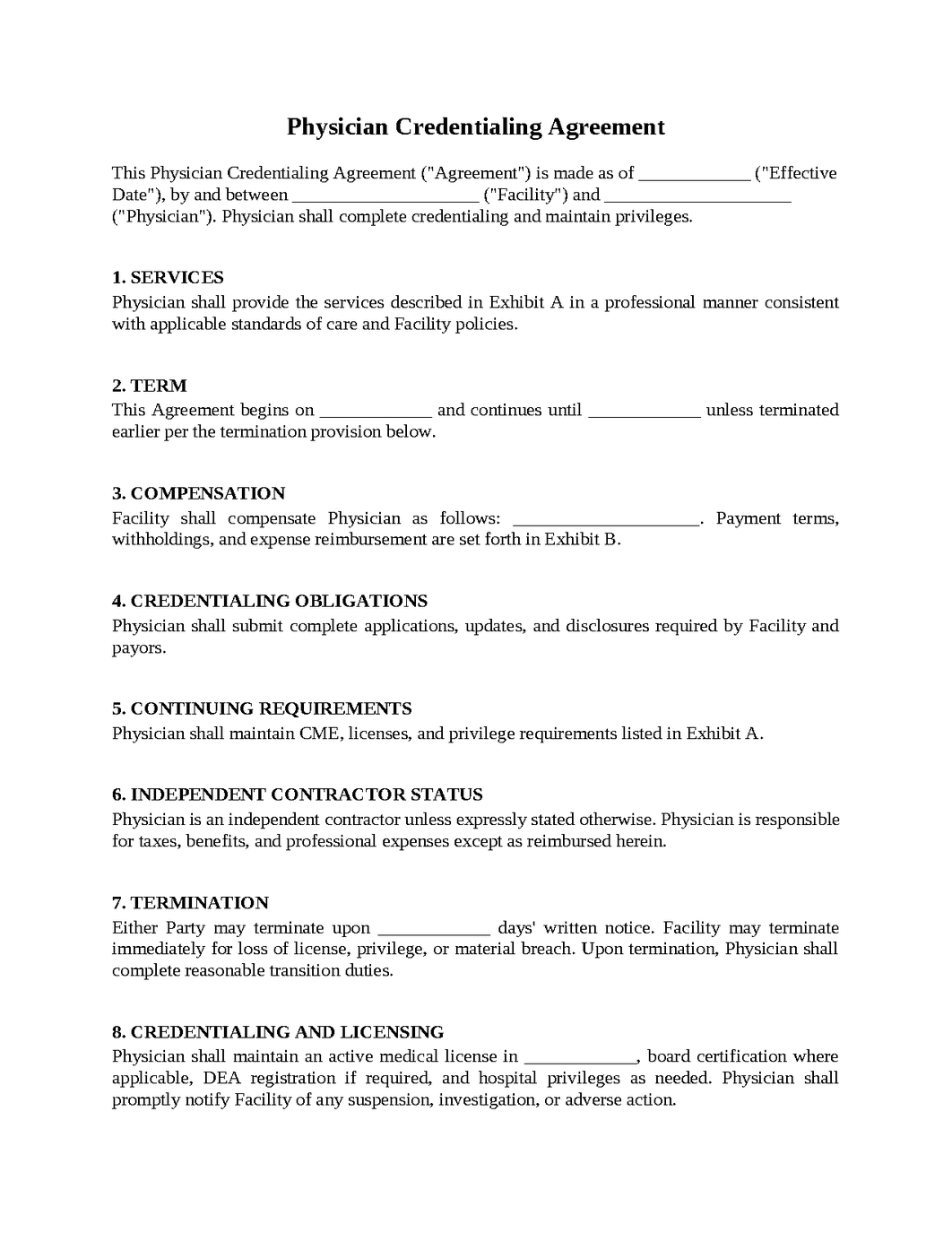
A Physician Credentialing Agreement is a legal contract that establishes the terms under which a physician undergoes credentialing, verification, enrollment, and approval processes with a hospital, healthcare system, insurance network, medical group, telemedicine provider, or credentialing organization. These agreements commonly address licensing verification, education review, board certifications, malpractice history, payer enrollment, ongoing reporting obligations, and compliance requirements. Because credentialing directly affects a physician's ability to provide services, receive reimbursement, and maintain professional privileges, disputes can arise when responsibilities and expectations are not clearly documented. A well-drafted Physician Credentialing Agreement helps streamline the credentialing process while reducing administrative and regulatory risks.
Missing Documentation Delays the Entire Process
A physician accepts a position with a growing healthcare organization and is eager to begin seeing patients. Both the physician and the organization anticipate a smooth onboarding process because the physician has extensive experience, active licenses, and strong professional credentials.
As credentialing begins, however, problems quickly emerge. Certain training records are difficult to locate, prior employment verifications remain outstanding, and a former institution takes weeks to respond to information requests. Small delays begin accumulating and create larger scheduling problems.
The healthcare organization expected the physician to become operational by a specific date and has already begun scheduling patients. The physician becomes frustrated because many of the delays involve third parties outside of direct control.
As weeks pass, revenue opportunities are lost and staffing plans must be adjusted. Both sides become increasingly frustrated even though neither intentionally caused the delays.
To help avoid this problem, a Physician Credentialing Agreement should clearly identify documentation requirements, establish submission deadlines, allocate responsibility for obtaining records, and address the consequences of delayed credentialing. Detailed timelines help both parties understand what is required for successful approval.
A Prior Disclosure Creates Unexpected Issues
A hospital begins credentialing a physician who has practiced successfully for many years without significant professional problems.
During the review process, credentialing staff discover a prior malpractice claim that was settled years earlier. The physician disclosed the matter accurately and believes it was resolved long ago. Credentialing personnel, however, request additional information and supporting documentation before moving forward.
The physician becomes concerned that a previously resolved matter may jeopardize credentialing approval. The hospital wants to conduct a thorough review to ensure compliance with internal policies and accreditation requirements.
As additional questions arise, both parties spend substantial time gathering records and explaining events that occurred many years earlier. The process becomes far more complicated than anyone anticipated.
Although no wrongdoing occurred, uncertainty develops because expectations regarding disclosures and review procedures were never fully discussed.
To reduce these risks, a Physician Credentialing Agreement should clearly define disclosure requirements, establish review procedures for prior claims or disciplinary matters, and identify how potentially adverse information will be evaluated. Transparency helps reduce misunderstandings during the credentialing process.
Payer Enrollment Responsibilities Become Confusing
A physician joins a specialty practice and completes hospital credentialing successfully. Both the physician and practice assume that patient services can begin immediately.
Shortly after opening the schedule, however, the practice discovers that enrollment with several insurance carriers remains incomplete. Claims submitted for patient services cannot be processed properly because the physician has not yet been approved within certain payer networks.
The physician assumes the practice is handling enrollment activities. The practice believes the physician is responsible for providing additional information necessary to complete the process.
As claim denials begin accumulating, financial consequences become significant. Patients become confused regarding coverage, and administrative staff spend countless hours addressing reimbursement problems.
What initially appeared to be a simple credentialing issue evolves into a costly operational challenge.
To help prevent these disputes, a Physician Credentialing Agreement should clearly allocate responsibility for payer enrollment activities, establish timelines for completion, identify documentation requirements, and define cooperation obligations throughout the enrollment process.
Ongoing Reporting Obligations Are Overlooked
A physician successfully completes credentialing and begins practicing within a healthcare organization.
Several years later, the physician renews a professional license and experiences a minor regulatory issue that requires disclosure under organizational policies. Because the physician does not realize the event triggers reporting obligations, the matter is not communicated promptly.
The issue eventually comes to the organization's attention through another source. Credentialing staff become concerned because reporting requirements exist specifically to ensure ongoing compliance and risk management.
The physician explains that there was no intent to conceal information and simply misunderstood the reporting obligations. The organization acknowledges the explanation but remains concerned about maintaining compliance standards.
The disagreement centers not on the underlying issue but on whether disclosure obligations were understood clearly.
To help avoid these problems, a Physician Credentialing Agreement should establish ongoing reporting requirements, identify events that require disclosure, define reporting timelines, and explain the consequences of failing to provide timely notice.
Credentialing Privileges Are Suspended Unexpectedly
A physician has maintained privileges and credentials with a healthcare organization for many years without difficulty.
During a routine recredentialing review, administrators discover that certain continuing education records have not been submitted and several required documents are missing from the physician's file. Although the physician remains fully qualified, organizational policies require complete documentation before credentials can be renewed.
Because the deficiencies are not corrected immediately, credentialing privileges are suspended temporarily. Patient appointments must be rescheduled, procedures are postponed, and revenue opportunities are lost.
The physician believes the organization should have provided additional notice before taking action. The organization argues that repeated reminders were issued and compliance deadlines were clearly established.
The situation creates unnecessary disruption for patients, providers, and staff.
To reduce these risks, a Physician Credentialing Agreement should establish recredentialing procedures, identify renewal requirements, define notice obligations, and provide clear timelines for correcting deficiencies before privileges are affected.
Physician credentialing is a critical process that protects patients, supports regulatory compliance, and ensures that healthcare organizations maintain high professional standards. However, issues involving documentation, disclosures, payer enrollment, ongoing reporting requirements, and recredentialing can become significant sources of conflict when expectations are not documented clearly. A carefully drafted Physician Credentialing Agreement provides a structured framework for managing these responsibilities and supporting efficient credentialing operations. When prepared thoughtfully, it can help reduce delays, improve compliance, protect professional opportunities, and promote successful healthcare operations.

Get started with Upsign today!
Easily send, sign and track your documents