

Physician Co-Management Agreement
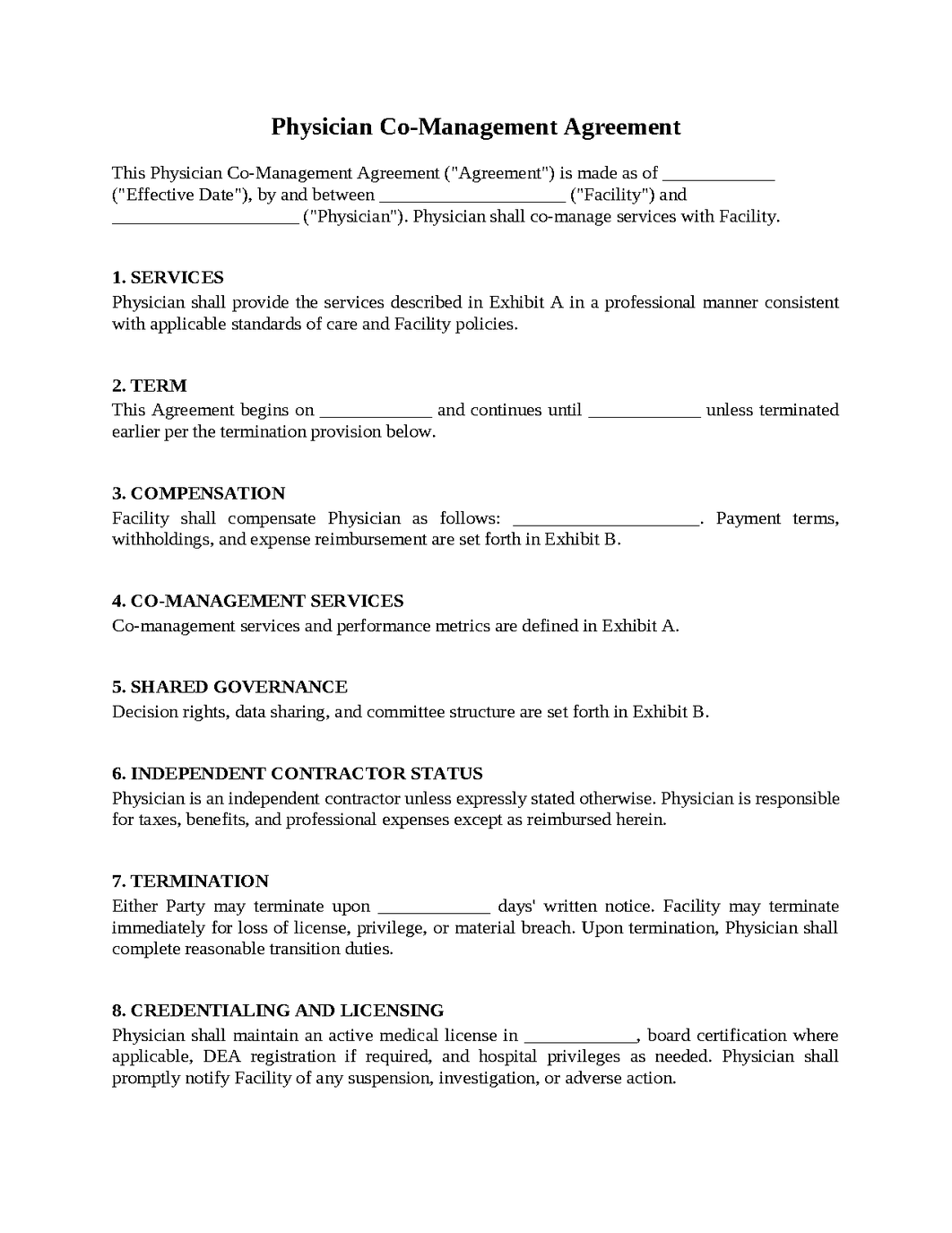
A Physician Co-Management Agreement is a legal contract that establishes the terms under which physicians participate in the management, oversight, quality improvement, and operational performance of a healthcare service line, department, facility, or clinical program. These agreements are commonly used by hospitals, surgical centers, cardiovascular programs, orthopedic service lines, oncology departments, and other healthcare organizations seeking greater physician involvement in operational leadership. Unlike traditional clinical arrangements, co-management agreements often compensate physicians for administrative services, quality initiatives, efficiency improvements, strategic planning, and performance-based objectives. Because these arrangements involve both financial incentives and patient care responsibilities, disputes can arise when expectations are not clearly documented. A well-drafted Physician Co-Management Agreement helps align incentives while protecting the interests of physicians, healthcare organizations, and patients.
Performance Goals Are Not Clearly Defined
A hospital enters into a co-management arrangement with a group of orthopedic surgeons to improve operational efficiency, patient satisfaction, and quality outcomes within the orthopedic service line.
At the beginning of the relationship, both parties are enthusiastic. Hospital leadership believes physician involvement will improve performance, while the physicians appreciate the opportunity to influence operational decisions affecting patient care. The agreement references quality improvement goals and performance metrics, but many of the benchmarks are described only in general terms.
As the first year progresses, disagreements begin emerging regarding whether the physicians have successfully met the agreed-upon objectives. The physicians point to reduced wait times, improved patient feedback, and stronger physician engagement. Hospital administrators focus on different measures and argue that certain performance targets were not achieved.
Neither side believes it is acting unfairly. The problem is that the agreement never established objective standards for measuring success. What should have been a straightforward evaluation of performance becomes a debate about how performance should be measured.
To help avoid this problem, a Physician Co-Management Agreement should clearly define performance metrics, establish measurement methodologies, identify data sources, and explain how achievement will be evaluated. Objective standards help ensure that both parties share the same expectations from the beginning.
Administrative Responsibilities Become Overwhelming
A cardiovascular service line engages several physicians under a co-management arrangement intended to improve quality and operational performance.
Initially, the physicians expect to attend periodic meetings, review performance reports, and provide strategic guidance. As the program evolves, however, hospital leadership begins requesting additional involvement. Physicians are asked to participate in staffing discussions, vendor evaluations, accreditation efforts, committee meetings, budgeting reviews, and operational planning sessions.
While each request appears reasonable individually, the cumulative workload becomes substantial. The physicians find themselves devoting significantly more time to administrative activities than they originally anticipated.
The hospital believes the expanded involvement demonstrates the success of the co-management model. The physicians become concerned that the arrangement is interfering with patient care responsibilities and consuming far more time than contemplated when the agreement was signed.
The disagreement develops gradually because the agreement never clearly established limits on the scope of management services.
To reduce these risks, a Physician Co-Management Agreement should define administrative responsibilities carefully, establish expected time commitments, identify required activities, and provide procedures for approving additional duties. The agreement should also address compensation adjustments if management responsibilities increase materially.
Compensation Draws Regulatory Scrutiny
A hospital compensates a physician management company under a co-management arrangement designed to improve quality and operational performance.
For several years, the relationship appears successful. Quality metrics improve, physician participation increases, and both parties view the arrangement positively. During a routine compliance review, however, questions arise regarding the compensation structure.
Auditors request documentation showing the services provided, time devoted to management activities, performance results achieved, and the methodology used to determine compensation. The hospital discovers that documentation practices have varied over time, and some records are less detailed than expected.
The physicians become concerned because they want assurance that compensation is tied to legitimate services and not perceived as payment for referrals or patient volume. Hospital leadership shares the concern because regulatory compliance is essential to maintaining the program.
Although no improper conduct occurred, inadequate documentation creates unnecessary scrutiny and administrative burden.
To help prevent these issues, a Physician Co-Management Agreement should clearly describe services, establish fair market value compensation, require detailed documentation of activities, and address applicable healthcare compliance requirements. Strong documentation helps demonstrate the legitimacy of the arrangement.
Decision-Making Authority Creates Conflict
A healthcare organization establishes a co-management structure to encourage physician involvement in operational decisions affecting a surgical service line.
The physicians assume that participation in management means they will have meaningful authority to influence policies, staffing decisions, equipment purchases, and quality initiatives. Hospital administrators view the arrangement differently and believe physicians are serving primarily in an advisory role.
The difference in expectations becomes apparent when the physicians recommend operational changes designed to improve efficiency and patient outcomes. Some recommendations are implemented, while others are delayed or rejected.
The physicians become frustrated because they believe their expertise is not being utilized effectively. Hospital leadership becomes concerned that physicians expect authority beyond what the organization is prepared to delegate.
The resulting tension undermines the collaborative spirit that the co-management arrangement was intended to create.
To help avoid these disputes, a Physician Co-Management Agreement should clearly define decision-making authority, identify advisory versus operational responsibilities, establish reporting relationships, and explain how recommendations will be evaluated and implemented.
The Co-Management Relationship Ends Abruptly
A hospital and a physician management group maintain a successful co-management relationship for nearly a decade. During that time, the physicians help develop quality programs, performance metrics, operational protocols, and strategic initiatives that become central to the service line's success.
Eventually, the hospital decides to reorganize its management structure and terminate the arrangement. Although the decision is based on broader organizational goals, neither party has established a detailed transition plan.
Numerous projects remain underway. Quality initiatives are midstream, performance reviews are pending, and committees continue relying on physician leadership. Staff members are uncertain who will assume responsibility for ongoing efforts after the agreement ends.
The physicians want a reasonable transition period to ensure continuity, while the hospital seeks flexibility to implement its new structure quickly. What should be a manageable organizational change becomes complicated by uncertainty regarding ongoing responsibilities.
To help prevent these problems, a Physician Co-Management Agreement should establish notice requirements, transition obligations, record-transfer procedures, and responsibilities for unfinished initiatives. Thoughtful transition planning can help preserve operational continuity and reduce disruption when the relationship concludes.
Physician co-management arrangements can create significant value by combining clinical expertise with operational leadership. However, issues involving performance metrics, administrative responsibilities, compensation, decision-making authority, and transition planning can become sources of conflict when expectations are not documented clearly. A carefully drafted Physician Co-Management Agreement provides a structured framework for managing these relationships and aligning incentives among all parties. When prepared thoughtfully, it can help improve healthcare quality, support regulatory compliance, strengthen physician engagement, and promote long-term organizational success.

Get started with Upsign today!
Easily send, sign and track your documents