

Physician Assistant Supervisory Agreement
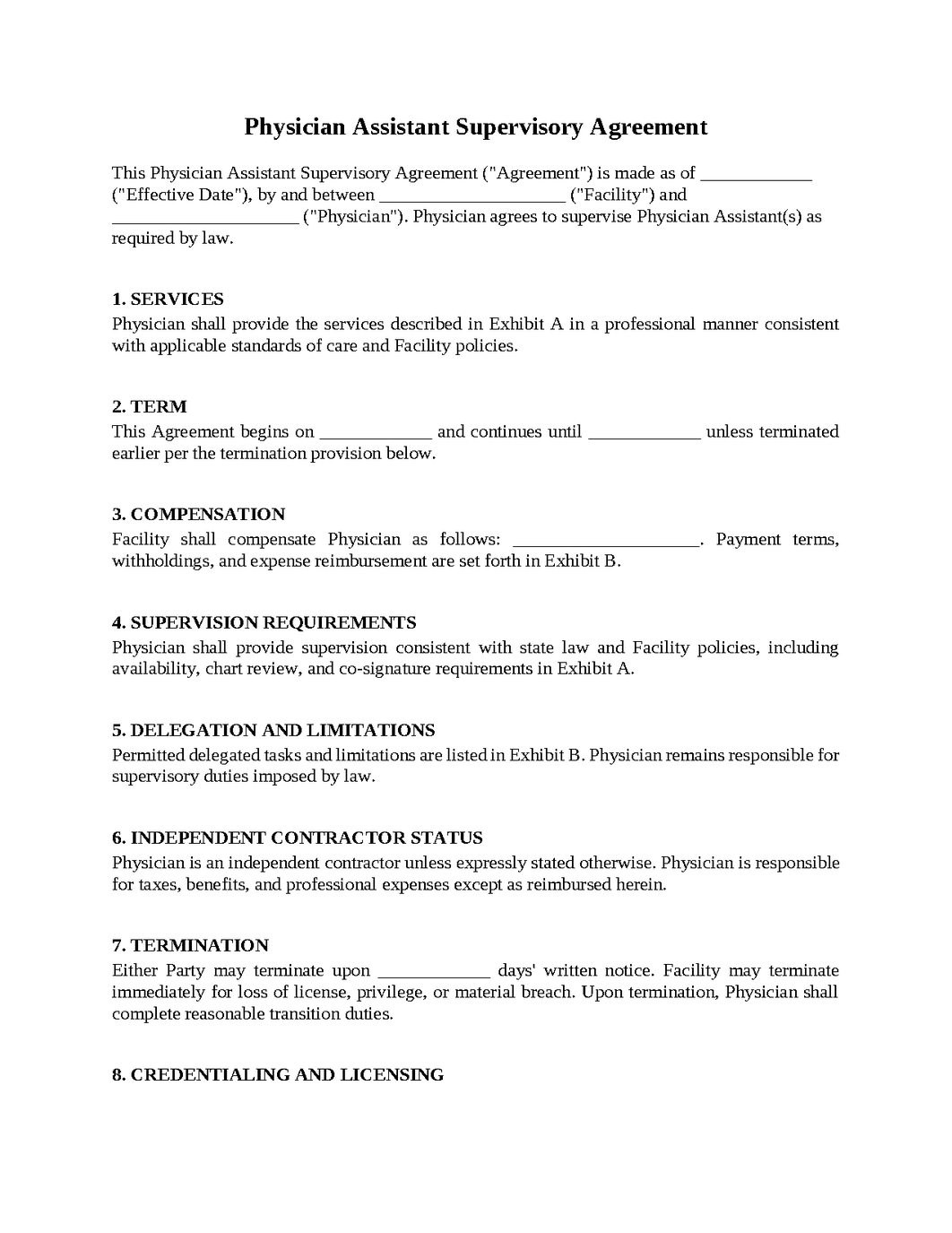
A Physician Assistant Supervisory Agreement is a legal contract that establishes the professional relationship between a physician and a physician assistant (PA), defining how supervision, collaboration, patient care responsibilities, and regulatory compliance obligations will be managed. These agreements are commonly required by state laws, healthcare organizations, hospitals, medical groups, and specialty practices. A Physician Assistant Supervisory Agreement typically addresses the scope of delegated duties, consultation requirements, chart review procedures, prescribing authority, supervision standards, and responsibilities during physician absences. Because patient care, professional licensure, and regulatory compliance are involved, misunderstandings can create significant legal and operational risks. A well-drafted Physician Assistant Supervisory Agreement helps establish clear expectations and supports safe, compliant healthcare delivery.
The Scope of Delegated Authority Is Never Clearly Defined
A busy family medicine practice hires a physician assistant to help meet growing patient demand. During onboarding, the supervising physician explains that the physician assistant will handle routine patient visits, follow-up appointments, and certain diagnostic evaluations.
Initially, the arrangement functions well because both professionals communicate frequently and work closely together. As the practice grows, however, patient volume increases significantly and schedules become more demanding. The physician assistant begins handling increasingly complex cases in an effort to keep up with demand.
Over time, uncertainty develops regarding which services may be performed independently and which situations require physician involvement. The physician assistant believes certain cases fall within professional competence, while the supervising physician expects consultation before specific decisions are made.
The disagreement becomes particularly concerning when a patient experiences complications and questions arise regarding whether the physician assistant exceeded delegated authority. What began as an operational issue now carries potential regulatory and liability implications.
To help avoid this problem, a Physician Assistant Supervisory Agreement should clearly define the physician assistant's scope of authority, identify services that may be performed independently, establish consultation requirements, and describe circumstances that require direct physician involvement. Detailed guidance can significantly reduce uncertainty when clinical judgment calls arise.
Availability Requirements Create Operational Problems
A physician assistant joins a specialty practice that serves patients across several clinic locations. The supervising physician travels frequently between offices and occasionally participates in conferences, training programs, and professional activities outside the practice.
At the beginning of the relationship, communication occurs easily because patient volumes remain manageable. As the practice expands, however, the physician assistant begins encountering situations that require physician input more frequently.
On several occasions, the supervising physician is unavailable for extended periods due to travel or competing obligations. The physician assistant becomes frustrated because guidance is not always available when needed. The physician, meanwhile, believes reasonable efforts are being made to remain accessible.
Tension develops as both parties struggle to determine what level of availability is required under the supervisory arrangement. Patient care decisions become more difficult, and operational efficiency suffers.
To reduce these risks, a Physician Assistant Supervisory Agreement should establish clear availability requirements, communication expectations, backup supervision procedures, and protocols for handling situations when the supervising physician cannot be reached. These provisions help ensure continuity of care and reduce operational uncertainty.
Chart Review Expectations Become a Compliance Concern
A physician assistant provides patient care under a supervisory arrangement that requires periodic review of patient charts by the supervising physician.
During the first several months, chart reviews occur consistently and documentation requirements are satisfied. As patient volume increases and administrative demands grow, however, the review process begins falling behind schedule.
The physician assumes reviews can be completed later when time permits. The physician assistant believes the responsibility rests primarily with the supervising physician. Months pass before either party realizes that required reviews have not been performed consistently.
During a routine audit, regulators request documentation regarding supervision and chart review procedures. The practice struggles to demonstrate compliance because records are incomplete.
What started as a simple administrative oversight becomes a significant regulatory concern.
To help avoid these problems, a Physician Assistant Supervisory Agreement should establish chart review requirements, identify review frequency, assign responsibility for documentation, and create procedures for monitoring compliance. Clear expectations help ensure that supervisory obligations are consistently satisfied.
Prescribing Authority Leads to Disagreement
A physician assistant works in a medical practice where prescribing authority is delegated under applicable state law and organizational policies.
Initially, prescribing decisions involve routine medications and common treatment plans. As the physician assistant gains experience, more complex prescribing situations begin arising.
Questions emerge regarding which medications require physician approval, which prescriptions may be issued independently, and how controlled substances should be handled. The physician assistant believes certain prescribing decisions fall within delegated authority. The supervising physician prefers a more conservative approach.
The disagreement grows because neither party can point to detailed guidance within the supervisory arrangement. Both are attempting to protect patients while complying with applicable regulations, yet they have different interpretations of their responsibilities.
The uncertainty creates frustration and increases the risk of compliance issues.
To help prevent these disputes, a Physician Assistant Supervisory Agreement should clearly address prescribing authority, consultation requirements, medication restrictions, controlled substance procedures, and compliance obligations. Detailed prescribing provisions can help ensure consistency and reduce risk.
A Patient Complaint Triggers Questions About Responsibility
A physician assistant evaluates and treats a patient under the supervision of a physician. Several weeks later, the patient files a complaint alleging that important symptoms were not addressed appropriately during the visit.
An internal investigation begins. The physician assistant believes the care provided was appropriate and consistent with training and experience. The supervising physician reviews the matter and discovers that different clinical decisions may have been made if consultation had occurred earlier.
As the investigation continues, questions arise regarding supervision procedures, communication expectations, and responsibility for patient outcomes. Both professionals are concerned about protecting patients and complying with professional standards.
The situation becomes increasingly complicated because patient care responsibilities were shared, yet the exact boundaries of those responsibilities were never documented clearly.
What began as a routine patient encounter evolves into a dispute regarding supervision and accountability.
To reduce these risks, a Physician Assistant Supervisory Agreement should clearly allocate responsibilities, establish consultation protocols, document supervision procedures, and address how patient care concerns will be reviewed. Clear drafting can help protect both professionals while supporting high-quality patient care.
Physician assistants play an increasingly important role in healthcare delivery, helping expand access to care and improve operational efficiency. However, supervisory relationships require careful planning to ensure that responsibilities, authority, and compliance obligations are clearly understood. Issues involving delegated authority, physician availability, chart reviews, prescribing authority, and patient care accountability can all become sources of conflict if expectations are not documented properly. A well-drafted Physician Assistant Supervisory Agreement provides a structured framework for addressing these challenges and supporting effective collaboration. When prepared thoughtfully, it can help protect patients, promote regulatory compliance, reduce misunderstandings, and strengthen the professional relationship between the physician and physician assistant.

Get started with Upsign today!
Easily send, sign and track your documents