

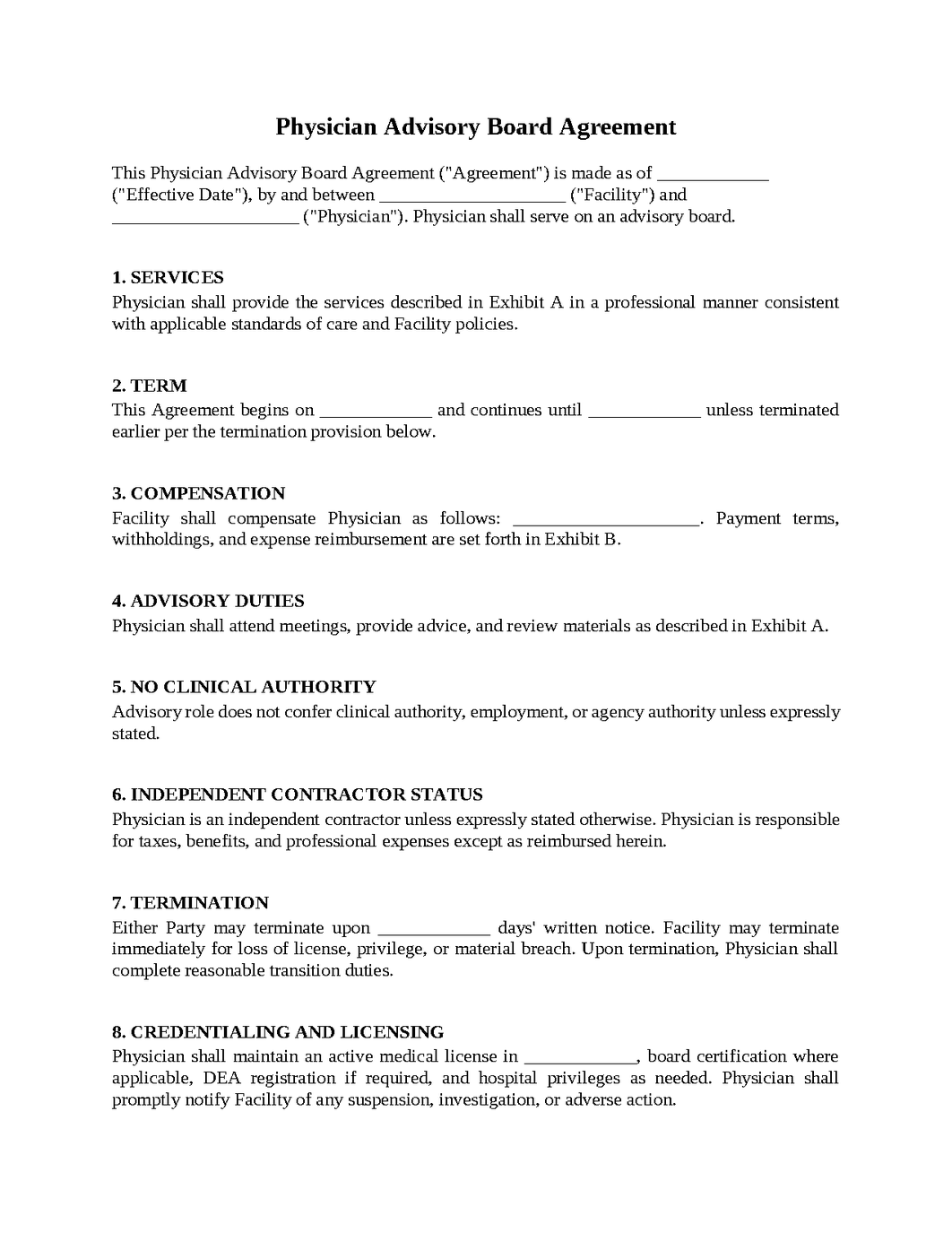
Physician Advisory Board Agreement
A Physician Advisory Board Agreement is a legal contract that establishes the terms under which a physician serves on an advisory board for a healthcare company, pharmaceutical manufacturer, medical device developer, biotechnology firm, healthcare technology provider, insurance company, or other organization seeking clinical expertise. Advisory boards allow organizations to obtain professional insight regarding products, services, research initiatives, market needs, regulatory considerations, and strategic planning. Because physicians often provide valuable industry knowledge while maintaining independent medical practices and professional obligations, disputes can arise when expectations regarding compensation, confidentiality, intellectual property, conflicts of interest, and participation requirements are not clearly documented. A well-drafted Physician Advisory Board Agreement helps establish a productive relationship while protecting the interests of both the physician and the organization.
Participation Expectations Are Never Clearly Defined
A medical technology company recruits several respected physicians to serve on a newly formed advisory board. During recruitment discussions, the company explains that members will provide strategic feedback regarding product development and industry trends.
The physicians are attracted to the opportunity because it allows them to contribute expertise without making a significant time commitment. Everyone assumes the advisory role will involve a few meetings each year and occasional feedback on specific projects.
As the company grows, however, demands on the advisory board increase substantially. Members are asked to attend additional meetings, review extensive materials, participate in conference calls, evaluate marketing strategies, and provide ongoing consultation between scheduled meetings.
Several physicians become frustrated because the workload is far greater than originally anticipated. The company believes these activities are necessary to maximize the value of the advisory board and support important business objectives.
The disagreement develops gradually because neither party established clear expectations regarding time commitments, meeting attendance, or participation requirements. What began as an attractive professional opportunity starts feeling burdensome to some board members.
To help avoid this problem, a Physician Advisory Board Agreement should clearly define participation expectations, anticipated meeting frequency, review obligations, preparation requirements, and expected time commitments. Detailed provisions help ensure that both parties understand the scope of involvement before the relationship begins.
Compensation Raises Regulatory Concerns
A healthcare company forms an advisory board consisting of prominent physicians from across the country. To attract highly qualified participants, the company offers compensation for meeting attendance, preparation time, and professional expertise.
For several years, the arrangement functions smoothly. During a compliance review, however, questions arise regarding how compensation was determined and whether payments accurately reflect the services being provided.
Regulators and auditors request documentation demonstrating that compensation is commercially reasonable and consistent with fair market value. The company discovers that meeting attendance records, activity logs, and documentation supporting compensation decisions are incomplete.
The physicians become concerned because they want assurance that participation on the advisory board will not create professional or regulatory complications. The company worries that inadequate documentation may create unnecessary scrutiny.
Although the parties intended to establish a legitimate advisory relationship, poor documentation makes it difficult to demonstrate compliance.
To reduce these risks, a Physician Advisory Board Agreement should clearly describe services being provided, establish compensation that reflects fair market value, require documentation of participation, and address applicable healthcare compliance requirements. Careful drafting and recordkeeping can significantly reduce regulatory concerns.
Confidential Information Is Shared Improperly
A pharmaceutical company creates an advisory board to obtain physician feedback regarding several products under development. During meetings, board members receive access to confidential research data, product strategies, market analyses, and future business plans.
The physicians understand that the information is sensitive and agree to maintain confidentiality. Several months later, one physician participates in an industry conference and discusses certain trends and observations learned through advisory board activities.
Although no confidential documents are disclosed directly, company executives become concerned that proprietary information may have been revealed indirectly. The physician argues that the comments reflected general industry knowledge rather than confidential business information.
The disagreement quickly becomes complicated because distinguishing confidential information from professional expertise is not always straightforward. Both parties believe they acted reasonably, yet their expectations regarding confidentiality differ significantly.
To help prevent these disputes, a Physician Advisory Board Agreement should clearly define confidential information, identify permissible disclosures, establish confidentiality obligations, and address how proprietary information must be handled during and after board service. Detailed confidentiality provisions help protect valuable business information while allowing physicians to continue participating in their profession.
Intellectual Property Ownership Becomes Unclear
A biotechnology company assembles an advisory board to help guide development of a new therapeutic platform. During meetings, physicians provide substantial feedback regarding product design, treatment protocols, clinical workflows, and future research opportunities.
Over time, several physician recommendations become integrated into commercially valuable products and services. As the company's success grows, questions begin emerging regarding ownership of ideas contributed during advisory board discussions.
Some physicians believe they played a meaningful role in developing concepts that contributed to the organization's success. The company believes all contributions made during advisory board activities belong to the organization.
The disagreement is not necessarily driven by money alone. Many physicians simply want clarity regarding how their contributions are being used and whether any rights have been retained.
Without clear contractual guidance, uncertainty develops regarding ownership of innovations generated through collaborative discussions.
To help avoid these problems, a Physician Advisory Board Agreement should clearly address intellectual property ownership, define advisory board contributions, identify pre-existing intellectual property rights, and establish how future ideas, inventions, and developments will be treated.
Conflicts of Interest Create Tension
A physician serves on the advisory board of a healthcare technology company while simultaneously maintaining relationships with hospitals, professional organizations, and other healthcare businesses.
Initially, these various professional activities coexist without issue. As the physician's advisory role expands, however, situations begin arising in which competing business interests overlap.
The company becomes concerned that advisory board members may have relationships with competitors or may be involved in projects that create potential conflicts of interest. The physician believes professional independence is essential and does not want advisory board participation to limit future opportunities.
Neither party objects to the other's position in principle, but both want clarity regarding what disclosures are required and how potential conflicts should be managed.
As the relationship evolves, uncertainty regarding these issues creates unnecessary tension and risk.
To reduce these concerns, a Physician Advisory Board Agreement should establish conflict-of-interest disclosure requirements, identify prohibited activities if any exist, and create procedures for addressing situations in which competing interests arise. Clear expectations help preserve trust and transparency throughout the relationship.
Physician advisory boards provide organizations with valuable clinical insight while giving physicians opportunities to influence innovation, strategy, and healthcare advancement. However, issues involving participation requirements, compensation, confidentiality, intellectual property, and conflicts of interest can quickly become sources of disagreement when expectations are not documented clearly. A carefully drafted Physician Advisory Board Agreement provides a structured framework for managing these relationships and protecting all parties involved. When prepared thoughtfully, it can help foster productive collaboration, support regulatory compliance, safeguard proprietary information, and create a successful long-term advisory relationship.

Get started with Upsign today!
Easily send, sign and track your documents