

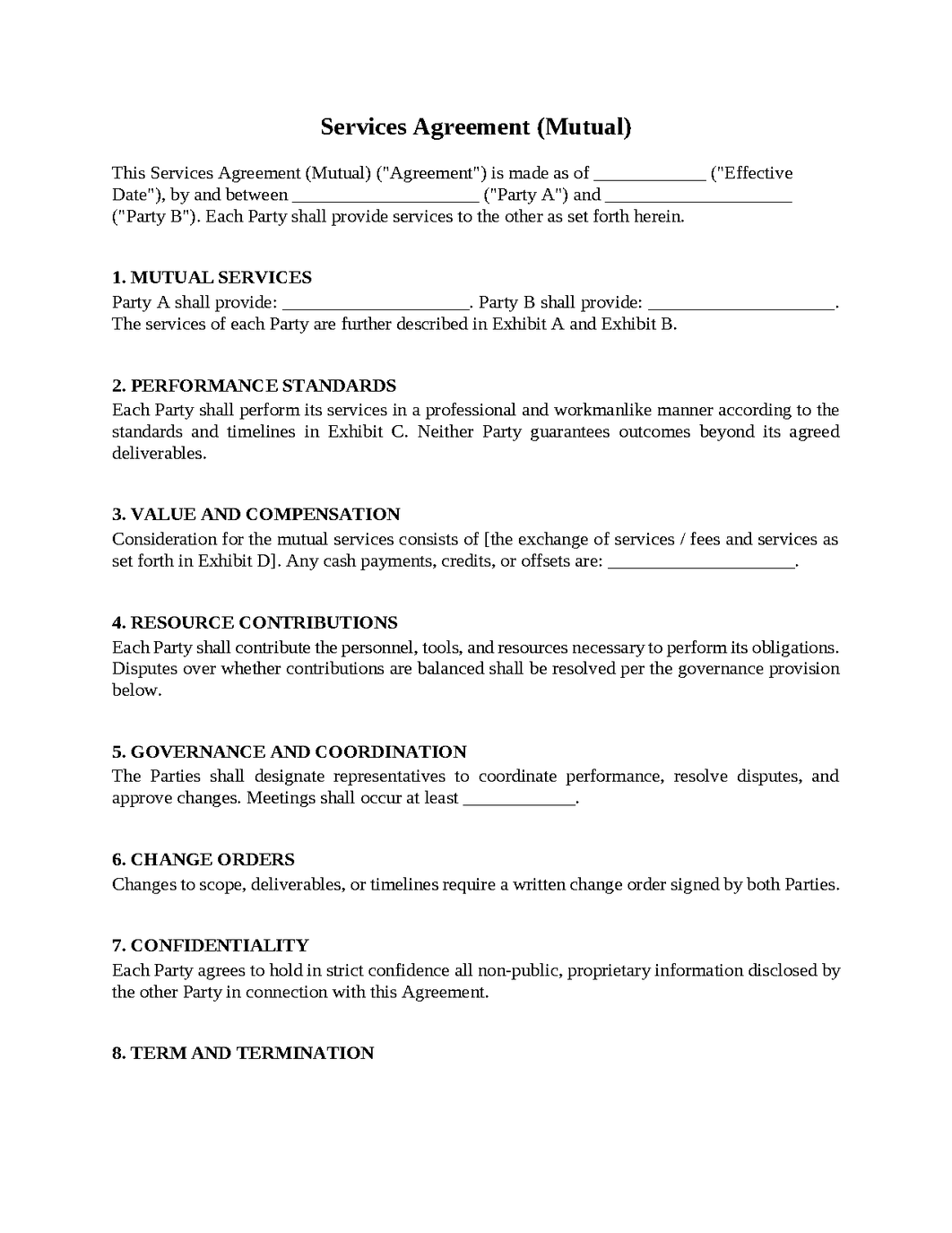
Services Agreement (Mutual)
A Services Agreement (Mutual) is a legal contract in which two parties agree to provide services, resources, expertise, support, or other business value to one another. Unlike a traditional service agreement where one party is solely the provider and the other is solely the client, a mutual arrangement involves obligations and benefits flowing in both directions. These agreements are commonly used in strategic partnerships, technology collaborations, marketing alliances, co-development projects, professional service exchanges, and long-term business relationships. Because both parties simultaneously act as service providers and service recipients, disputes can arise when responsibilities, expectations, and performance standards are not documented clearly. A well-drafted Services Agreement (Mutual) helps align interests and establish accountability for both sides.
One Party Believes It Is Contributing More Than the Other
Two companies enter into a mutual services arrangement designed to leverage each other's strengths.
One company provides technical expertise, software support, and operational assistance. The other contributes marketing services, customer introductions, and business development efforts.
Initially, both parties believe the arrangement is balanced and mutually beneficial. As time passes, however, one party begins tracking the time, resources, and personnel dedicated to the relationship and concludes that its contributions substantially exceed what it is receiving in return.
The other party believes its contributions are equally valuable, even if they are less visible or more difficult to measure.
The disagreement creates tension because each side evaluates value differently.
What began as a collaborative partnership becomes a debate regarding fairness and reciprocity.
To help avoid this problem, a Services Agreement (Mutual) should clearly define each party's obligations, establish measurable deliverables where appropriate, and identify procedures for reviewing performance throughout the relationship.
Responsibilities Become Blurred Over Time
A technology company and a consulting firm enter into a mutual services arrangement to support shared customers.
At the beginning of the relationship, responsibilities appear straightforward. As projects become more complex, however, customers begin requesting assistance that falls somewhere between the services offered by each organization.
The technology company assumes certain tasks belong to the consulting firm. The consulting firm believes those responsibilities remain with the technology provider.
Customers become frustrated because they receive conflicting answers regarding who is responsible for resolving issues.
Neither company intentionally avoids responsibility, but the division of duties becomes increasingly unclear.
To reduce these risks, a Services Agreement (Mutual) should clearly define responsibilities, identify ownership of specific functions, and establish escalation procedures for situations involving overlapping obligations.
Confidential Information Flows in Both Directions
Two businesses collaborate under a mutual services arrangement that requires the sharing of proprietary information.
Each company provides access to customer data, operational processes, strategic plans, technical documentation, and other confidential materials necessary for successful collaboration.
As the relationship develops, concerns arise regarding how information is being stored, who has access to it, and whether certain disclosures are appropriate.
Because both parties are sharing sensitive information simultaneously, each faces similar risks.
The relationship becomes strained when questions emerge regarding confidentiality expectations.
To help avoid these problems, a Services Agreement (Mutual) should clearly define confidential information, establish security obligations for both parties, restrict unauthorized disclosures, and identify remedies for confidentiality breaches.
One Party Terminates While Active Projects Remain Open
Two organizations work together successfully for several years under a mutual services arrangement.
Eventually, strategic priorities change and one party decides to end the relationship. At the time of termination, multiple projects remain active, customers continue relying on services, and shared initiatives are still underway.
The terminating party wants a clean exit and minimal ongoing obligations. The other party needs time to transition customers, transfer information, and complete existing commitments.
Questions arise regarding unfinished work, data ownership, customer communications, and future responsibilities.
What should be a business decision becomes an operational challenge.
To reduce these risks, a Services Agreement (Mutual) should establish termination procedures, define transition obligations, address ownership of work product, and require reasonable cooperation during the wind-down process.
The Parties Disagree About Liability for Customer Problems
A mutual services relationship supports a shared customer base.
When a customer experiences losses, service interruptions, or operational problems, both parties become involved in investigating the issue. The customer claims that failures by both organizations contributed to the problem.
Each company believes the other bears primary responsibility. Neither wants to assume liability for issues outside its direct control.
The disagreement creates additional challenges because the parties must continue working together while determining responsibility.
A problem affecting a customer now threatens the broader business relationship.
To help prevent these issues, a Services Agreement (Mutual) should clearly allocate risk, establish indemnification provisions, define liability limitations, and identify procedures for responding to customer claims involving both parties.
Mutual Services Agreements can be highly effective tools for creating strategic partnerships and collaborative business relationships. However, issues involving contribution levels, overlapping responsibilities, confidentiality obligations, termination procedures, and liability allocation can become significant sources of conflict when expectations are not documented clearly. A carefully drafted Services Agreement (Mutual) provides a structured framework for managing these relationships and protecting all parties involved. When prepared thoughtfully, it can help reduce misunderstandings, strengthen collaboration, improve accountability, and support successful long-term partnerships.

Get started with Upsign today!
Easily send, sign and track your documents