

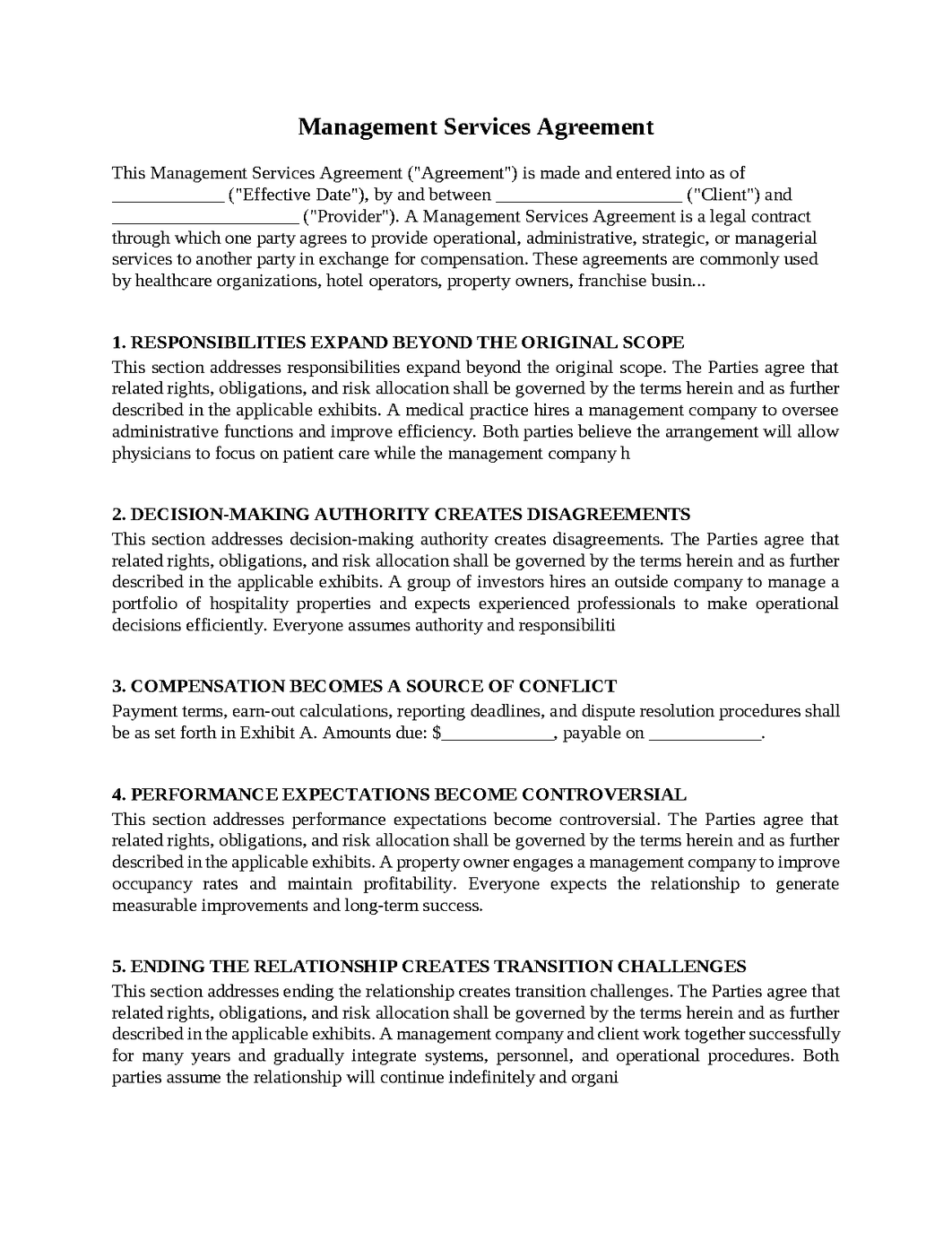
Management Services Agreement
A Management Services Agreement is a legal contract through which one party agrees to provide operational, administrative, strategic, or managerial services to another party in exchange for compensation. These agreements are commonly used by healthcare organizations, hotel operators, property owners, franchise businesses, investment companies, family offices, and affiliated entities seeking professional management expertise without transferring ownership. A Management Services Agreement typically addresses the scope of services, compensation arrangements, decision-making authority, performance standards, confidentiality obligations, and procedures governing disputes and termination. Because management relationships involve significant operational responsibilities and long-term collaboration, disputes can arise when expectations regarding authority and performance are not documented clearly. A carefully drafted Management Services Agreement helps establish certainty and protect the interests of both the manager and the client.
Responsibilities Expand Beyond the Original Scope
A medical practice hires a management company to oversee administrative functions and improve efficiency. Both parties believe the arrangement will allow physicians to focus on patient care while the management company handles operational matters.
Initially, billing, staffing, and vendor relationships are managed successfully. Over time, however, additional responsibilities involving marketing, strategic planning, and technology upgrades are requested, increasing the complexity of the relationship.
The practice believes the additional tasks are natural extensions of the management relationship because they support the overall success of the business. The management company believes those services require additional resources and compensation and argues that they were not included in the original arrangement. As demands increase, tensions emerge regarding the scope of responsibilities.
To help avoid this problem, a Management Services Agreement should clearly establish the scope of services and define how additional responsibilities and projects will be approved.
Decision-Making Authority Creates Disagreements
A group of investors hires an outside company to manage a portfolio of hospitality properties and expects experienced professionals to make operational decisions efficiently. Everyone assumes authority and responsibilities are clearly understood.
As market conditions change, disagreements arise regarding staffing levels, capital expenditures, and pricing strategies. Questions emerge concerning who possesses final authority over important business decisions.
The owners believe major decisions should remain under their control because they bear the financial risks associated with the properties. The management company believes operational flexibility is essential and argues that excessive oversight limits its ability to perform effectively. As strategic differences become more frequent, tensions develop regarding decision-making authority.
To help prevent these issues, a Management Services Agreement should clearly establish management authority and define which decisions require owner approval.
Compensation Becomes a Source of Conflict
A manufacturing company retains a management firm to improve operations and expects the fee structure to remain predictable and fair. Both parties believe compensation reflects the value of the services being provided.
As the business grows and performance improves, questions arise regarding incentive fees, reimbursements, and additional expenses. Different expectations create uncertainty about the appropriate level of compensation.
The management company believes improved results justify increased compensation because its expertise contributed significantly to the success of the business. The client believes costs should remain consistent with the original understanding and argues that expenses should be controlled carefully. As revenues increase, disagreements emerge regarding compensation arrangements.
To help avoid these problems, a Management Services Agreement should clearly establish compensation provisions and define how additional fees and expenses will be calculated.
Performance Expectations Become Controversial
A property owner engages a management company to improve occupancy rates and maintain profitability. Everyone expects the relationship to generate measurable improvements and long-term success.
After several years, results fail to meet expectations and owners begin questioning the effectiveness of the management team. Different opinions emerge regarding whether external conditions or management decisions are responsible for the disappointing performance.
The owner believes stronger results should have been achieved because professional expertise was one of the primary reasons for hiring outside management. The management company believes market conditions and economic factors affected performance and argues that reasonable efforts were made to maximize results. As financial pressures increase, tensions emerge regarding accountability.
To help prevent these issues, a Management Services Agreement should clearly establish performance expectations and define the standards used to evaluate results.
Ending the Relationship Creates Transition Challenges
A management company and client work together successfully for many years and gradually integrate systems, personnel, and operational procedures. Both parties assume the relationship will continue indefinitely and organize future plans around that expectation.
Eventually, changing priorities lead the client to terminate the arrangement. Questions arise regarding access to records, outstanding fees, employee transitions, and responsibilities involving ongoing operations.
The client believes a smooth transition is necessary to preserve continuity and avoid disruptions. The management company believes compensation obligations should be satisfied before providing additional assistance and expects contractual rights to be respected. As the relationship concludes, disagreements emerge regarding the rights and obligations that survive termination.
To help avoid this problem, a Management Services Agreement should clearly establish termination procedures and identify the rights and responsibilities that continue after the relationship ends.
Management Services Agreements are valuable tools that allow businesses and organizations to benefit from specialized expertise while maintaining ownership and strategic control. However, issues involving expanding responsibilities, decision-making authority, compensation disputes, performance expectations, and post-termination obligations can become significant sources of conflict when expectations are not documented clearly. A carefully drafted Management Services Agreement provides a structured framework for allocating responsibilities and protecting the interests of both managers and clients. When prepared thoughtfully, it can reduce uncertainty, strengthen working relationships, improve operational performance, and provide the foundation necessary for successful long-term management arrangements.

Get started with Upsign today!
Easily send, sign and track your documents