

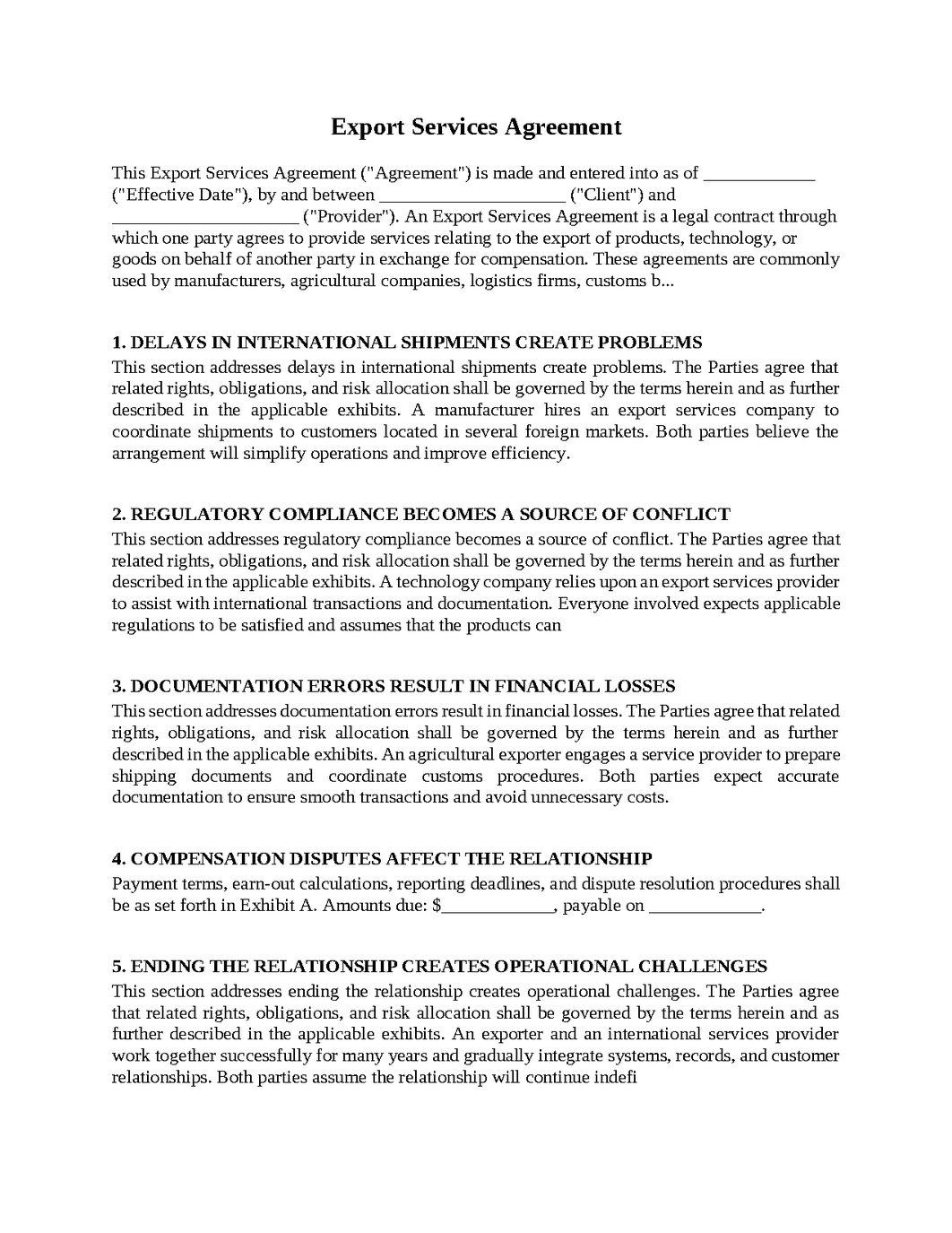
Export Services Agreement
An Export Services Agreement is a legal contract through which one party agrees to provide services relating to the export of products, technology, or goods on behalf of another party in exchange for compensation. These agreements are commonly used by manufacturers, agricultural companies, logistics firms, customs brokers, freight forwarders, technology companies, and businesses seeking assistance with international trade operations. An Export Services Agreement typically addresses the scope of services, regulatory compliance, documentation requirements, compensation, liability limitations, and procedures governing termination and renewal. Because international trade involves multiple jurisdictions and complex regulatory obligations, disputes can arise when expectations regarding responsibilities and performance are not documented clearly. A carefully drafted Export Services Agreement helps establish certainty and protect the interests of both service providers and their clients.
Delays in International Shipments Create Problems
A manufacturer hires an export services company to coordinate shipments to customers located in several foreign markets. Both parties believe the arrangement will simplify operations and improve efficiency.
Initially, deliveries are completed according to schedule and customers are satisfied with the process. Over time, however, customs delays, transportation disruptions, and documentation issues begin affecting delivery schedules and causing frustration among international customers.
The manufacturer believes the service provider should have anticipated these challenges and implemented solutions because managing international logistics was one of the reasons the relationship was established. The service provider believes external factors beyond its control created unavoidable delays and argues that reasonable efforts were made to minimize disruptions. As customers begin complaining and revenue opportunities are lost, tensions emerge regarding responsibility for the delays.
To help avoid this problem, an Export Services Agreement should clearly establish performance expectations and define how shipping delays and service interruptions will be addressed.
Regulatory Compliance Becomes a Source of Conflict
A technology company relies upon an export services provider to assist with international transactions and documentation. Everyone involved expects applicable regulations to be satisfied and assumes that the products can be exported without difficulty.
As international sales increase, authorities question whether certain licenses and approvals should have been obtained before shipments were completed. Investigations and delays create uncertainty regarding future transactions.
The technology company believes the export services provider should have identified compliance concerns because it possessed expertise in international trade. The service provider believes product classifications and licensing decisions required information that only the manufacturer could provide. As legal risks increase, both sides begin disagreeing about who should bear responsibility for the regulatory issues.
To help prevent these issues, an Export Services Agreement should clearly establish compliance responsibilities and define the duties associated with licenses, classifications, and regulatory approvals.
Documentation Errors Result in Financial Losses
An agricultural exporter engages a service provider to prepare shipping documents and coordinate customs procedures. Both parties expect accurate documentation to ensure smooth transactions and avoid unnecessary costs.
During several transactions, errors in invoices and customs paperwork lead to delays, penalties, and additional storage charges. Customers become dissatisfied and important business relationships are affected.
The exporter believes the service provider should be responsible because preparing documentation was a central aspect of the services being provided. The service provider believes incomplete information supplied by the exporter contributed to the mistakes and argues that both parties share responsibility. As losses increase, tensions develop regarding liability for the errors.
To help avoid these problems, an Export Services Agreement should clearly establish documentation requirements and define how responsibility will be allocated if mistakes occur.
Compensation Disputes Affect the Relationship
A consumer products company retains an export services firm and agrees to compensate it based upon a combination of fees and transaction volume. At the outset, both parties believe the pricing structure is fair and straightforward.
As international business expands, questions arise regarding additional services, expedited shipments, and unexpected expenses. Different interpretations of the agreement produce conflicting expectations regarding the amount owed.
The service provider believes the increased workload and complexity justify additional compensation. The exporter believes many of the services fall within the original scope of the engagement and argues that extra fees are unwarranted. As invoices become larger, disagreements emerge regarding compensation and reimbursements.
To help prevent these issues, an Export Services Agreement should clearly establish fee arrangements and define how additional services and expenses will be handled.
Ending the Relationship Creates Operational Challenges
An exporter and an international services provider work together successfully for many years and gradually integrate systems, records, and customer relationships. Both parties assume the relationship will continue indefinitely and make decisions based on that expectation.
Eventually, changing priorities lead one side to terminate the arrangement. Questions arise regarding access to records, pending shipments, customer communications, and obligations involving unresolved transactions.
The exporter believes a smooth transition is necessary to avoid disrupting customers and preserve valuable relationships. The service provider believes its responsibilities should conclude promptly and expects all outstanding invoices to be paid before additional assistance is provided. As the transition becomes more complicated, disagreements emerge regarding the obligations that survive termination.
To help avoid this problem, an Export Services Agreement should clearly establish termination procedures and identify the rights and responsibilities that continue after the relationship ends.
Export Services Agreements are valuable tools that allow businesses to participate in international trade while relying upon specialized expertise and support. However, issues involving shipment delays, regulatory compliance, documentation errors, compensation disputes, and post-termination obligations can become significant sources of conflict when expectations are not documented clearly. A carefully drafted Export Services Agreement provides a structured framework for allocating responsibilities and protecting the interests of both parties. When prepared thoughtfully, it can reduce uncertainty, strengthen commercial relationships, facilitate global trade, and provide the foundation necessary for successful international operations.

Get started with Upsign today!
Easily send, sign and track your documents