

Affidavit of Workplace Accident
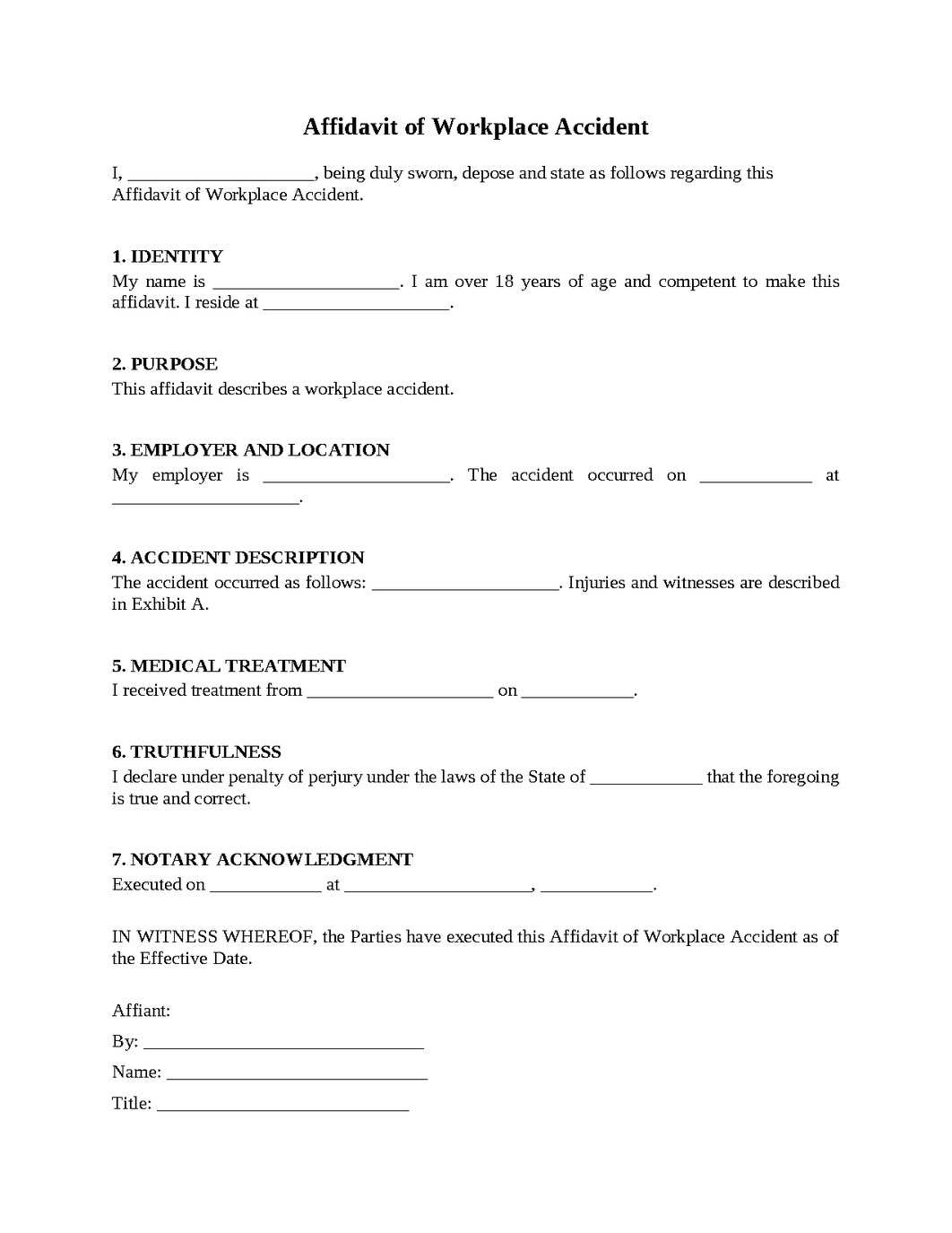
An Affidavit of Workplace Accident is a sworn statement used to document the facts and circumstances surrounding an accident that occurred in a workplace setting. Employees, employers, insurance companies, attorneys, government agencies, and workers' compensation administrators frequently rely on this document when evaluating injury claims, investigating incidents, determining liability, and preserving important facts. Workplace accidents can involve injuries caused by equipment, vehicles, falls, hazardous conditions, repetitive motion, chemical exposure, or other work-related activities. Because memories fade and facts may become disputed over time, a detailed affidavit can provide an important record of what occurred. When prepared accurately and promptly, the document helps support investigations and claims. When facts are unclear or disputed, however, benefits, compensation, liability determinations, and legal rights may be affected.
Witnesses Remember the Accident Differently
A warehouse employee is injured while unloading heavy inventory from a delivery truck. Immediately after the incident, several coworkers gather to help and report what they observed.
At first, everyone appears to agree regarding what happened. However, as the employer begins investigating the incident, differences emerge in the witness accounts. One employee believes the injured worker slipped on a wet surface. Another believes the worker lost balance while carrying an oversized load. A third insists that defective equipment contributed to the accident.
These differing accounts create uncertainty regarding the cause of the injury. The distinction matters because responsibility for the accident may depend on what actually occurred.
Witness memories are often less reliable than people assume. Even when individuals are acting honestly, stress, distractions, limited visibility, and differing perspectives can affect how events are remembered.
As time passes, recollections may change further. Conversations with coworkers, supervisors, attorneys, and insurance representatives can unintentionally influence how individuals remember events.
An Affidavit of Workplace Accident helps preserve important facts while memories remain fresh. By documenting observations promptly and under oath, the affidavit creates a reliable record that can be referenced later if witness accounts begin to differ.
The Employer Questions Whether the Injury Was Work-Related
A construction worker reports a back injury and files a workers' compensation claim. According to the employee, the injury occurred while lifting building materials at a job site.
The employer does not immediately dispute that the employee is injured. Instead, the company questions whether the injury actually occurred at work. Supervisors note that the employee previously mentioned back pain and recently participated in recreational activities outside of work.
The distinction becomes critical because workers' compensation coverage generally applies only to injuries arising out of and during employment.
Disputes regarding the cause of an injury are common. Employers and insurers often investigate whether an injury occurred at work, whether a preexisting condition contributed to the problem, or whether non-work activities played a role.
These investigations may involve medical records, witness interviews, photographs, surveillance footage, and employment records.
Without clear documentation, determining what happened can become difficult. Delays may occur while evidence is gathered and evaluated.
An Affidavit of Workplace Accident helps establish the employee's account of the incident and creates a formal record regarding when, where, and how the injury occurred. The document often becomes an important part of the claim evaluation process.
Critical Evidence Disappears Before an Investigation Begins
A manufacturing employee suffers an injury involving a piece of production equipment. Shortly after the incident, operations resume and the equipment is returned to service.
By the time investigators review the matter, conditions have changed significantly. Equipment settings have been adjusted, work areas have been cleaned, and physical evidence that may have been relevant is no longer available.
This problem occurs frequently after workplace accidents. Employers understandably want to resume operations, but doing so may alter conditions that could help explain what happened.
Environmental conditions may change. Equipment may be repaired. Hazardous materials may be removed. Witnesses may forget important details.
The loss of evidence can make it difficult to determine whether safety violations existed, whether procedures were followed properly, or whether equipment contributed to the accident.
An Affidavit of Workplace Accident helps preserve important information before evidence disappears. By documenting conditions shortly after the incident, the affidavit creates a record that may prove valuable during later investigations.
Insurance Companies Dispute the Severity of the Accident
An office employee slips on a recently mopped floor and suffers what initially appears to be a minor injury. The employee reports soreness but continues working for several days.
Over time, symptoms worsen and medical treatment becomes necessary. The employee eventually requires surgery and misses several months of work.
The insurance carrier questions whether the accident described initially could reasonably have caused such significant injuries. Additional review is requested before benefits are approved.
Disputes regarding injury severity are common in workplace accident cases. Some injuries become worse over time. Others involve symptoms that are not immediately obvious following an incident.
Medical providers, employers, insurers, and employees may have different perspectives regarding the relationship between an accident and subsequent medical conditions.
Without clear documentation regarding the original incident, evaluating these claims becomes more difficult. Questions may arise regarding what symptoms existed initially and how the accident occurred.
An Affidavit of Workplace Accident helps create a contemporaneous record of the event and the employee's condition. The document can provide important context when later questions arise regarding the extent of injuries.
A Lawsuit Is Filed Years After the Accident
A delivery driver is injured when equipment fails during a loading operation. Workers' compensation benefits are paid and the employee eventually returns to work.
Several years later, the employee files a lawsuit against the manufacturer of the equipment, alleging that a design defect contributed to the accident.
By this point, many individuals involved have changed jobs, records are difficult to locate, and memories have faded. Attorneys representing the parties must reconstruct what occurred years earlier.
This situation illustrates why accident documentation remains important long after an incident appears resolved. Workplace accidents sometimes lead to litigation involving equipment manufacturers, contractors, property owners, vendors, or other third parties.
The passage of time often makes fact-finding more difficult. Witnesses may no longer be available, evidence may be lost, and recollections may become unreliable.
An Affidavit of Workplace Accident helps preserve important facts while information is still available. Rather than relying solely on memory years later, investigators and attorneys can refer to a sworn statement prepared close to the time of the incident.
Workplace accidents can have significant consequences for employees, employers, insurers, and other parties involved. Questions regarding how an accident occurred, whether injuries were work-related, what evidence existed, and who may be responsible frequently arise during claims and investigations. An Affidavit of Workplace Accident provides a practical method for documenting important facts and preserving information while it remains fresh and available. When completed accurately and supported by reliable observations, the affidavit can help reduce disputes, support investigations, and provide decision-makers with greater confidence when evaluating workplace accident claims.
:::

Get started with Upsign today!
Easily send, sign and track your documents